
Bill of Sale Sep 18, 2026
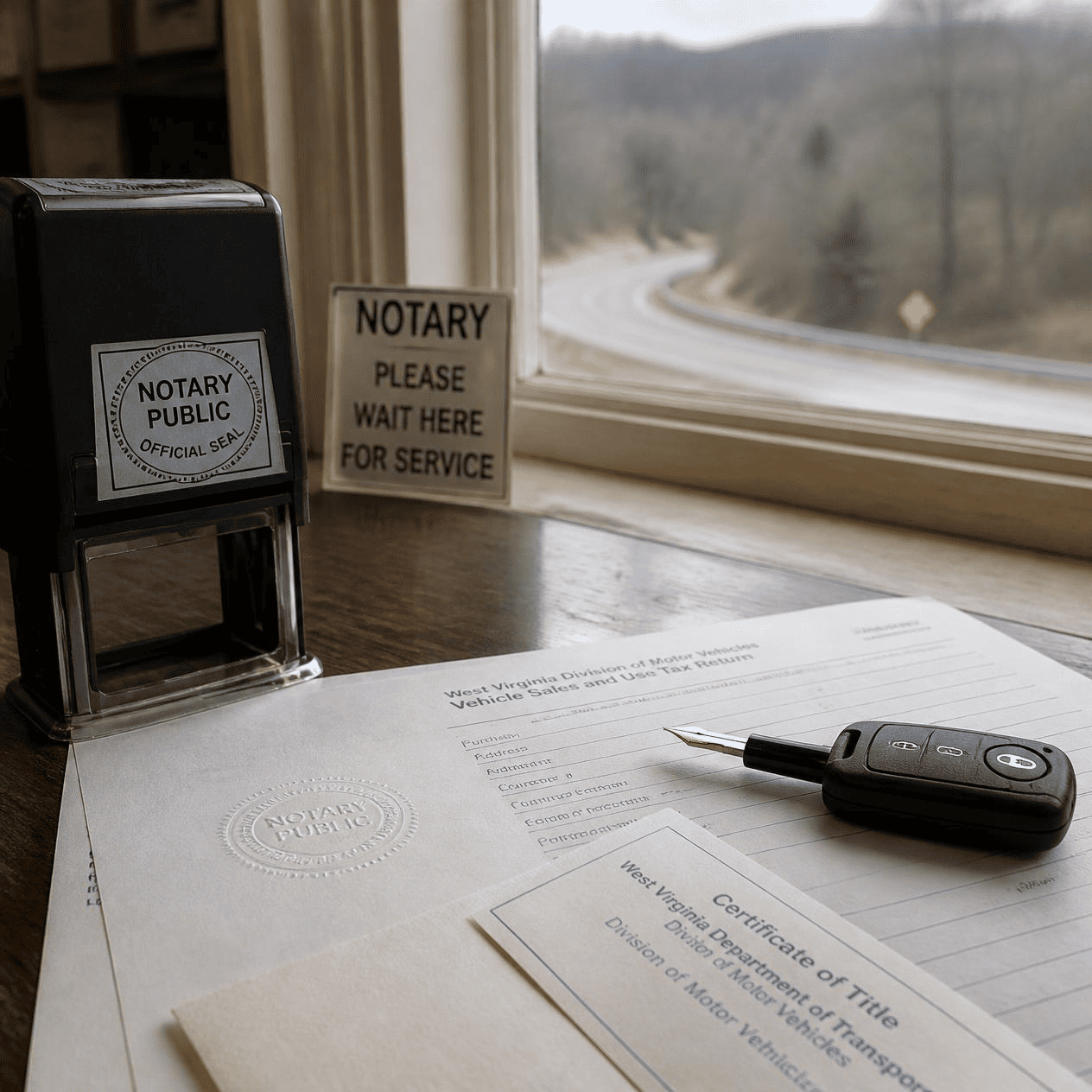
West Virginia publishes Form DMV-7-TR as its official Bill of Sale for a Motor Vehicle, Trailer, or Boat. Unlike many state bill-of-sale forms, DMV-7-TR requires the buyer and seller to complete the document, sign it, and have it notarized.
The notarized bill of sale does not itself change ownership. The buyer must apply for a West Virginia certificate of title, pay the 6% motor vehicle sales tax, and complete registration before ordinary highway operation.
Download the free KarKiosk vehicle bill of sale PDF to create an additional buyer-seller record of the VIN, mileage, payment, and handover terms. Keep it with West Virginia’s notarized DMV-7-TR and the assigned title rather than using it as a replacement for either document.
DMV-7-TR Has a Mandatory Notary Section
West Virginia’s official bill of sale is more formal than a basic handwritten receipt.
DMV-7-TR records:
Vehicle year and make.
Body type and model.
Color.
Title number.
VIN.
Seller’s name and address.
Buyer’s name and address.
Sale date.
Selling price.
Odometer reading.
Mileage status.
Buyer and seller signatures.
The form states directly that notary certification is required.
Both buyer and seller should complete the entire document before notarization.
Do not sign an incomplete form containing a blank buyer name or sale price.
West Virginia Private Vehicle Sale Rules
Item | West Virginia Rule | Why It Matters |
Official bill of sale | DMV-7-TR | Documents the private transaction |
Notarization | Required on DMV-7-TR | Buyer and seller signatures are certified |
Main ownership document | Properly assigned title | Bill of sale does not transfer ownership alone |
Title application | DMV-1-TR | Used to obtain West Virginia title and registration |
Non-operating buyer title filing | Within 60 days | State law requires title submission within this period |
Motor vehicle sales tax | 6% | Applies to private vehicle purchases |
Minimum tax on sales below $500 | $30 | Replaces straight 6% calculation for those low-price sales |
Title fee | $15 | Paid with title application |
Standard Class A registration | $51.50 | Applies to standard passenger cars/light trucks |
Plate transfer | $10.50 | Eligible owner may move plate to another vehicle |
Safety inspection | Every 2 years | Current cycle has applied since 2024 |
The Assigned Title Still Controls Ownership
DMV-7-TR specifically warns that completing the form does not change the ownership status of the vehicle.
Ownership changes when the buyer applies for and receives a certificate of title.
The seller should complete the assignment and warranty of title and disclose recorded liens.
West Virginia law requires the seller to deliver the endorsed certificate of title to the buyer no later than 60 days from the sale date.
A buyer should not agree to wait 60 days simply because the law sets an outside delivery period.
The safest transaction is to receive the properly assigned title when money and possession change hands.
The notarization rules differ significantly from those covered in KarKiosk’s Massachusetts Bill of Sale guide, where a separate bill of sale is primarily required in specific title-exempt or price-documentation situations.
The Buyer Uses DMV-1-TR
The buyer applies for the new West Virginia title using DMV-1-TR, Application for Certificate of Title for a Motor Vehicle.
The application requires information including:
Buyer or owner information.
Vehicle description.
VIN.
Purchase information.
Lien information.
Insurance certification.
Taxes and applicable fees.
The form must be completed in blue or black ink.
If registration is requested, proof of West Virginia insurance must accompany the transaction.
West Virginia Uses a 60-Day Title Filing Rule
West Virginia law distinguishes between driving the vehicle and simply holding it without operating it.
A buyer who does not drive or permit the vehicle to be driven on public highways must forward the title and apply for a new certificate in the buyer’s name within 60 days after transfer.
A buyer who intends to operate the vehicle must obtain the required registration and title documentation before normal road use, subject to narrow statutory exceptions.
The 60-day title period should therefore not be treated as a 60-day unrestricted driving grace period.
West Virginia Motor Vehicle Sales Tax Is 6%
West Virginia imposes a 6% consumers sales tax on motor vehicle sales, including casual and occasional sales between private individuals.
The tax applies to vehicles purchased in West Virginia and to taxable vehicles purchased outside the state for use by West Virginia residents.
Official statutory source: West Virginia Code §11-15-3c — Motor Vehicle Sales Tax
Municipal sales tax is not added to the motor vehicle tax covered by this section.
Purchases Under $500 Have a $30 Minimum Tax
DMV-1-TR gives an important low-price rule.
For vehicle sales under $500, the form instructs the buyer to pay $30 instead of calculating 6%.
Examples:
$100 vehicle → $30 tax.
$250 vehicle → $30 tax.
$400 vehicle → $30 tax.
$499 vehicle → $30 tax.
$1,000 vehicle → $60 tax.
$5,000 vehicle → $300 tax.
A buyer should report the actual transaction price.
West Virginia law also allows DMV rules to use minimum taxable values and fair market value in specified situations.

Current West Virginia Title and Registration Fees
The standard title fee is $15.
Other common current charges include:
Lien recording: $10.
Standard Class A registration: $51.50.
Plate transfer: $10.50.
Duplicate title: $15.
Duplicate registration: $10.
Duplicate plate: $10.
For Class A vehicles, West Virginia also adds higher annual amounts for alternative powertrains:
Hybrid: $100 additional per year.
Electric or alternative fuel: $200 additional per year.
These costs are separate from the 6% vehicle sales tax.
Plates Stay With the West Virginia Seller
The seller retains the existing West Virginia registration plates after transferring the vehicle.
The registration expires when the seller transfers ownership. State law requires the original owner to retain the plates and notify DMV of the transfer.
The seller can transfer eligible plates to another vehicle owned by that seller.
The current DMV transaction fee for a plate transfer is $10.50.
Do not leave the seller’s plates permanently attached to the buyer’s vehicle.
Pennsylvania follows its own plate-removal and authorized-agent process. See KarKiosk’s Pennsylvania Bill of Sale guide for that separate system.
West Virginia Inspections Are Now Every Two Years
West Virginia no longer uses the former annual inspection cycle for ordinary registered passenger vehicles.
State law now requires covered vehicles to be inspected once every two years. The change took effect January 1, 2024.
The inspection covers equipment including vehicle mechanisms, brakes, and other required safety components.
The legislation also increased the maximum standard inspection charge to $19 when the two-year system was adopted.
A 2026 bill proposing repeal of the inspection requirement remained pending rather than becoming current law, so the inspection program remains in effect as of September 2026.

DMV-7-TR Includes Odometer Disclosure
The official West Virginia Bill of Sale contains an odometer section.
The seller enters the current mileage and identifies whether:
Mileage is actual.
Mileage exceeds mechanical limits.
Odometer reading is not actual mileage.
Federal odometer-disclosure rules can require mileage reporting for newer vehicles over the applicable 20-year disclosure period.
The mileage on the bill of sale and title should agree.
Do not alter the mileage after notarization.

What If the Vehicle Has a Lien?
The buyer should confirm the lien release before paying the seller in full.
DMV-1-TR charges $10 per recorded lien when a new lien is entered.
A previously satisfied lien must be properly discharged before DMV can issue a clear title.
When a lien remains active, determine:
Which lender holds the lien.
Current payoff amount.
Who possesses the title.
How the lender will release its interest.
When the buyer will receive transferable ownership documents.
A notarized bill of sale does not cancel a lender’s security interest.
What If the Title Is Missing?
The titled owner should obtain a duplicate before an ordinary private transfer when the original cannot be located.
West Virginia charges $15 for a duplicate title.
The duplicate-title application requires owner identification and, when applicable, proper lien-release information.
Do not pay for a vehicle based only on a notarized bill of sale when the seller cannot establish a valid title path.
How to Complete a West Virginia Private Vehicle Sale
Confirm that the seller is the titled owner.
Match the VIN on the vehicle and title.
Resolve any recorded lien.
Complete the title assignment.
Complete DMV-7-TR fully.
Record the correct odometer reading.
Have buyer and seller sign DMV-7-TR before a notary.
Have the seller retain the plates.
Complete DMV-1-TR.
Obtain West Virginia insurance before registration.
Pay the 6% tax, title fee, and registration charges.
Complete the title filing within the applicable 60-day period.
Maintain a valid two-year West Virginia inspection.
Confirm that the seller is the titled owner.
Match the VIN on the vehicle and title.
Resolve any recorded lien.
Complete the title assignment.
Complete DMV-7-TR fully.
Record the correct odometer reading.
Have buyer and seller sign DMV-7-TR before a notary.
Have the seller retain the plates.
Complete DMV-1-TR.
Obtain West Virginia insurance before registration.
Pay the 6% tax, title fee, and registration charges.
Complete the title filing within the applicable 60-day period.
Maintain a valid two-year West Virginia inspection.
Common West Virginia Private-Sale Mistakes
Using an unsigned or unnotarized DMV-7-TR.
Assuming the notarized bill of sale transfers ownership by itself.
Buying from someone who is not the titled owner.
Treating the 60-day title period as permission to drive unregistered.
Forgetting the $30 minimum tax on purchases below $500.
Leaving the seller’s plates on the vehicle.
Ignoring an unreleased lien.
Using outdated information that says inspections are annual.