
Seller Guide Oct 19, 2026
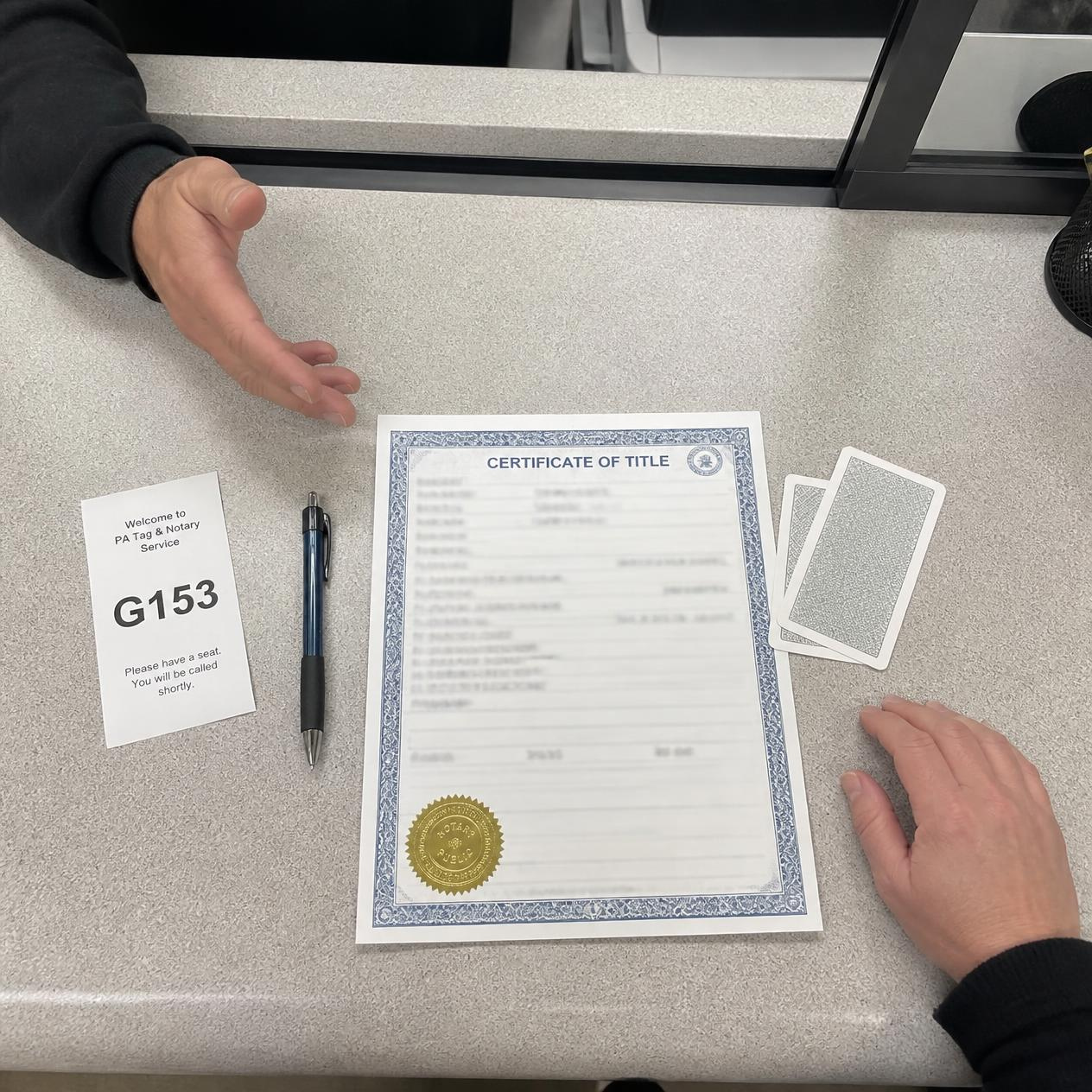
Pennsylvania does not use a standalone bill of sale as the document that transfers ownership of a Pennsylvania-titled vehicle. The buyer and seller complete the title through an authorized PennDOT agent, and the applicable title sections are signed and notarized or verified as part of the transfer.
A separate bill of sale remains useful because Pennsylvania’s Department of Revenue can request it when a reported private-sale price is substantially below fair market value. The completed title and registration paperwork must be submitted to PennDOT within 20 days of the sale.
Download our free vehicle bill of sale PDF and complete it with the actual sale price, VIN, mileage and buyer-seller information. Pennsylvania can request this transaction evidence if the purchase price is later reviewed for sales tax.
Pennsylvania Private Sales Go Through an Authorized Agent
A Pennsylvania-titled private sale is completed through:
An authorized PennDOT agent.
A licensed tag service.
A motor vehicle dealer acting as an authorized agent.
The seller cannot simply sign the title at home and hand it to the buyer as though the transfer is complete.
For a Pennsylvania title, the seller enters the purchaser’s information, mileage and seller details in the appropriate section in the presence of the authorized agent. The buyer completes the applicable purchaser section and signs as required.
Use PennDOT’s current private-sale instructions here: PennDOT — Buying or Selling a Vehicle
Is a Separate Pennsylvania Bill of Sale Required?
A standalone bill of sale is not the ownership-transfer document for a normal Pennsylvania-titled vehicle.
The properly completed and notarized title controls the ownership transfer.
A separate bill of sale should still be completed because it records:
Seller’s name, address and phone number.
Buyer’s name, address and phone number.
Vehicle year, make and model.
Full VIN.
Exact sale date.
Actual purchase price.
Odometer reading.
Payment status.
Vehicle-condition explanation.
Buyer’s and seller’s signatures.
Pennsylvania’s Department of Revenue specifically accepts a bill of sale as evidence when it reviews an unusually low reported purchase price.
This makes the bill of sale more than a duplicate receipt. It can become evidence in a tax review.
Pennsylvania Private-Sale Rules at a Glance
Item | Pennsylvania Rule |
Main ownership document | Properly transferred certificate of title |
Transfer location | Authorized PennDOT agent, tag service or authorized dealer |
Pennsylvania title signatures | Notarized or verified as required |
PennDOT submission deadline | Within 20 days of sale |
State sales tax | 6% |
Allegheny County rate | 7% |
Philadelphia rate | 8% |
Original title fee | $72 |
One-year passenger registration | $48 |
Two-year passenger registration | $96 |
Seller’s plate | Removed after transfer |
Safety inspection | Within 10 days if no valid inspection is displayed |
Emissions inspection | Required in participating areas |
Separate bill-of-sale notarization | Not generally required |
Which Signatures Must Be Notarized?
For a Pennsylvania-titled vehicle, both sides of the transfer process are formally completed through the authorized-agent system.
PennDOT states that:
The seller signs and prints the seller’s name in the presence of the authorized agent.
The buyer completes the required purchaser section.
The buyer signs and prints the buyer’s name.
The applicable title sections are notarized.
All new owners sign when the vehicle will be titled in multiple names.
An authorized dealership may perform verification in place of notarization in specified sections.
An out-of-state title follows the signature and notarization requirements of the state that issued that title.
The separate bill of sale itself does not carry a general Pennsylvania notary requirement for an ordinary transaction.
The Seller Should Not Sign the Title in Advance
The seller should arrange to meet the buyer at the authorized PennDOT agent.
Signing the required Pennsylvania title section before appearing at the agent can interfere with the required notarization or verification process.
Bring acceptable identification.
The seller should also verify:
VIN.
Purchase price.
Buyer’s full legal name.
Buyer’s address.
Current odometer reading.
Existing lien information.
The buyer should refuse a title with unexplained erasures, overwritten buyer information or a prior purchaser who never titled the vehicle.
Form MV-4ST Is Prepared Through the Agent
Form MV-4ST, Vehicle Sales and Use Tax Return/Application for Registration, is used to obtain a Pennsylvania title for a vehicle already titled in Pennsylvania.
The form is for completion through PennDOT authorized agents rather than a blank form that a private buyer independently fills out at home.
The application package must be submitted to PennDOT within 20 days from the date of sale.
Do not confuse this processing deadline with the separate inspection rule.
Pennsylvania Sales Tax Is 6%, 7% or 8%
Pennsylvania’s base sales and use tax rate is 6%.
Two locations add local tax:
Allegheny County: 7% total.
City of Philadelphia: 8% total.
The applicable tax is collected as part of the title-transfer process.
Use the official tax guidance for the current rates: Pennsylvania Department of Revenue — Sales and Use Tax
A Low Bill-of-Sale Price Can Trigger Review
Pennsylvania operates a Motor Vehicle Understated Value Program.
The Department of Revenue routinely reviews transactions where the reported purchase price is substantially lower than fair market value.
When the state requests verification, the buyer can provide:
Bill of sale.
Seller statement.
Financial agreement.
Repair invoices.
Repair estimates.
Photographs showing damage.
Appraisal or other value evidence.
A proper bill of sale submitted for purchase-price verification should show the seller and purchaser contact details, price, sale date, make, model and VIN.
If the buyer cannot adequately prove the lower price, Revenue can assess additional sales tax based on fair market value, together with applicable penalties and interest.
For comparison, the New York Bill of Sale guide covers a different system where New York explicitly separates proof of sale from proof of ownership.
Do Not Put $1 on a Genuine Gift
Pennsylvania specifically warns against entering a nominal $1 purchase price simply because the vehicle is being gifted.
A genuine gift uses the applicable gift-exemption paperwork, including Form MV-13ST when required.
A false $1 amount can trigger a purchase-price review because it appears substantially below fair market value.
The gift exemption does not mean the recipient can skip the title transfer.
Current Pennsylvania Title and Registration Fees
The current original title fee is $72.
Standard passenger registration is:
One year: $48.
Two years: $96.
Registration charges already include the cost of a standard registration plate for first-time issuance. Specialty plates and transaction-specific charges cost extra.
Electric and plug-in hybrid vehicles can also be subject to separate Road User Charge fees.
Use the current PennDOT schedule before quoting a transaction total: PennDOT — Payments and Fees
The Seller Removes the Pennsylvania Plate
After the title transfer, the seller removes the licence plate from the sold vehicle.
The seller can:
Transfer the plate to another eligible vehicle.
Retain it temporarily while arranging an eligible transfer.
Return it to PennDOT when it will not be reused.
The buyer should not drive away using the seller’s plate.
When the seller is not transferring the plate, returning it provides a clear end to the registration associated with the sold vehicle.

Inspection Status Matters Immediately After the Purchase
Pennsylvania requires annual safety inspections.
For a used vehicle sold without a valid inspection certificate displayed, the buyer must have the vehicle inspected within 10 days of the sale.
When a valid Pennsylvania inspection sticker remains displayed at the time of sale, the vehicle can generally continue to use that inspection until the certificate expires.
The safety inspection covers required vehicle equipment rather than acting as a pre-purchase warranty.
A buyer should still obtain an independent mechanical inspection before payment.

Emissions Testing Depends on the Registration Area
Pennsylvania also operates an emissions inspection program in participating counties.
When a vehicle is registered in a participating area and subject to emissions testing, the emissions inspection is generally due annually at the same time as or before the safety inspection.
The test method varies by vehicle model year, fuel type and region.
Do not assume every Pennsylvania county has the same emissions procedure.
Out-of-State Vehicles Need Extra VIN Evidence
A Pennsylvania resident buying a vehicle titled in another state follows a different paperwork route.
The buyer generally uses Form MV-1 rather than MV-4ST.
A VIN tracing or acceptable VIN verification can be required. PennDOT allows qualifying verification by specified individuals when a tracing cannot be obtained.
The seller’s out-of-state title signature may also require notarization if the issuing state requires it.
Contact the authorized PennDOT agent before the purchase when the out-of-state title has unusual reassignment sections, brands or lien information.
Odometer Information Must Be Entered on the Ownership Document
The seller records the current mileage in the appropriate title section when disclosure applies.
The buyer should compare:
Dashboard odometer.
Title mileage.
Bill-of-sale mileage.
Vehicle-history information.
Do not accept a title with a mileage figure that has been erased or overwritten.
The seller’s title signature acknowledges the odometer and purchaser information entered during the transfer.
The Seller Should Keep a Buyer Acknowledgement
PennDOT recommends that the seller obtain a receipt from the buyer acknowledging receipt of:
The properly assigned title.
The vehicle itself.
This record helps establish the date the seller delivered both ownership paperwork and possession.
The KarKiosk bill of sale can serve as a stronger transaction record when it also includes the exact handover date, payment, VIN and mileage.
The notarization requirements in Pennsylvania are also worth comparing with the North Carolina Bill of Sale guide, where the North Carolina title assignment and title application follow their own notarization rules.
How to Complete a Pennsylvania Private Sale
Confirm that the seller is named on the Pennsylvania title.
Verify the VIN and any lien information.
Complete a separate bill of sale with the actual purchase price.
Meet at an authorized PennDOT agent.
Complete the seller and purchaser title sections through the required notarization or verification process.
Record the odometer disclosure.
Complete the required title, tax and registration application.
Have the seller remove the Pennsylvania plate.
Submit the completed title transaction to PennDOT within 20 days.
Obtain a safety inspection within 10 days when the vehicle does not display a valid inspection.
Complete an emissions inspection when the vehicle and registration county require it.
Confirm that the seller is named on the Pennsylvania title.
Verify the VIN and any lien information.
Complete a separate bill of sale with the actual purchase price.
Meet at an authorized PennDOT agent.
Complete the seller and purchaser title sections through the required notarization or verification process.
Record the odometer disclosure.
Complete the required title, tax and registration application.
Have the seller remove the Pennsylvania plate.
Submit the completed title transaction to PennDOT within 20 days.
Obtain a safety inspection within 10 days when the vehicle does not display a valid inspection.
Complete an emissions inspection when the vehicle and registration county require it.
Common Pennsylvania Private-Sale Mistakes
Signing the Pennsylvania title before meeting the authorized agent.
Treating a handwritten bill of sale as the ownership document.
Leaving the purchaser information blank.
Failing to report the actual purchase price.
Entering $1 for a genuine gift instead of using gift paperwork.
Ignoring a Department of Revenue purchase-price verification request.
Missing the 20-day submission period.
Allowing the buyer to use the seller’s plate.
Ignoring the 10-day inspection requirement when no valid sticker is displayed.
Assuming emissions requirements are identical statewide.