

Seller Guide Oct 19, 2026
North Carolina does not list a separate bill of sale as a standard document for an ordinary private purchase when the certificate of title is complete. The controlling requirement is notarization: a North Carolina title assignment and Form MVR-1 must be signed through the required notarial process.
Even though a separate bill of sale is optional in a standard transfer, KarKiosk’s free bill of sale PDF can preserve the purchase price, sale date, and other transaction details for both parties.
The buyer must apply for the new title within 28 days. A late application can result in a $20 civil penalty and a Class 2 misdemeanor.
The Title Is Required; the Separate Bill of Sale Is Optional
NCDMV’s private-purchase checklist requires the vehicle title, title application, odometer statement, damage disclosure and any applicable lien or tax-exemption documents. A separate bill of sale appears on the dealer-purchase checklist but not on the ordinary individual-purchase checklist.
A private buyer and seller should still complete a bill of sale. It creates a record of:
The actual amount paid.
Date and time of possession.
Payment method.
Vehicle condition.
Included equipment.
Written repair or warranty promises.
Buyer’s and seller’s contact information.
The document does not replace the notarized title or change how North Carolina calculates highway-use tax.
North Carolina Transfer Rules at a Glance
Requirement | North Carolina Rule |
Separate private-sale bill of sale | Not listed as a standard requirement |
Main ownership document | Properly assigned vehicle title |
North Carolina title assignment | Must be notarized |
MVR-1 Title Application | Must be notarized |
Buyer’s title deadline | 28 days |
Highway-use tax | 3% |
Private-sale tax base | State-determined market value |
Certificate of title | $66.75 |
Passenger registration | $46.25 |
Used private-sale inspection | Before registration unless passed within previous 12 months |
Seller’s plate | Retained or surrendered by seller |
Insurance | North Carolina-licensed insurer required |
The current rules and forms are published by the North Carolina Division of Motor Vehicles.
Exactly Which Documents Need Notarization?
“If the original title is a North Carolina title, it must also be notarized.”
— North Carolina Division of Motor Vehicles
Not every document in the packet receives the same treatment.
Document | Standard Signature Requirement |
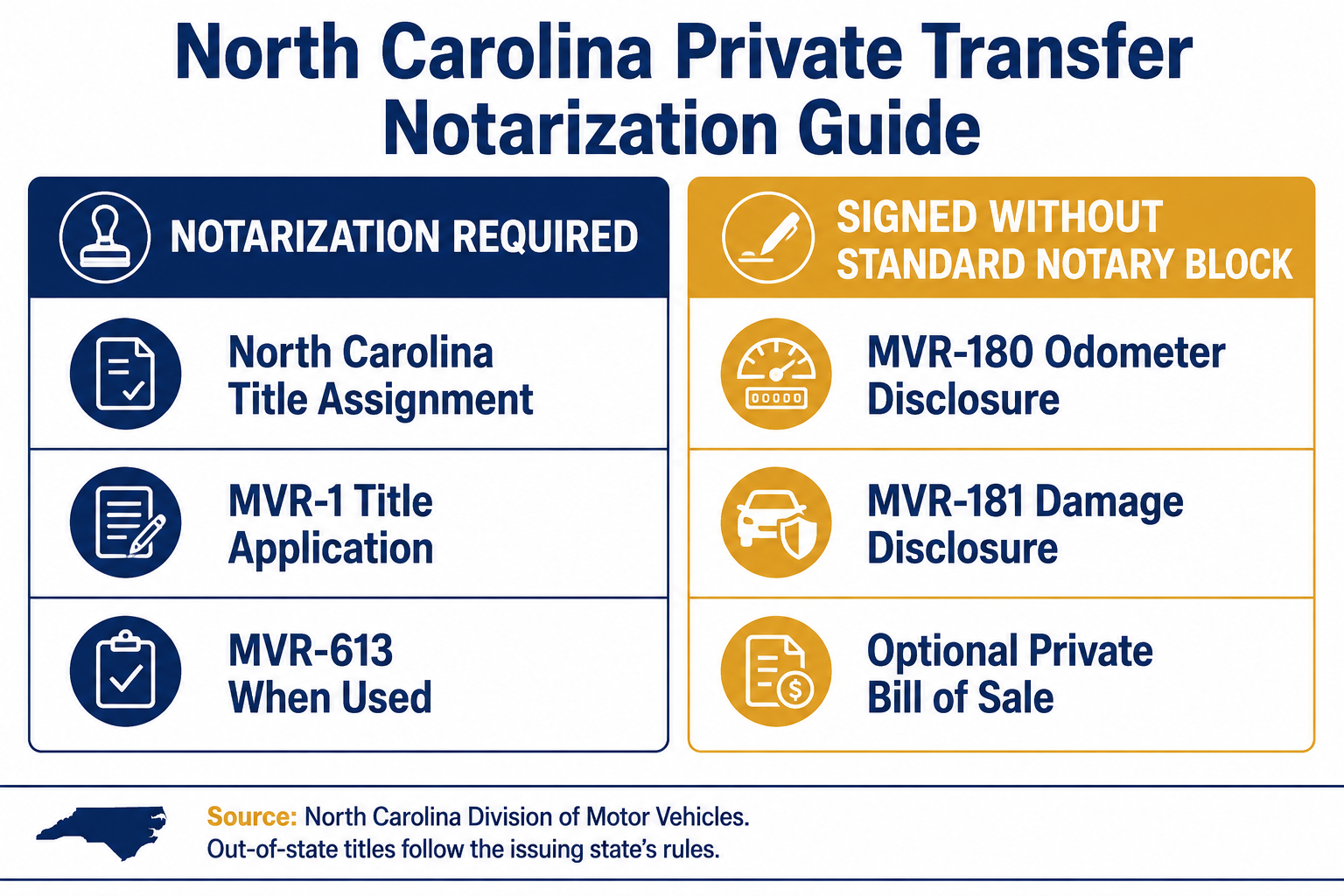
North Carolina title assignment | Notarized |
MVR-1 Title Application | Notarized |
MVR-613 family tax-exemption certification | Notarized |
MVR-180 Odometer Disclosure | Buyer and seller signatures; no notary block |
MVR-181 Damage Disclosure | Buyer and seller signatures; no notary block |
Optional private bill of sale | No general notary requirement |
Out-of-state title | Follow the issuing state’s assignment rules |
The current MVR-1 Title Application contains an owner-signature section followed by a notarial acknowledgement.
When more than one owner will appear on the new title, NCDMV requires notarized signatures on the applicable documents and a copy of the alternate owner’s valid identification, unless a properly authorized power of attorney is used.
What Goes in the Buyer’s Title Packet?
Document | When It Is Required |
Original assigned title | Every standard private transfer |
Lien release | When the title shows a satisfied lien |
MVR-1 | Every title application |
MVR-180 | When odometer disclosure applies |
MVR-181 | Required damage disclosure |
MVR-613 | Qualifying family or exempt transfer |
North Carolina insurance | When a registration plate is issued or transferred |
Identification and payment | Every transaction |
NCDMV provides the current forms through its Vehicle Documents and Forms page.
The title should identify the buyer, buyer’s address, sale or delivery date, seller, mileage and required damage information. The seller should not sign until the title can be notarized correctly.
How Does MVR-180 Handle Mileage?
The current MVR-180 Odometer Disclosure Statement requires the seller to enter the mileage and identify whether it is:
Actual mileage.
Mileage exceeding the odometer’s mechanical limits.
Not the actual mileage.
The buyer signs to acknowledge the disclosure. Alterations or erasures void the form.
The disclosure generally does not apply to vehicles over 16,000 pounds, non-self-propelled vehicles or vehicles that have reached the applicable exemption age. Model-year 2011 and newer vehicles use the 20-year federal disclosure period.
What Must Be Disclosed on MVR-181?
The MVR-181 Damage Disclosure Statement asks whether the vehicle:
Sustained damage exceeding 25% of its value.
Was a salvage vehicle.
Was a flood vehicle.
Was a recovered theft vehicle.
Was reconstructed.
The collision-damage and recovered-theft questions apply to vehicles five model years old or newer. Salvage, flood and reconstruction questions apply to all model years. Both the seller and buyer sign the statement.
The Buyer Has 28 Days to Apply for Title
North Carolina law requires the buyer to submit the title application within 28 days after the vehicle is transferred.
The buyer remains responsible even when the seller, lender or another person agrees to submit the application. A person who misses the deadline is subject to a $20 civil penalty and is guilty of a Class 2 misdemeanor.
The 28-day period should not be treated as permission to drive an unregistered vehicle. Registration, insurance and inspection requirements apply separately.
North Carolina Uses Highway-Use Tax, Not Ordinary Sales Tax
North Carolina generally collects a highway-use tax when it issues a certificate of title.
The rate is 3%. In a private sale by someone who is not a vehicle retailer, the tax base is the vehicle’s market value, less any qualifying trade-in allowance—not necessarily the amount written on the bill of sale.
The state uses a vehicle-value schedule. A very low private-sale price does not automatically reduce the highway-use tax.
The $2,000 maximum described in the tax statute applies to specified commercial Class A or Class B vehicles and recreational vehicles. It is not a general passenger-car tax cap.
What Fees Apply?
Charge | Current Amount |
Certificate of title | $66.75 |
Instant title | $105.75 |
Duplicate title | $25.50 |
Passenger registration | $46.25 |
Registration transfer | $25.50 |
10-day temporary plate | $10 |
Late title application | $20 civil penalty |
Highway-use tax | 3% |
County registration taxes | May apply |
Durham, Orange and Wake counties add $15 in regional and county vehicle-registration taxes. Randolph County adds $1. Other transaction, notary and online-service charges may apply.
North Carolina also assesses annual vehicle property tax through its registration system. That tax is separate from the 3% highway-use tax.
A Private-Sale Vehicle Usually Needs Inspection Before Registration
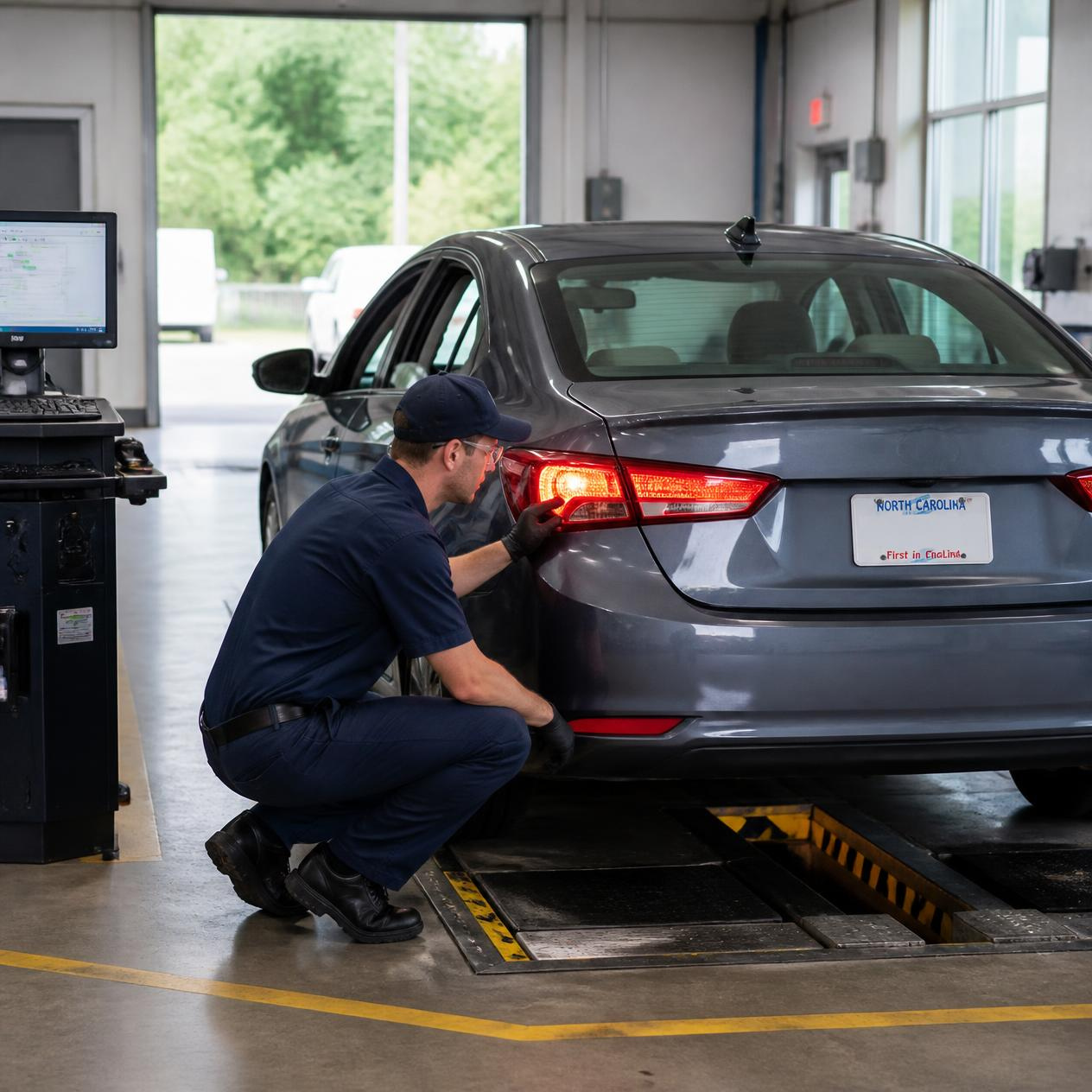
A used vehicle purchased from an individual must pass a North Carolina safety inspection before it can be registered unless it received a passing inspection within the previous 12 months.
When the vehicle cannot be registered until it is inspected, NCDMV may issue a $10 temporary plate valid for 10 days so the buyer can drive it for inspection and registration.
As of December 1, 2025, the annual inspection no longer includes the former window-tint check. Other required safety components remain part of the inspection.
Emissions Testing Applies in 19 Counties
Qualifying vehicles registered in the following counties receive an onboard diagnostic emissions inspection with the annual safety inspection:
Alamance | Buncombe | Cabarrus |
Cumberland | Davidson | Durham |
Forsyth | Franklin | Gaston |
Guilford | Iredell | Johnston |
Lincoln | Mecklenburg | New Hanover |
Randolph | Rowan | Wake |
Union |
Exemptions apply to specified newer low-mileage vehicles, vehicles 20 years old or older, diesel vehicles, farm vehicles and qualifying antique vehicles.
Insurance Must Come From a North Carolina-Licensed Company
North Carolina does not accept an out-of-state liability policy for a North Carolina registration.
For policies issued or renewed after July 1, 2025, the minimum liability limits are:
Coverage | Minimum |
Bodily injury to one person | $50,000 |
Bodily injury to two or more people | $100,000 |
Property damage | $50,000 |
Continuous coverage must remain in force while the vehicle has a valid North Carolina registration.
The Seller Returns the Plate Before Cancelling Insurance
The seller should remove the North Carolina plate from the sold vehicle.
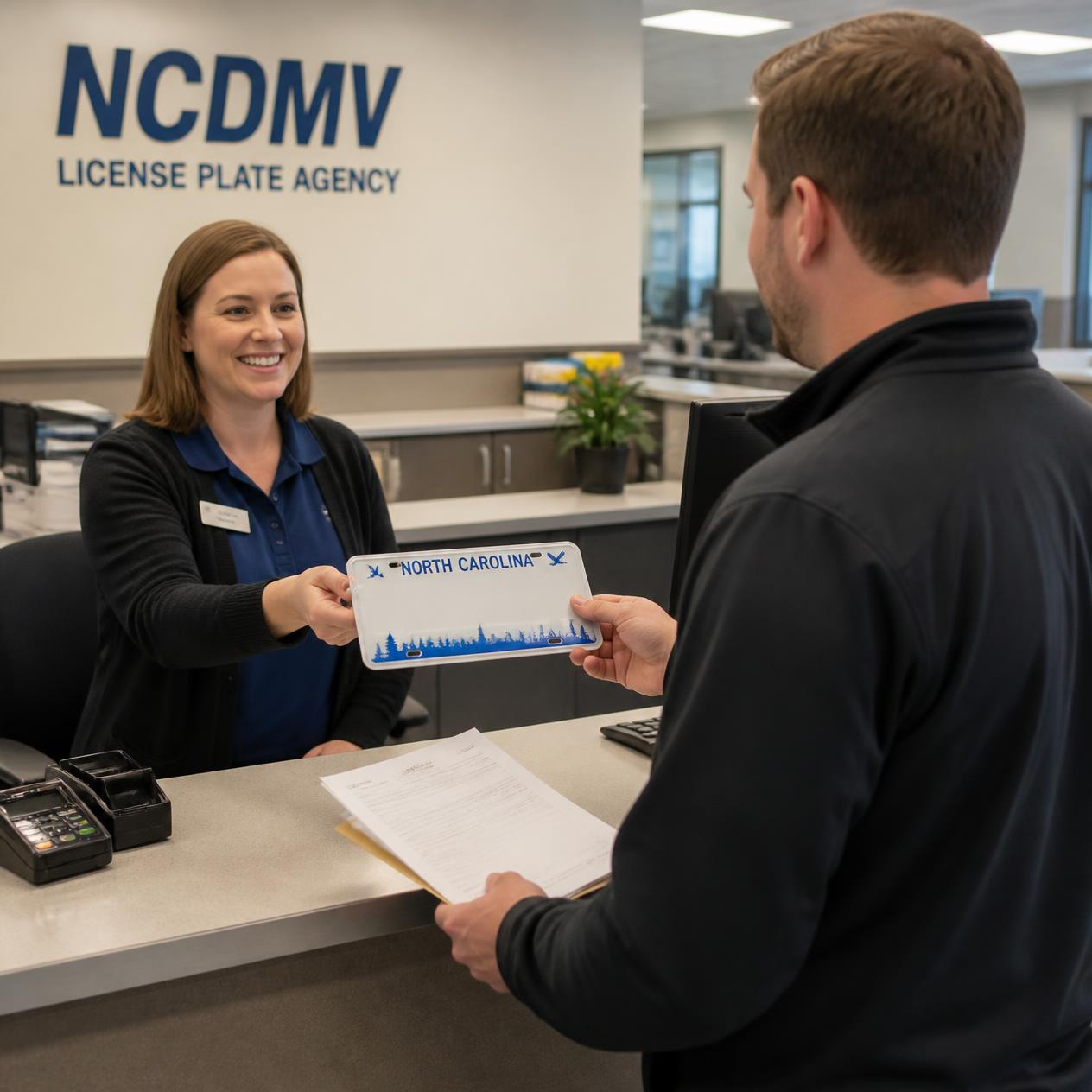
When the seller will not transfer the plate to another eligible vehicle, it should be surrendered to NCDMV before the associated insurance is cancelled. Cancelling insurance first can produce a lapse notice, fine and registration consequences.
Which Family Gifts Qualify for a Tax Exemption?
A qualifying transfer may use Form MVR-613.
Listed tax-exempt family transfers include:
Spouse to spouse.
Parent to child or child to parent.
Stepparent to stepchild or stepchild to stepparent.
Certain transfers connected with separation or divorce.
Certain transfers to a co-owner without compensation.
MVR-613 must be completed and notarized. Siblings, grandparents and grandchildren are not included in the form’s ordinary family-gift categories.
How to Complete a North Carolina Private Sale
Confirm that the seller is named on the title.
Review the title for liens and obtain any release.
Complete the buyer, sale date, mileage and damage information.
Sign the North Carolina title before a notary.
Complete and notarize MVR-1.
Complete MVR-180 and MVR-181 without alterations.
Obtain North Carolina insurance.
Have the vehicle inspected when required.
Submit the title application within 28 days.
Have the seller retain or surrender the plate before cancelling insurance.
Confirm that the seller is named on the title.
Review the title for liens and obtain any release.
Complete the buyer, sale date, mileage and damage information.
Sign the North Carolina title before a notary.
Complete and notarize MVR-1.
Complete MVR-180 and MVR-181 without alterations.
Obtain North Carolina insurance.
Have the vehicle inspected when required.
Submit the title application within 28 days.
Have the seller retain or surrender the plate before cancelling insurance.
Common North Carolina Transfer Mistakes
Signing a North Carolina title without a notary.
Treating an optional bill of sale as a replacement for the title.
Forgetting to notarize MVR-1.
Using correction fluid on MVR-180 or MVR-181.
Assuming highway-use tax is always based on the stated sale price.
Missing the 28-day title deadline.
Cancelling the seller’s insurance before surrendering the plate.
Failing to inspect a privately purchased used vehicle before registration.