Seller Guide Oct 19, 2026
To sell a car privately in Texas, prepare the vehicle, set a realistic price, find a buyer, and complete payment and the ownership paperwork. You can sell your car privately in Texas on KarKiosk by creating a listing, managing offers, and arranging buyer conversations and test drives. After the sale, file your vehicle transfer notice promptly and make sure the buyer understands the separate title application deadline.
Check Your Texas Title Before You Advertise
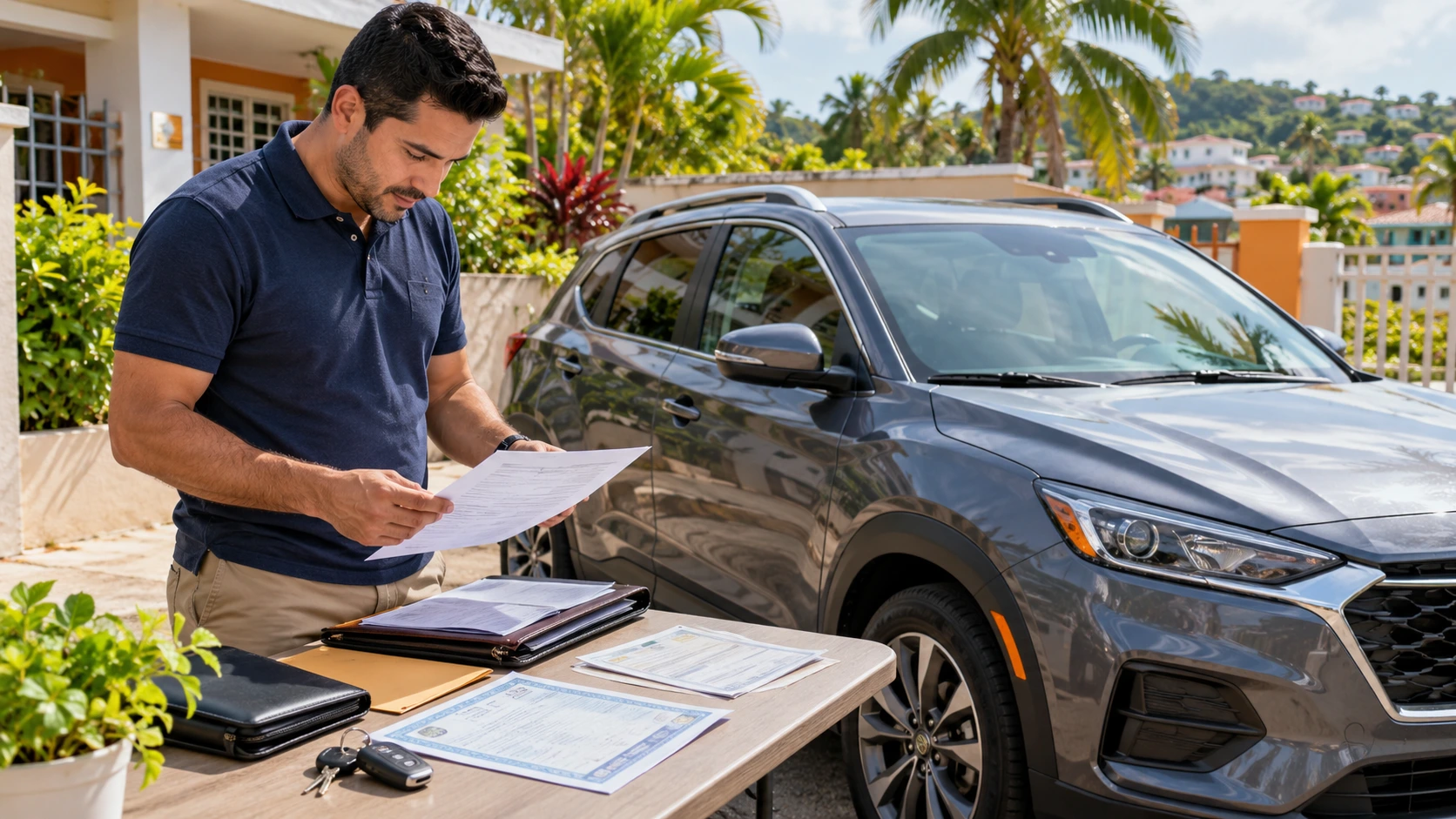
Start with the title, especially if you need to sell quickly. A missing document, unreleased lien, or ownership mismatch can prevent an otherwise ready buyer from completing the purchase.
Match the vehicle identification number, or VIN, on the title to the car. Check the recorded owners, any lienholder, and any title brands. Confirm who must sign before you accept a deposit or promise a delivery date.
Gather the Documents for Your Sale
Document or record | What the Texas seller should prepare | When it matters |
Original title or certified copy | Confirm ownership and complete the assignment to the named buyer | At closing |
Form 130-U | Complete and sign the Application for Texas Title and/or Registration, including the actual sale price | Buyer’s title application |
Lien release, when applicable | Obtain the required release for a paid lien shown on the title record | Before completing the transfer |
Odometer disclosure, when required | Record the reading and correct mileage status in the required ownership documents | At transfer |
Separate bill of sale | Record the parties, VIN, price, sale date, handover time, and agreed terms | Both parties keep a copy |
Maintenance and inspection records | Collect service invoices, repair receipts, and any applicable emissions report | Listing, inspection, and handover |
Vehicle Transfer Notification | Retain buyer details and submit Form VTR-346 or the online notice | Seller files promptly, within 30 days |
A separate bill of sale provides a useful transaction record. It supplements the assigned title and Form 130-U; it does not replace them. KarKiosk’s Texas bill of sale guide explains how these documents work together.
Replace a Missing Title Before Promising Immediate Pickup
For a lost Texas title, use the certified-copy process with Form VTR-34. The listed application fee is $2 by mail or $5.45 in person at a TxDMV Regional Service Center.
Recorded owners must provide the required signatures and identification. A lien still on record may require the lienholder’s involvement or an original release. Allow time to receive the usable ownership document before scheduling the sale.
Arrange the Payoff if You Still Have a Loan
Ask the lender for a current payoff amount, payment instructions, and its title-release procedure. Explain that you are selling to a private buyer and confirm how the buyer can verify the payoff arrangement.
For example, a $19,000 sale with a $14,500 payoff leaves $4,500 before selling expenses. If the payoff is $20,000, you need to cover the $1,000 shortfall to satisfy the loan.
Put the lender’s role and the expected title-delivery timing in writing. Paying the loan and receiving the transferable title may happen on different dates.
Prepare the Car for Texas Conditions and Buyer Questions
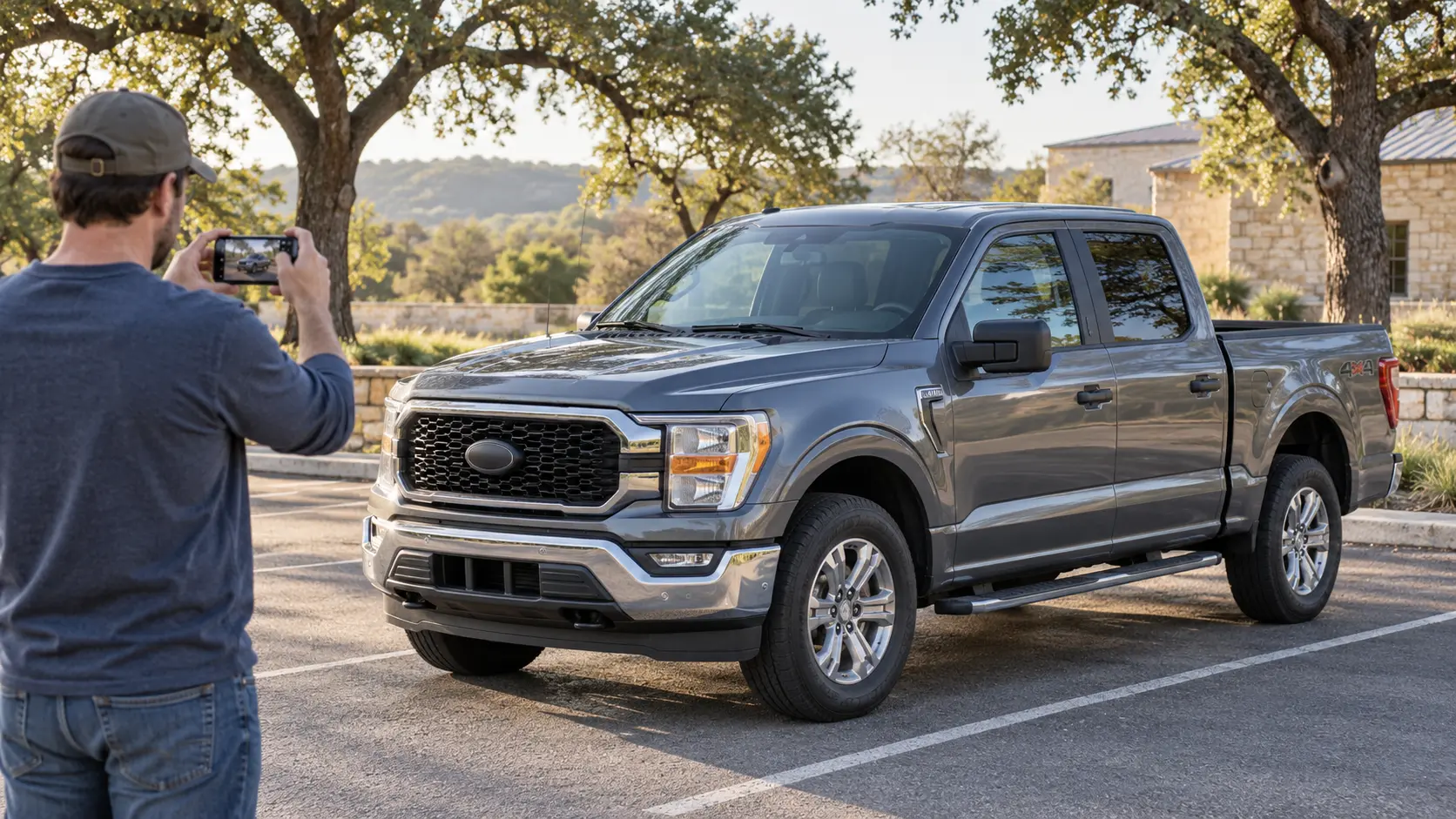
Clean the interior, wash the exterior, remove personal belongings, and photograph the vehicle in its current condition. Gather receipts before writing claims about recent repairs or maintenance.
Give particular attention to air conditioning, cooling-system performance, tire condition, and any hail or water damage. For pickups, document towing equipment, bed wear, and modifications. For a coastal vehicle, include clear photographs of the underbody and any corrosion.
Describe known damage directly. If hail dents remain, show them in daylight. If the car has flood history, a rebuilt title, or a significant repair, disclose it before a buyer travels to inspect the vehicle. Describe the title status and the physical condition separately.
Understand What Changed About Texas Inspections
Since January 1, 2025, noncommercial vehicles no longer need the former state safety inspection before registration. A $7.50 Inspection Program Replacement Fee still applies with registration for an ordinary noncommercial vehicle. Commercial vehicles follow different inspection rules.
The change makes an independent mechanical inspection particularly useful during a private sale. Keep records of work on brakes, tires, lights, suspension, and other safety equipment. An emissions pass does not establish that all those systems are in good condition.
Check the Buyer’s Emissions County
Texas still requires emissions testing for covered vehicles in designated counties. The program generally covers gasoline-powered vehicles 2 through 24 model years old that are registered or primarily operated in an emissions county. Electric vehicles, diesel vehicles, motorcycles, and mopeds are exempt from this emissions-testing requirement.
As of October 22, 2026, the existing 17 counties are:
Dallas–Fort Worth: Collin, Dallas, Denton, Ellis, Johnson, Kaufman, Parker, Rockwall, and Tarrant.
Houston area: Brazoria, Fort Bend, Galveston, Harris, and Montgomery.
Austin area: Travis and Williamson.
El Paso area: El Paso County.
Bexar County joins on November 1, 2026. Drivers with unexpired registration generally do not need the new test until renewal. For a sale around that date, confirm the buyer’s registration requirements before promising the vehicle is ready for immediate registration.
A seller outside an emissions county can still attract a buyer who will register the car in one. Ask about the buyer’s county, disclose warning lights, and agree on any required testing before setting the handover date.
Price the Car for Your Local Texas Market
Texas recorded nearly 27 million vehicle registrations and 7.7 million vehicle title transactions in fiscal year 2025, according to TxDMV. Those figures describe statewide activity; comparable vehicles near your buyer provide a more useful basis for your asking price.
Compare the same model year, trim, engine, drivetrain, mileage range, and title status. A work truck with heavy bed wear should not be priced from an otherwise similar low-mileage truck with documented light use. Include known mechanical faults and cosmetic damage in your comparison.
KarKiosk offers comparisons with similar vehicles listed nearby. Treat advertised prices as asking prices, then adjust for your car’s records, equipment, and condition. Decide on an asking price, a reasonable negotiation range, and the minimum amount you can accept after loan payoff and selling expenses.
Avoid assuming that every dollar spent on detailing or repairs will return through a higher price. Prioritize safety issues, necessary repairs, and improvements that let buyers assess the vehicle clearly.
Explain the Texas Tax Bill During Negotiation
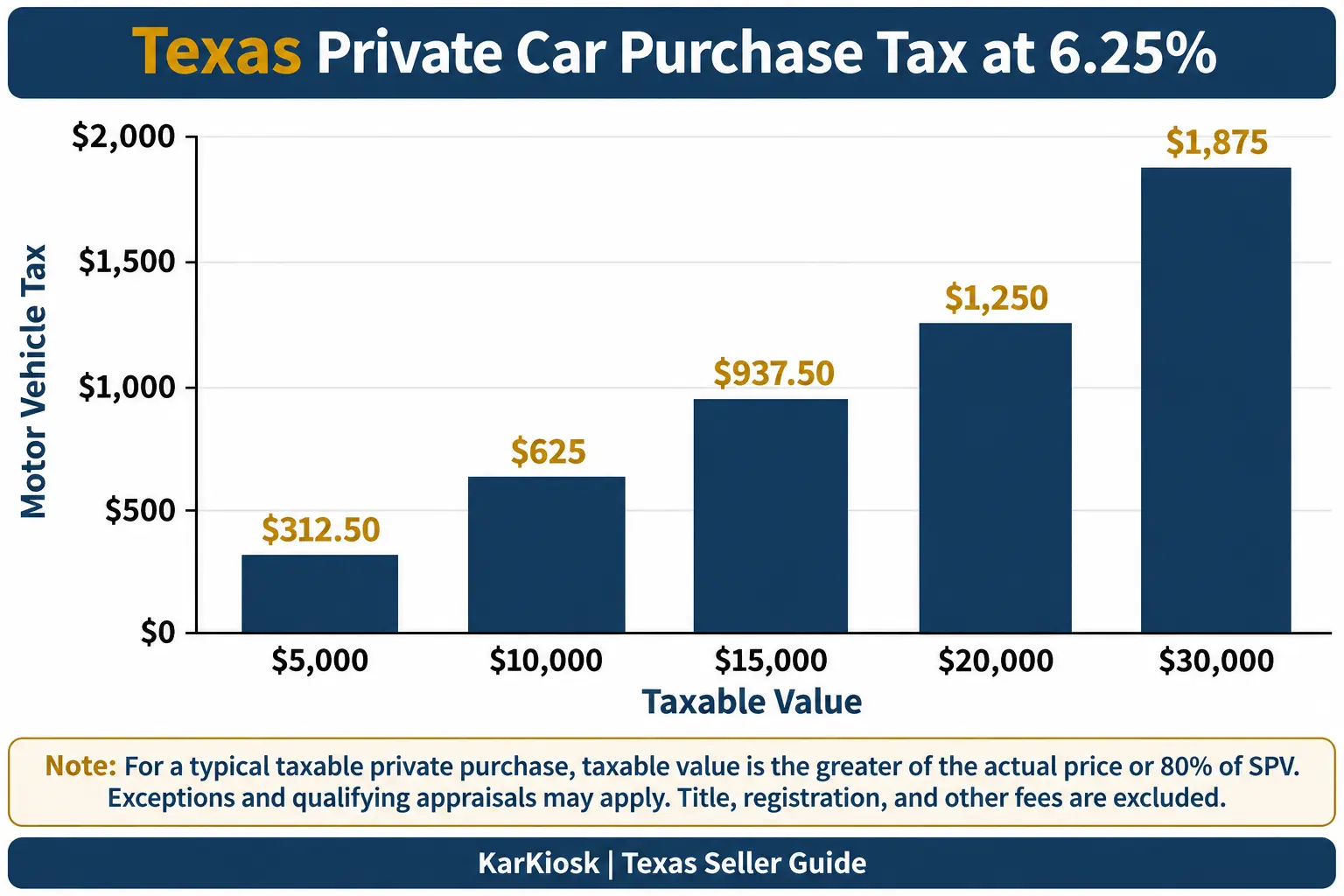
For an ordinary taxable private purchase, the buyer generally owes 6.25% motor vehicle tax on the greater of the actual purchase price or 80% of the vehicle’s Standard Presumptive Value, commonly called SPV.
For example, a $12,000 purchase with a $17,000 SPV produces a $13,600 taxable value. The buyer’s tax is $850, before title, registration, and other applicable charges.
The buyer pays this tax to the county. It is separate from the agreed amount paid to you. Record the actual sale price accurately on the transaction documents.
SPV does not account for the vehicle’s individual condition. A buyer paying below 80% of SPV may use a qualifying certified appraisal obtained within 30 calendar days, subject to the appraisal rules. The taxable amount cannot fall below the actual price paid. This may matter for a car discounted because of substantial damage.
The Texas title application fee is $28 or $33, depending on the buyer’s county of residence. Registration and other charges vary with the transaction. A buyer’s total budget should allow for these costs in addition to your asking price.
Create a KarKiosk Listing That Answers Buyers’ Questions
Prepare your mileage, asking price, photographs, and description before starting. Use the city where buyers can realistically inspect the car, and explain any limits on viewing or pickup times.
Follow the Listing Steps
Identify the vehicle. Enter its VIN or license plate and state. Manual year, make, model, and trim selection is also available.
Check the matched details. Correct the trim, engine, drivetrain, or equipment if the displayed information does not match your car.
Register or sign in. Complete the account step required to finish your listing.
Add the selling information. Supply the mileage, price, location, condition, and a description supported by your records.
Upload photographs and a short video. Show the exterior, interior, cargo area, dashboard, tires, and any significant defects, within your plan’s limits.
Review the plan and listing. Confirm the price, included features, viewing arrangements, and vehicle details before publishing.
At the October 22, 2026 check, KarKiosk displayed Lite at $24.99 with 5 photos, Starter at $34.99 with 15 photos, and Advanced at $49.99 with 25 photos, priced per listing. Check the current package details before paying because inclusions and prices can change.
Write a Description a Texas Buyer Can Use
Open with the year, make, model, trim, mileage, location, and asking price. Then explain ownership, title status, maintenance, equipment, known defects, and inspection availability.
Be specific about air-conditioning repairs, tire replacement, hail damage, or pickup use when relevant. State whether the title is available or whether a lender payoff must be arranged. Avoid unsupported claims such as “perfect condition” or “never damaged.”
Illustrative listing wording:
“2019 midsize SUV in Round Rock, 88,400 miles. Texas title in my name with no lien. A/C compressor replaced in June 2026; receipt available. Two keys. Small rear-bumper scrape shown in photos. Independent inspection welcome by appointment.”
Use only statements that are true for your vehicle.
For help organizing those details, read KarKiosk’s guide to writing a car listing description.
Choose Photos That Support the Description
Use a clear front three-quarter image as the lead photo. Follow with the other exterior angles, seats, dashboard, cargo space or truck bed, and important condition details. If your plan limits photos, prioritize views that answer the most likely questions.
Keep the car’s condition visible when adjusting lighting or using image-enhancement tools. Preserve dents, scratches, wheel damage, and other details a buyer will see in person. Keep personal documents and home-security information out of public photos.
Use KarKiosk Features to Move Buyers Toward an Appointment
Use each tool to answer a specific buyer question or organize the next step:
KarReport: Review the included vehicle history information and explain any reported title or damage entries. Add your service records and disclose known issues even if the report does not show them.
Message Center: Keep initial conversations in KarKiosk’s chat or voice-call tools, and answer questions about condition, ownership, and availability.
Offers and counteroffers: Keep track of proposed prices and respond with a clear amount and any conditions, such as an inspection or lender payoff.
Test-drive scheduling: Agree on a practical location and time, especially when the buyer is traveling from another Texas city.
Optional promotion: Review featured placement and additional distribution included with your selected plan before deciding whether to pay for more exposure.
If inquiries are weak, first review the asking price, lead photo, and missing information. If buyers repeatedly ask the same question, add the answer to the description. If visits do not lead to offers, ask whether price, condition, or paperwork is the obstacle.
KarKiosk helps you advertise and communicate. You and the buyer still need to verify the vehicle, arrange payment, and complete the Texas ownership transfer.
Screen Buyers and Plan a Useful Test Drive
Before arranging a visit, confirm that the buyer has read the price, location, title situation, and known defects. Ask whether they plan to use financing, request a mechanical inspection, or travel from outside Texas. These details affect timing and paperwork.
Choose a daylight meeting in a busy public location. Check the prospective driver’s valid license and confirm test-drive coverage with your insurer beforehand. Keep your original title and spare key under your control during the visit.
Agree on a route that allows normal braking, steering, and acceleration checks. Let the buyer test the air conditioning and inspect the car after the drive. For a pickup, show the hitch, bed, tire condition, and relevant service records.
Accommodate a reasonable inspection at a mutually agreed repair facility. Decide in advance who pays and how the car will get there. Discuss findings using the written inspection results rather than guessing at repair costs.
Recognize Payment and Deposit Red Flags
Stop and verify independently if a buyer:
Sends more than the agreed amount and asks you to refund the difference or pay a transporter.
Uses a payment screenshot or email as the only proof that you have been paid.
Requests a verification code, banking login, or a fee to release their payment.
Pressures you to release the car, keys, or signed title before your bank can verify the payment.
Fake checks can initially appear in an account balance and still be returned later. Agree on the payment method before the meeting and ask your bank how to verify receipt and settlement for that method.
If accepting a deposit, write down the amount, how long you will hold the car, whether it is refundable, and what happens if an inspection or financing falls through. Keep the agreement with your messages and receipt.
Schedule the Closing Around the Bank and County Tax Office
Arrange the sale when your bank, lender if applicable, and the relevant county tax office can help. This is especially useful for a financed vehicle or a buyer who must drive a long distance home.
The Travis County Tax Office gives this practical recommendation:
“For your protection, we recommend that you and the buyer come to the tax office together to process the title transaction.”
Check the office’s appointment arrangements and payment requirements. The buyer should bring insurance documentation and identification that meets current Texas registration rules. Texas updated identification requirements for initial registration and title-and-registration transfers on March 5, 2026, so the buyer should confirm acceptable documents before the visit.
Complete the Payment and Paperwork Carefully
Confirm the final terms. Agree on the actual price, included accessories, known-condition disclosures, and any lender payoff arrangements.
Verify payment. Coordinate with the bank or lender and confirm receipt before releasing the vehicle and ownership documents.
Complete the title assignment. Enter the buyer’s correct legal name, sale date, required mileage information, and signatures. Do not leave the buyer’s name blank.
Complete Form 130-U. Check the VIN, parties’ information, actual price, and required signatures against the title and sale agreement.
Sign the separate bill of sale. Record the price, date and time of handover, included items, and any written terms. Give each party a copy.
Prepare for handover. Keep copies of the completed records and provide the buyer with the required originals and lien release. Remove toll tags and clear paired phones, saved addresses, garage-door codes, and connected-vehicle access. Finish the plate and transport arrangements before handing over the keys.
If a title entry is wrong, ask the county office how to correct it before altering the document. A rushed correction can create another transfer problem.
Apply the Correct Odometer Rule
In 2026, model year 2011 and newer vehicles generally still require odometer disclosure. The federal rule covers the first 20 years, beginning with model year 2011. A 2011 vehicle first becomes age-exempt in 2031.
Model year 2010 and older vehicles remain under the earlier age-exemption rules. Complete the applicable mileage fields accurately, including the correct status if the reading is not the actual mileage.
Keep the Buyer’s Deadline Separate From Your Notice
For a standard private sale, the buyer generally must apply for title and pay the motor vehicle tax within 30 calendar days. That is a filing deadline, not the delivery date of the new paper title. Qualifying active-duty military buyers have a longer period.
Late tax payment can add a 5% penalty when paid 1–30 days after the due date, or 10% when paid more than 30 days late. A separate late-title fee can also apply. Completing the county transaction together reduces the chance of an unfinished transfer.
Remove Your Plates and Arrange the Buyer’s Trip Home
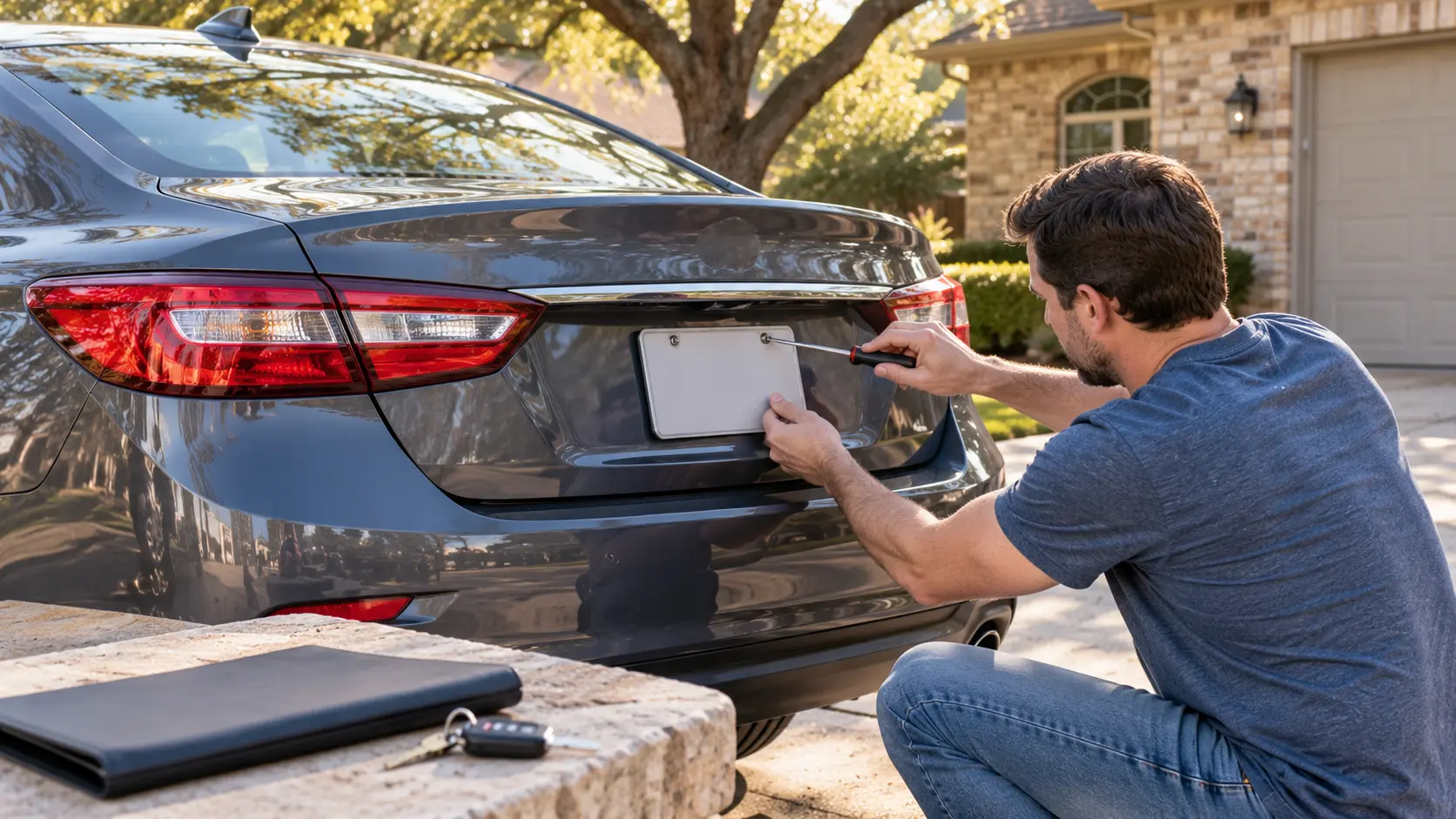
For a private Texas sale, remove your license plates and the windshield registration sticker when delivering the vehicle. You may be able to transfer eligible plates to another vehicle you own through the county tax office.
Texas changed dealer plate procedures on July 1, 2025, but the person-to-person sale process remained unchanged. A private seller should not assume they can issue a dealer-style buyer plate.
Understand the Current Vehicle Transit Permit
For an eligible passenger car or light truck, the buyer can obtain a Vehicle Transit Permit to drive home or to the county tax office when the seller retains the Texas plates.
The current permit is valid for five calendar days from issuance, including the issue date. Only one permit per vehicle may be issued, and the buyer must maintain the required liability insurance. Salvage and nonrepairable vehicles are not eligible.
Arrange lawful transport before handover. The permit has a limited transport purpose; the buyer’s 30-day title deadline does not authorize unrestricted driving without valid registration or a suitable permit.
For an out-of-state buyer, confirm permit recognition along the route and the destination state’s title requirements. Use the actual buyer’s information on your documents and still complete your Texas transfer notice.
Finish Your Responsibilities After the Sale
Submit the Texas Motor Vehicle Transfer Notification immediately after handover, keeping within the 30-day period. Use the online notice or Form VTR-346, check the buyer’s details and sale date, and save the confirmation.
The notice updates the vehicle record to show the sale. It does not transfer the title. Filing within 30 days provides important protection against the buyer’s later parking tickets and toll violations. It should not be treated as blanket protection from every possible claim.
Finish these practical tasks:
Keep the sale file. Retain copies of the signed title, Form 130-U, bill of sale, payment record, lien release, and transfer-notice confirmation.
Update your insurance. Coordinate the end of coverage with your insurer after the completed handover and arrange coverage for any replacement vehicle.
Update toll accounts. Remove the sold vehicle and its plate from your accounts and confirm that your transponder is no longer assigned to it.
Check connected services. Confirm that the sold vehicle no longer appears in your connected-car, parking, or charging accounts.
Close the advertisement. Mark the vehicle sold or remove the listing, and cancel remaining viewing appointments.
If you missed the notice deadline, submit it anyway. TxDMV can still record a late notice. Keep your evidence of the sale and respond promptly if a later toll bill or citation arrives.