
Bill of Sale Sep 16, 2026
Texas does not require a separate generic bill of sale to replace a properly assigned title and Form 130-U in a standard private vehicle sale. The buyer must transfer the vehicle into the buyer’s name within 30 days, while the seller should file a Vehicle Transfer Notification within the same 30-day period.
Private purchases are generally subject to 6.25% motor vehicle tax. Texas can calculate the tax using Standard Presumptive Value when the reported private-sale price is below the state’s valuation threshold.
Download the free KarKiosk vehicle bill of sale PDF before handing over the title or payment. It creates a separate signed record of the VIN, mileage, actual sale price, buyer, seller, and sale date.
The Texas Title Carries the Ownership Transfer
The seller gives the buyer a properly assigned title showing the sale date and required odometer information.
The buyer and seller also complete Form 130-U, Application for Texas Title and/or Registration. The sale price should be entered accurately.
Texas DMV advises sellers to keep detailed written records of the transaction, including the buyer’s contact details, date of sale, and VIN. A separate bill of sale is useful for that purpose.
Current state instructions are available from Texas DMV — Buying or Selling a Vehicle.
A bill of sale does not correct:
An open title.
A missing title.
An unreleased lien.
A seller who is not the titled owner.
An assignment already made to another buyer.
The title, Form 130-U, and bill of sale should all show matching vehicle and transaction information.
For a different private-sale system, see KarKiosk’s Arizona Bill of Sale guide.
Texas Private Vehicle Sale Rules
Item | Texas Rule | Why It Matters |
Main ownership document | Properly assigned vehicle title | Transfers the seller’s ownership interest |
Title application | Form 130-U | Used to apply for title and registration |
Buyer title deadline | 30 days from sale | Delayed transfer can create penalties and ownership problems |
Seller transfer notice | Within 30 days | Helps protect the seller from later tolls and parking violations |
Motor vehicle tax | 6.25% | Private sales can also be subject to SPV |
SPV threshold | 80% of Standard Presumptive Value | A low sale price may not control the taxable value |
Title application fee | $28 or $33 depending on county | Paid during the title transaction |
Base passenger registration | $50.75 plus $1 TexasSure fee | County and processing charges can be added |
Safety inspection | Not required for ordinary noncommercial vehicles | Texas ended the requirement in 2025 |
Emissions testing | Required in covered counties | Registration can depend on a current emissions test |
The Buyer Has 30 Days to Transfer the Vehicle
A vehicle purchased in a private transaction must be titled in the buyer’s name within 30 days of the sale date.
The buyer normally takes the following to the county tax assessor-collector:
Properly assigned title.
Completed Form 130-U.
Proof of liability insurance.
Identification.
Applicable tax.
Title and registration fees.
Required emissions documentation when applicable.
The buyer should complete the transfer early enough to correct missing signatures or lien problems before the deadline.
The Seller Should File a Vehicle Transfer Notification
Texas gives the seller a separate protection step.
The Vehicle Transfer Notification should be filed within 30 days after the sale.
When TxDMV receives the notice within that period, the motor vehicle record is updated to show that the vehicle was sold. Texas states that timely filing protects the seller from responsibility for parking tickets and toll violations committed by the purchaser after the sale.
The seller should retain:
Bill of sale.
Buyer’s contact information.
Copy or photograph of the completed title assignment.
Transfer-notification confirmation.
Payment record.
The notification does not transfer ownership. The buyer still has to complete the title process.
Texas Motor Vehicle Tax Is 6.25%
Texas charges 6.25% motor vehicle tax on taxable vehicle purchases.
Private used-vehicle sales have an additional valuation rule.
Texas can apply Standard Presumptive Value, or SPV, rather than accepting a substantially lower written sale price.
The official private-sale tax rules are available from Texas Comptroller — Private-Party Purchases and Standard Presumptive Values.
How Standard Presumptive Value Changes the Tax
For a normal private-party purchase, tax is generally calculated on the greater of:
The actual sale price; or
80% of the vehicle’s SPV.
A valid certified appraisal can change the result when the buyer paid less than 80% of SPV and meets the appraisal requirements.
Example: Vehicle Sold for $12,000
Assume:
SPV = $20,000.
80% of SPV = $16,000.
Actual price = $12,000.
The taxable amount is generally $16,000.
At 6.25%, the tax equals $1,000.
Example: Vehicle Sold for $18,000
Using the same $20,000 SPV:
80% SPV = $16,000.
Actual sale price = $18,000.
The taxable amount is $18,000.
Tax equals $1,125.
A bill of sale should still show the actual amount paid even when SPV controls the tax calculation.

Texas Title and Registration Fees
The title application fee is currently $28 or $33, depending on the county.
The standard registration base fee for a passenger vehicle or light truck up to 6,000 pounds is $50.75. Texas also collects a $1 TexasSure insurance-verification amount, making the state registration component $51.75 before county and other charges.
Other possible charges include:
County fees.
$4.75 processing and handling fee.
Emissions-related charges.
Specialty plate charges.
Electric vehicle fee when applicable.
Tax is additional.
The Seller Can Remove the Texas Plates
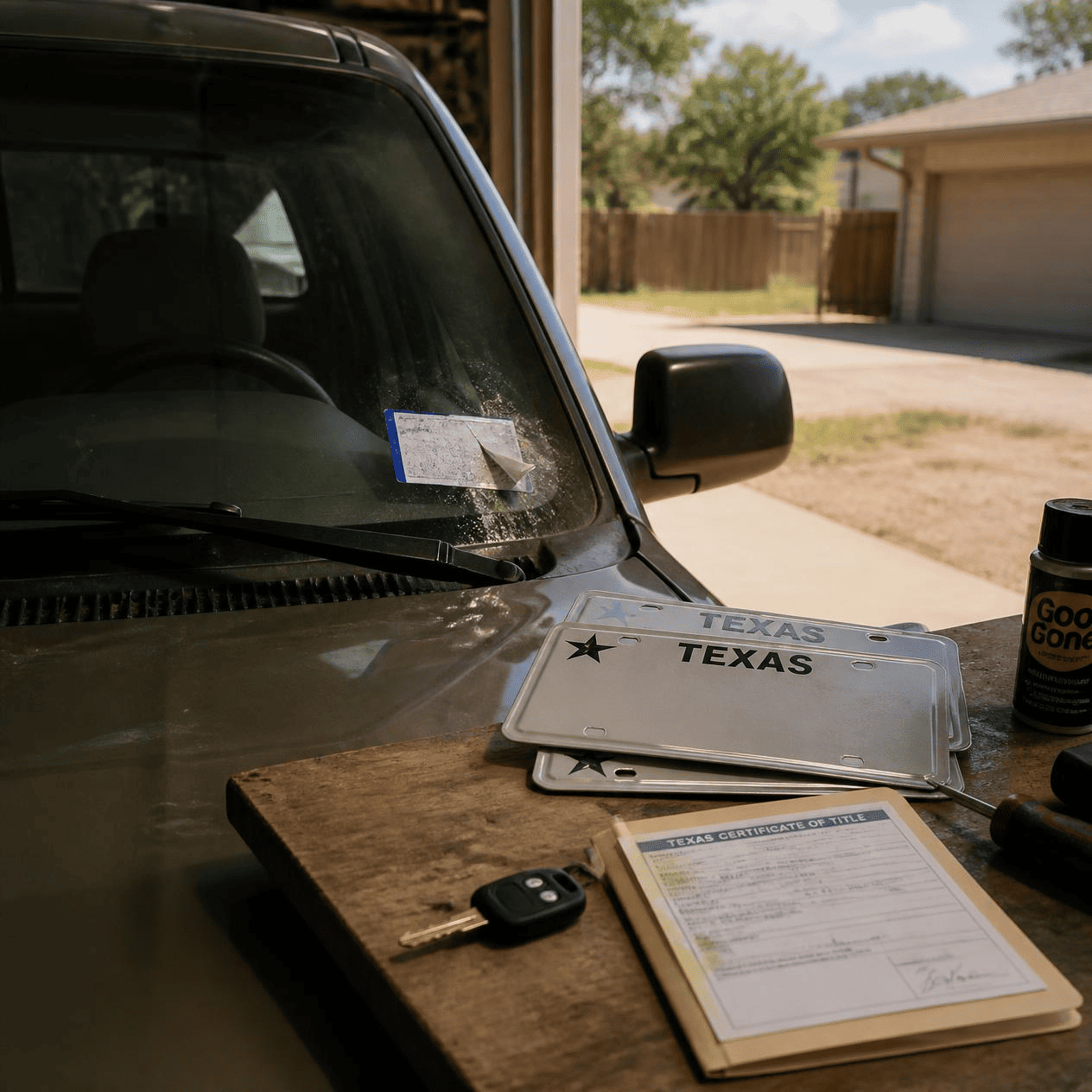
Texas gives a private seller the option to remove the license plates and registration sticker from the vehicle.
If the seller removes the plates, the seller can:
Transfer eligible plates to another vehicle of the same classification.
Keep them for a future eligible transfer.
Deface and dispose of them to prevent fraudulent use.
The registration sticker does not transfer to another vehicle.
The seller should decide how the plates will be handled before the buyer drives away.

Most Texas Cars No Longer Need a Safety Inspection
Texas eliminated the annual safety inspection requirement for ordinary noncommercial vehicles on January 1, 2025.
Commercial vehicle inspection requirements remain separate.
The change did not eliminate emissions testing in covered counties.
Emissions Testing Still Applies in Covered Counties
As of September 2026, qualifying gasoline vehicles are subject to emissions testing when registered in:
Brazoria.
Collin.
Dallas.
Denton.
El Paso.
Ellis.
Fort Bend.
Galveston.
Harris.
Johnson.
Kaufman.
Montgomery.
Parker.
Rockwall.
Tarrant.
Travis.
Williamson.
Bexar County joins the emissions program on November 1, 2026.
Covered gasoline vehicles are generally tested from two through 24 years old.
Current requirements are published by Texas DPS — Emission Inspection Criteria.

Gift Transfers Use a Separate Tax Rule
A qualifying Texas vehicle gift can be subject to the state’s $10 gift tax instead of ordinary 6.25% motor vehicle tax.
Eligible transfers can include specified relationships such as spouses, parents, children, grandparents, grandchildren, and siblings.
The parties must use the state’s required gift-transfer affidavit.
Do not record a genuine gift as a false $1 sale.
What If the Vehicle Has a Lien?
The seller should resolve the lien before completing the private transfer.
For a paper title, the buyer needs evidence that the lienholder released its interest.
For an electronic lien, the lender reports the release through the Texas system. A paid lienholder generally has 10 days after receiving payment to release the lien.
A bill of sale does not cancel a security interest.
The buyer should not hand over final payment without understanding how the lien and title will be released.
The notarized-paperwork requirements can be very different elsewhere. KarKiosk’s Louisiana Bill of Sale guide explains Louisiana’s separate notarization rules.
How to Complete a Texas Private Vehicle Sale
Match the seller’s identity with the title.
Compare the VIN on the title and vehicle.
Confirm that all liens have been released.
Complete the title assignment.
Complete Form 130-U with the actual sale price.
Complete and retain a signed bill of sale.
Record the correct odometer reading.
Decide whether the seller will remove the plates and registration sticker.
File the seller’s Vehicle Transfer Notification within 30 days.
Complete required emissions testing when applicable.
Have the buyer title the vehicle and pay tax within 30 days.
Match the seller’s identity with the title.
Compare the VIN on the title and vehicle.
Confirm that all liens have been released.
Complete the title assignment.
Complete Form 130-U with the actual sale price.
Complete and retain a signed bill of sale.
Record the correct odometer reading.
Decide whether the seller will remove the plates and registration sticker.
File the seller’s Vehicle Transfer Notification within 30 days.
Complete required emissions testing when applicable.
Have the buyer title the vehicle and pay tax within 30 days.
Common Texas Private-Sale Mistakes
Accepting an open title.
Treating a bill of sale as a substitute for the title.
Reporting a false purchase price.
Ignoring Standard Presumptive Value.
Missing the 30-day title deadline.
Failing to file the seller’s transfer notification.
Leaving an active lien unresolved.
Using outdated information about Texas safety inspections.
Ignoring county emissions rules.