
Bill of Sale Sep 16, 2026
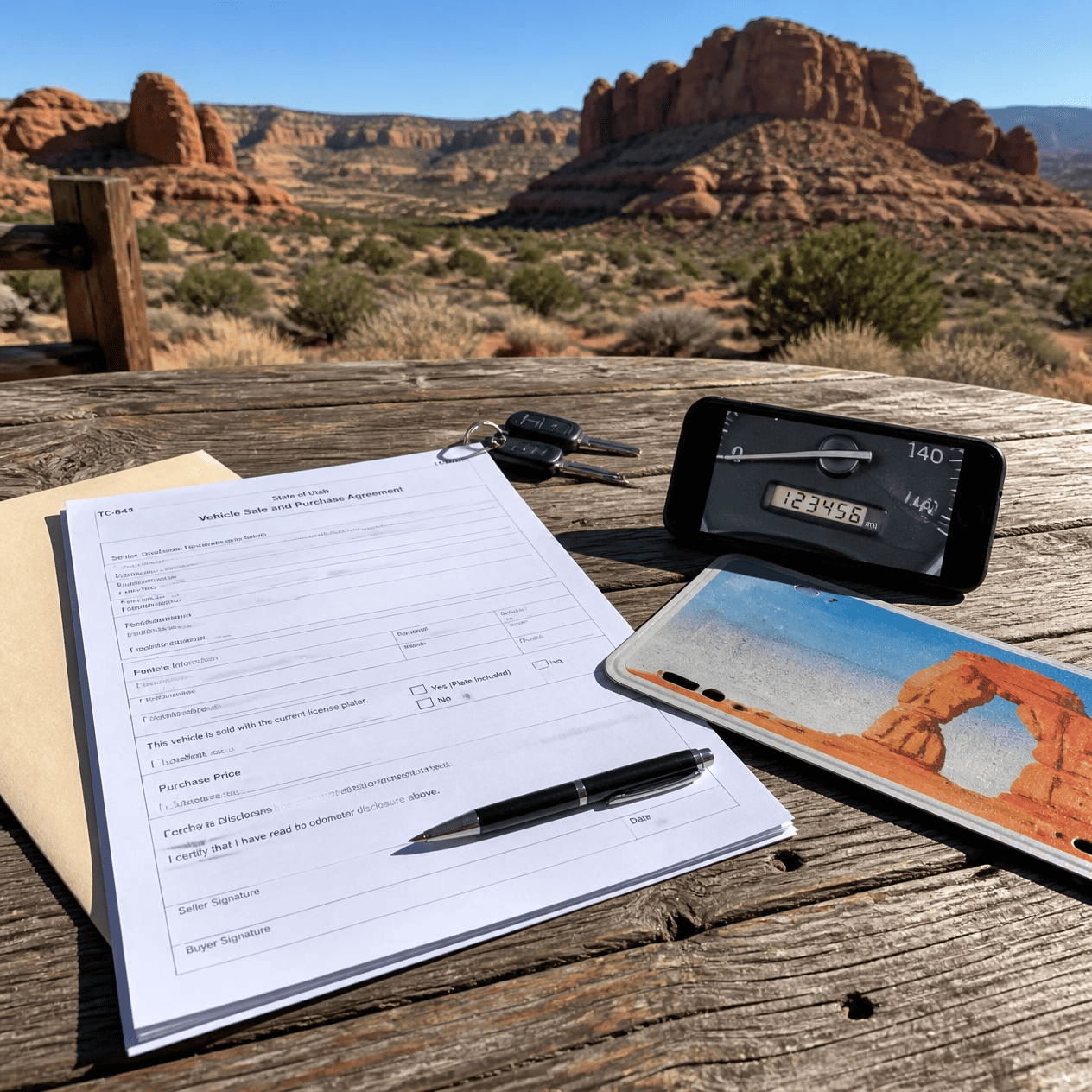
Utah provides Form TC-843 as its official Bill of Sale. The form records the purchase price, sale date, odometer reading, buyer, seller, VIN, and whether the existing license plate is included with the vehicle.
The buyer still needs acceptable ownership evidence to complete the title process. Eligible Utah-titled private purchases can be started online through Utah’s Person to Person title-transfer system.
Download the free KarKiosk vehicle bill of sale PDF before the sale is completed. Keep it with TC-843 and the title as a second signed record of the sale price, mileage, VIN, and handover date.
TC-843 Is Utah’s Official Bill of Sale
The current Form TC-843 records:
Vehicle year.
Make.
Model.
Body type.
VIN.
License plate number.
Seller’s name and address.
Sale price.
Date of sale.
Odometer reading.
Mileage status.
Buyer’s name and address.
Buyer’s and seller’s signatures.
The form also asks whether the plate is included with the vehicle.
If the plate is personalized and is being transferred with the sale, Utah requires the additional personalized-plate transfer process shown on the form.
The current form is available from Utah State Tax Commission — TC-843 Bill of Sale.
Utah Private Vehicle Sale Rules
Item | Utah Rule | Why It Matters |
Official bill of sale | TC-843 | Records the sale, mileage, parties, and plate decision |
Ownership evidence | Assigned Utah title or qualifying ownership document | Establishes the seller’s right to transfer the vehicle |
Online private transfer | UPP for eligible Utah-titled vehicles | Buyer may start title and registration without visiting DMV |
Title fee | $6 | Applies to a Utah title or duplicate title |
Sales tax | Based on actual purchase price | Private buyers pay tax when titling the vehicle |
Family sale | Not automatically tax-exempt | Relationship alone does not remove sales tax |
Temporary permit | $6 plus required tax and fees | Allows temporary operation while documents are completed |
96-hour in-transit permit | $2.50 | Allows limited movement of an unregistered vehicle |
Safety inspection | Not required for most passenger vehicles | Special vehicle classes remain exceptions |
Emissions programs | Five counties | County and model-year rules control testing |
The Title Still Controls the Ownership Chain
The seller should give the buyer the ownership document required for the vehicle.
For a standard Utah-titled vehicle, this is normally the properly assigned Utah title.
When ownership is listed as:
Owner A AND Owner B: both owners sign.
Owner A OR Owner B: one listed owner can generally sign.
An unresolved lien must be dealt with before the buyer assumes the title is clear.
The state’s current private-transfer guidance is available at Utah DMV — Buying and Selling Vehicles.
KarKiosk’s Arkansas Bill of Sale guide covers a different system in which Arkansas uses its own title, tax, and registration rules.
Utah Allows Eligible Person-to-Person Transfers Online
Utah’s UPP system lets a buyer of an eligible Utah-titled vehicle start the ownership change online.
The buyer can use UPP to:
Apply for a title.
Apply for registration.
Request a temporary permit.
Upload required ownership documents.
UPP does not handle every transaction.
Examples that cannot be processed through the standard online system include:
Out-of-state titles.
Non-repairable vehicle records.
Certain suspended or incomplete records.
The VIN, title number, and current owner information entered online must match Utah’s records.

Utah Sales Tax Uses the Actual Purchase Price
Private vehicle sales are subject to Utah sales tax.
The buyer pays the tax when the vehicle is titled for the first time after the private purchase. The applicable sales-tax rate follows the buyer’s registration address.
Utah requires the buyer to report the actual amount paid.
The state warns that fraudulent underreporting can result in:
Additional tax.
Interest.
Audit action.
Fraud penalties.
A family sale is not automatically exempt simply because the parties are related.
Utah specifically states that family-to-family vehicle purchases remain subject to sales tax when consideration is paid.
The Utah Title Fee Is $6
Utah currently charges $6 for a title.
A duplicate Utah title also carries a $6 title fee.
The buyer also pays:
Registration charges.
Applicable sales tax.
Age-based uniform fee.
Plate charges when applicable.
Emissions costs when required.
These amounts are separate.
Utah Uses an Age-Based Uniform Fee
Passenger cars, light trucks, SUVs, and vans are subject to a statewide uniform fee based on age.
For 2026:
Model years 2024–2026: $150.
Model years 2021–2023: $110.
Model years 2018–2020: $80.
Model years 2015–2017: $50.
Model years 2014 and older: $10.
The fee is paid with registration and is separate from sales tax and the title fee.

TC-843 Makes the Plate Decision Explicit
Utah is unusual because the official bill of sale asks whether the existing plate is included with the vehicle sale.
The seller checks either:
Plate included with the vehicle; or
Plate not included with the vehicle.
When the plate is not included, the seller should remove it before the buyer takes possession.
Utah warns sellers that leaving their plate on a vehicle can expose them to parking violations, traffic citations, towing, storage, and impound issues until the ownership record is updated.
For a very different plate system, see KarKiosk’s California Bill of Sale guide.
The Seller Should Report the Vehicle Sold
TC-843 directs sellers to report the sold vehicle through Utah’s Motor Vehicle Portal.
The seller should keep:
Copy of TC-843.
Copy of the signed title.
Payment record.
Sale date.
Buyer information.
Confirmation that the vehicle was reported sold.
This record is useful if registration, toll, towing, or ownership questions arise later.
Temporary Permits Cover Incomplete Registration
A Utah DMV office can issue a temporary permit when the buyer needs time to obtain required title, ownership, safety, or emissions documentation.
The temporary-permit fee is $6, and the buyer must pay the applicable taxes and title or registration fees when the permit is issued. DMV determines the permit length according to the circumstances.
Utah also offers a 96-hour in-transit permit.
That permit:
Costs $2.50.
Allows movement of an unregistered vehicle.
Requires proof of ownership.
Requires proof of insurance for a Utah resident.
Cannot exceed 96 hours.
The private-sale permit rules should not be confused with the 45-day temporary permit used in dealer transactions.
Odometer Disclosure Applies for 20 Years
Utah requires odometer disclosure when an ownership change occurs unless an exemption applies.
The current private-transfer guidance states that the odometer section must be completed when the vehicle is less than 20 years old.
TC-843 records whether the mileage is:
Actual.
In excess of the odometer’s mechanical limits.
Not actual mileage.
The mileage on the title and bill of sale should match.
Most Passenger Vehicles Do Not Need a Safety Inspection
Utah removed the general passenger-vehicle safety inspection as a prerequisite for registration beginning January 1, 2018.
Safety inspection rules still apply to specific categories, including:
Rebuilt salvage vehicles seeking a rebuilt title.
First-time street-legal ATV registrations.
Commercial vehicles.
Three-axle motor homes.
Five Utah Counties Have Emissions Programs
Vehicle emissions requirements apply in:
Cache County.
Davis County.
Salt Lake County.
Utah County.
Weber County.
Testing schedules vary by county, fuel type, and model year.
For 2026, Salt Lake and Davis counties, for example, exempt model years 2025 and 2026 while requiring qualifying even-model-year vehicles such as 2024 and 2022. Cache County follows a different schedule.
Current county rules are listed at Utah DMV — Vehicle Inspections.

Out-of-State Vehicles Need VIN Verification
Vehicles being titled in Utah for the first time generally require a VIN inspection unless a specific exemption applies, such as a qualifying new vehicle acquired with an MSO from an in-state dealer or manufacturer.
An out-of-state title cannot be processed through the standard UPP online title-transfer system.
The buyer should prepare:
Out-of-state ownership document.
Bill of sale.
VIN inspection.
Identification.
Insurance.
Applicable emissions documentation.
What If the Utah Title Is Missing?
The seller is responsible for providing ownership evidence.
When the missing title was issued by Utah, the seller can use Form TC-123, Application for Duplicate Utah Title.
Utah allows the completed duplicate-title application to be transferred directly to a Utah buyer in certain cases, and DMV recommends that a bill of sale accompany it.
When the missing title was issued by another state, the seller must obtain a duplicate from that issuing state.
TC-843 alone does not automatically solve a missing out-of-state title.
How to Complete a Utah Private Vehicle Sale
Verify the seller’s ownership document.
Compare the VIN on the vehicle, title, and TC-843.
Confirm that any lien has been released.
Complete the title assignment.
Complete TC-843 with the actual purchase price.
Record the required odometer disclosure.
State clearly whether the existing plate is included.
Have the seller report the vehicle sold.
Start the title transfer through UPP or DMV.
Obtain temporary operating authority before driving an unregistered vehicle.
Complete emissions testing when required.
Pay sales tax, title fees, registration, and the age-based uniform fee.
Verify the seller’s ownership document.
Compare the VIN on the vehicle, title, and TC-843.
Confirm that any lien has been released.
Complete the title assignment.
Complete TC-843 with the actual purchase price.
Record the required odometer disclosure.
State clearly whether the existing plate is included.
Have the seller report the vehicle sold.
Start the title transfer through UPP or DMV.
Obtain temporary operating authority before driving an unregistered vehicle.
Complete emissions testing when required.
Pay sales tax, title fees, registration, and the age-based uniform fee.
Common Utah Private-Sale Mistakes
Failing to keep a completed TC-843.
Reporting a false purchase price.
Assuming family sales are automatically tax-exempt.
Leaving the plate-transfer decision unclear.
Failing to report the vehicle sold.
Driving an unregistered vehicle without a permit.
Using the dealer 45-day permit rule for a private sale.
Assuming emissions rules are identical across Utah.
Trying to use UPP with an out-of-state title.
Treating TC-843 as a universal substitute for missing ownership evidence.