
Bill of Sale Sep 22, 2026
A separate Arkansas bill of sale is not required when the seller’s Arkansas title contains the accepted, fully completed sale and odometer sections. Older Arkansas titles and out-of-state titles require additional sale documentation, and the buyer generally has 60 days to register the vehicle. Keep a written transaction record with KarKiosk’s free bill of sale PDF, alongside the title and any required official forms.
Arkansas Bill of Sale Quick Facts
Requirement | Arkansas rule |
Combined sale and mileage form | Form 10-313, Vehicle Bill of Sale/Odometer Disclosure Statement |
Separate bill of sale | Depends on the title’s control number and issuing state |
Notarization of Form 10-313 | No notary block; buyer and seller signatures are required |
Buyer’s registration deadline | 60 calendar days after purchase |
Used vehicle priced below $4,000 | Exempt from vehicle sales and use tax |
Used vehicle priced $4,000 to under $10,000 | 3.5% state tax, plus applicable local tax |
Used vehicle priced $10,000 or more | 6.5% state tax, plus applicable local tax |
Additional registration paperwork | Current-year county assessment, clearance of property taxes due and liability insurance |
When Is a Separate Arkansas Bill of Sale Required?
Check the control number on the back of the Arkansas title. DFA uses this number to determine whether the title’s built-in sale and odometer sections satisfy the documentation requirement.
The Arkansas DFA registration requirements distinguish three situations:
Arkansas title numbered 3003001 or higher: Properly completed sale and odometer sections on the title are sufficient.
Arkansas title numbered below 3003001: Provide a separate bill of sale and the required conforming odometer documentation.
Title issued by another state: Provide the separate sale and odometer documentation required for an out-of-state title, subject to applicable mileage-disclosure exemptions.
A title with blank price, buyer or signature fields is not complete simply because its control number falls within the accepted range.
For an Oklahoma-titled vehicle coming into Arkansas, check the Oklahoma bill of sale and title-transfer process before collecting the seller’s documents. Arkansas then applies its own registration requirements to the buyer’s application.
What Does Form 10-313 Cover?
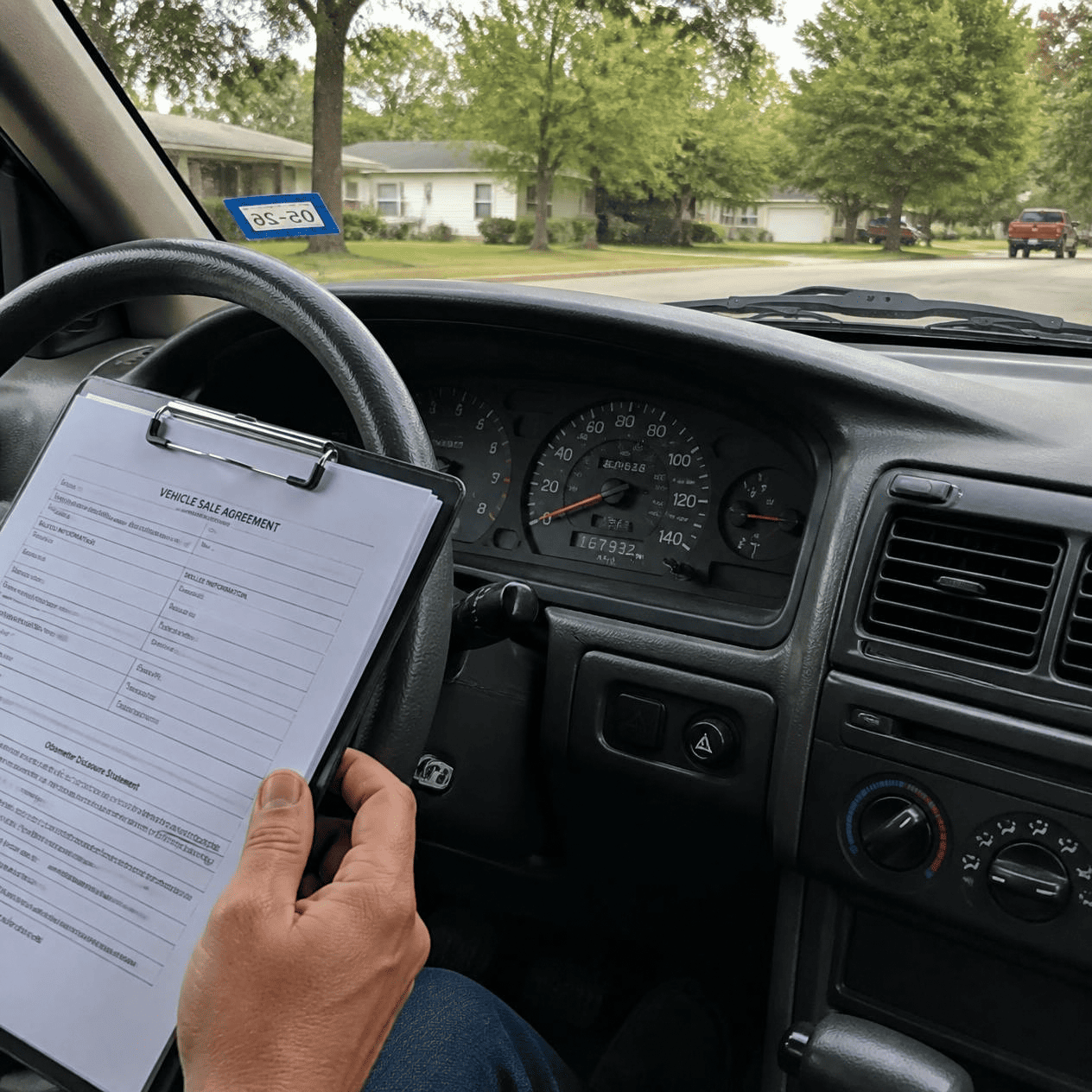
Arkansas’s Vehicle Bill of Sale/Odometer Disclosure Statement, Form 10-313, combines the sale record and mileage certification.
Complete the applicable sections for:
Buyer and seller names and addresses.
Vehicle year, make, model and full VIN.
Actual sale date and selling price.
Trade-in description and allowance, when applicable.
Odometer reading and mileage status.
Printed names and signatures of both parties.
Enter the odometer reading without tenths. The form treats it as actual mileage unless the seller checks the applicable exception for exceeding mechanical limits or an odometer discrepancy. Do not mark an exception unless it applies.
Does an Arkansas Bill of Sale Need Notarization?
Form 10-313 does not contain a notarial acknowledgment. The buyer and seller complete their own signature sections; a notary stamp is not part of that form’s standard execution.
Do not apply this answer to every possible document in the transaction. A power of attorney, estate document or another state’s title may carry separate signature or acknowledgment requirements.
The title must still be properly assigned. Signing a separate bill of sale does not fix an unsigned title or establish that someone other than the titled owner has authority to sell.
Which Documents Does the Buyer Need?
Prepare the complete packet, not just the receipt:
The seller’s properly assigned title.
A completed title and registration application.
The bill of sale and odometer documents required for that title.
Applicable lien releases and a signed financing agreement when financed.
Proof that the vehicle is assessed or listed for the current year’s assessment.
Proof that personal property taxes already due have been paid.
Proof of liability insurance identifying the vehicle.
Why Does Arkansas Require County Assessment Paperwork?
The county assessor records the vehicle for personal property assessment. The county collector handles payment of property taxes that are due. These are separate functions from the state Revenue Office’s title and registration work.
Make sure the newly purchased car appears in the current-year assessment record. A receipt for taxes on a different vehicle does not establish that the new car has been listed.
Current-year assessment does not necessarily mean the new vehicle’s property tax is payable immediately. A first assessment can also be documented when the buyer has no earlier county tax record.
What Is the Arkansas Registration Deadline?
Arkansas DFA states:
“You have 60 days from the date of purchase to register your vehicle.”
For an ordinary private car purchase, finish the title and registration application within that 60-calendar-day period. Keep the purchase date consistent on the title, bill of sale and application.
Late registration can result in a 10% penalty on sales tax due, plus a $3 registration penalty for each 10-day period of delinquency. A tax-exempt purchase does not automatically eliminate registration-related penalties.
Complete the county assessment and obtain any lien release early. Missing paperwork does not automatically extend the filing deadline.
How Much Tax Applies to an Arkansas Private Car Sale?
Arkansas taxes a used vehicle according to its gross purchase price. The DFA’s used-vehicle tax rules provide the exemption below $4,000, the 3.5% state rate from $4,000 to less than $10,000, and the 6.5% state rate at $10,000 or more.
These are not progressive income-tax-style brackets. Without a credit or other adjustment, an $8,000 car produces $280 in state tax, while a $10,000 car produces $650. The higher rate applies to the taxable purchase, not only the portion above $10,000.
Applicable local taxes are additional. The reduced state rate does not automatically reduce the local rate, and title and registration charges remain separate from the purchase tax.

Can Selling Your Old Car Reduce Tax on the Replacement?
Yes, a qualifying private sale can create a vehicle sales-tax credit. Arkansas allows the old vehicle to be sold within 60 days before or after the replacement purchase.
The claimant must have been the titled owner of the vehicle sold. Keep a bill of sale signed by all parties showing the vehicle, sale date, actual selling price and buyer and seller details.
If the old car has already been sold, present the qualifying documentation when registering the replacement. If it is sold after the replacement has been registered and taxed, a refund claim may be available.
For example, a qualifying $5,000 old-car sale against a $15,000 replacement purchase can reduce the taxable amount to $10,000. At the applicable 6.5% state rate, that reduces state tax from $975 to $650, a $325 saving, before local-tax calculations.
An insurance payout for a totaled vehicle is not a qualifying private sale. Also, this 60-day credit window is separate from the buyer’s 60-day registration deadline.

What Title and Registration Fees Are Added?
Arkansas lists a $10 title fee. Base annual registration for a passenger car depends on its weight:
3,000 pounds or less: $17.
3,001 to 4,500 pounds: $25.
4,501 pounds or more: $30.
A $2.50 validation-decal charge and other applicable charges are separate. Hybrid, plug-in hybrid and electric vehicles can have additional registration surcharges, so the base weight fee is not necessarily the full annual bill.
County personal property tax, vehicle purchase tax and state registration fees are different charges. Paying one does not settle the others.
Does the Seller Keep the License Plate?
Under Arkansas Code §27-14-902, the seller removes the plate in an ordinary passenger-car sale. An eligible plate can be transferred to another vehicle owned by that seller; it is not handed over as the buyer’s registration.
Arkansas also provides a Notice of Transfer of Ownership that the seller may submit voluntarily. Keep copies of the assigned title, bill of sale and notice. The notice does not replace the buyer’s registration application.
For a vehicle headed to Tennessee, the Tennessee bill of sale and plate-transfer requirements address the buyer’s next steps. The seller’s Arkansas plate is not a substitute for the buyer’s registration arrangements.
Will an Out-of-State Vehicle Need VIN Verification?
Arkansas requires VIN verification for vehicles carrying certain out-of-state title brands, including salvage, prior salvage and rebuilt or reconstructed designations.
Do not assume every clean-title out-of-state car has the same requirement. Check the actual title brand before the registration visit and arrange any required verification through an authorized process.
A bill of sale cannot remove a title brand or replace the required inspection documentation.