

Bill of Sale Sep 21, 2026
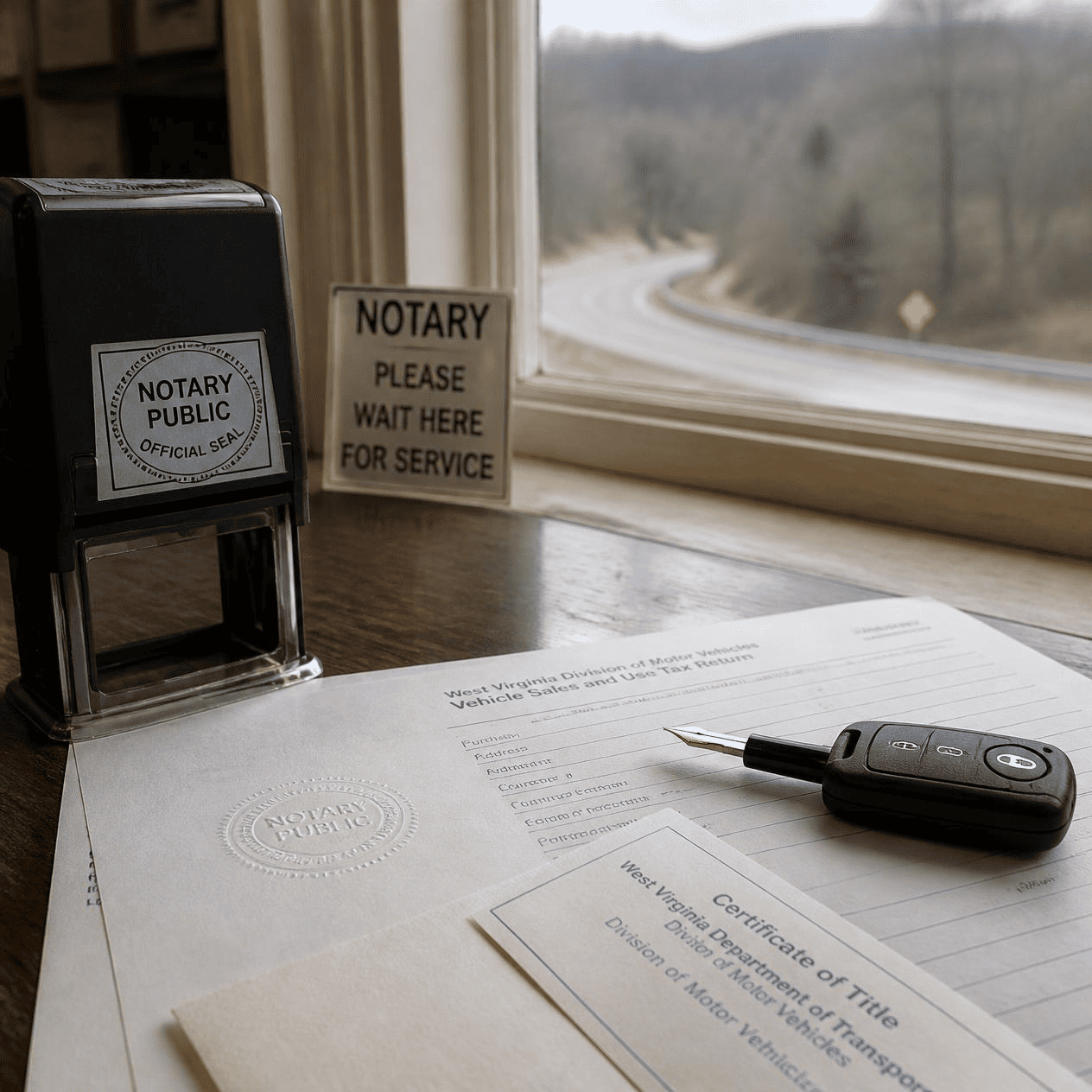
Wyoming’s normal private vehicle transfer centers on the certificate of title rather than a standalone statewide bill-of-sale form. The seller must complete the title assignment and sign it before a notarial officer, then deliver the properly executed title to the buyer.
For an ordinary private transfer, the buyer generally has 45 days to apply for the new Wyoming title and registration. Wyoming’s base state sales-tax rate is 4%, with local option tax added where applicable.
Download the free KarKiosk vehicle bill of sale PDF to record the actual price, VIN, mileage, lien status, and handover date. Keep it with the notarized Wyoming title because the bill of sale supports the transaction but does not replace the normal title assignment.
Wyoming Requires the Seller’s Title Signature to Be Notarized
Wyoming law requires the owner to complete the title assignment and warranty and disclose liens or encumbrances.
The seller’s signature is then:
Signed and dated.
Completed before a notarial officer.
Acknowledged according to law.
Delivered with the vehicle.
All required owners must sign according to the ownership wording shown on the title.
For Wyoming titles issued on or after January 1, 2020, when multiple owners are connected by “or” and the title does not designate joint tenants with right of survivorship, one qualifying owner’s notarized signature can be sufficient.
Current practical titling guidance and fee information are available from Laramie County Clerk — Motor Vehicle Titles.
South Carolina handles private sales differently through Form 4031 and the state’s Infrastructure Maintenance Fee. See KarKiosk’s South Carolina Bill of Sale guide.
Wyoming Private Vehicle Sale Rules
Item | Wyoming Rule | Why It Matters |
Main ownership document | Properly assigned Wyoming title | Transfers the seller’s ownership interest |
Seller title signature | Notarized | Required for a normal Wyoming title transfer |
Ordinary private transfer deadline | 45 days | Buyer must title/register within this period |
Road use during normal 45-day period | Properly executed title must accompany vehicle | Provides temporary operating evidence |
Bank-held title exception | Signed bill of sale at delivery; title within 30 days | Special statutory transfer path |
State sales tax | 4% | Local option tax can increase final rate |
Delinquent tax threshold | 65 days | Interest begins when tax remains unpaid |
Title fee | $15 | County clerk issues the title |
VIN inspection | $10 when required | Common for out-of-state and special-title vehicles |
State passenger registration fee | $30 | County registration fee is additional |
Plates after sale | Seller keeps them | Plates belong to the registered owner |
The Normal Buyer Deadline Is 45 Days
Wyoming law requires registration within 45 days for an ordinary ownership transfer.
The buyer can operate the vehicle during that period when carrying a properly executed title transferring the seller’s interest to the buyer.
This rule is different from dealer transfers.
A qualifying transaction involving a dealer temporary permit can receive a 60-day registration period.
The current registration timelines appear in Wyoming Statutes Title 31.
Do not treat a handwritten receipt alone as the normal 45-day operating document when the seller should have delivered a properly notarized title.
A Bank-Held Title Creates a Different Path
Wyoming law has a specific exception when the certificate of title is being held by a bank or another financial institution at the time the vehicle is delivered.
In that case, the seller can provide a signed bill of sale when the vehicle changes hands.
The seller must then deliver the properly executed title to the buyer within 30 days of the sale.
Transfers falling under this statutory exception can use the separate 60-day registration period when accompanied by the required bill of sale.
This exception does not justify a seller simply saying, “I lost the title.”
There must be a legitimate title-holding situation covered by the statute.
Wyoming Vehicle Sales Tax Starts With a 4% State Rate
Wyoming’s statewide sales-tax rate is 4%.
Local option taxes can be added, so the final motor-vehicle tax varies by location.
The county treasurer collects motor vehicle sales or use tax before the vehicle’s first Wyoming registration.
The governing tax provisions are available in Wyoming Statutes Title 39.
Example
Assume:
Purchase price: $20,000.
Combined applicable tax rate: 5%.
Tax would be:
$20,000 × 5% = $1,000
If the buyer’s applicable combined rate is 6%, the same purchase would produce $1,200 in tax.
Use the buyer’s county and local rate rather than assuming every Wyoming purchase is taxed at only 4%.
The Purchase Price Must Be Declared
For a private vehicle purchase, the purchaser declares the sales price using the documentation required by the county treasurer.
Wyoming law bases the motor-vehicle tax on that declared amount in a normal purchase transaction.
A bill of sale should therefore contain the actual consideration paid.
Do not create a false low-price receipt to reduce tax.
Do Not Leave Vehicle Tax Unpaid Beyond 65 Days
Current Wyoming law provides that when vehicle sales or use tax, including applicable local-option tax, remains unpaid beyond 65 days after the sale, interest begins to accrue.
The ordinary private title-and-registration deadline is earlier at 45 days.
For a normal transaction, the buyer should therefore complete the title, tax, and registration well before the 65-day delinquency point.
Wyoming Registration Uses Factory Price and Vehicle Age
Wyoming passenger registration consists of more than one component.
The state passenger-car registration charge is $30.
A county registration fee is added using the vehicle’s factory price and its year of service.
The county portion is calculated as:
First year: 3% of 60% of factory price.
Second year: 3% of 50%.
Third year: 3% of 40%.
Fourth year: 3% of 30%.
Fifth year: 3% of 20%.
Sixth year and later: 3% of 15%.
Special-equipment value can also affect the calculation.
Wyoming Charges $15 for the Title
A standard Wyoming certificate of title currently costs $15.
A duplicate title also costs $15.
Other common charges include:
VIN inspection: $10.
New lien filing: $20.
The county clerk handles title transactions.
The county treasurer handles registration, plates, and vehicle sales tax.
These are separate county functions even though both are part of the ownership-transfer process.
The Seller Keeps the Wyoming Plates
Wyoming plates belong to the registered owner.
The seller should remove them when the vehicle is sold.
The seller may be able to:
Transfer the physical plates to another qualifying vehicle of the same type.
Transfer unused registration credit to a newly purchased vehicle.
The buyer should not simply continue driving under plates registered to the seller.

Out-of-State Vehicles Need a VIN Inspection
A vehicle previously registered or titled in another state generally requires a VIN inspection before Wyoming issues the new title.
The same VIN-verification requirement can apply to:
Homemade vehicles.
Rebuilt vehicles.
Reconstructed vehicles.
Kit vehicles.
Vehicles using a bonded-title process.
The standard VIN inspection fee listed by Wyoming county title offices is $10.
Wyoming does not impose a routine emissions test as part of an ordinary private passenger-vehicle transfer. The inspection that frequently matters for a newly imported used vehicle is the VIN verification.

Missing Titles Can Trigger the Bonded-Title Process
A generic bill of sale does not automatically solve a missing-title transaction.
When the applicant cannot provide a certificate of title assigning the former owner’s interest, Wyoming can require a bonded-title process.
Requirements can include:
Affidavit of ownership.
VIN inspection.
Wyoming title search.
Attempts to obtain lien releases.
Attempts to contact the previous owner.
Vehicle valuation.
Surety bond.
A surety bond is generally not required when the vehicle or watercraft is valued below $2,500, but additional ownership evidence is still required.
Vermont has a very different old-vehicle ownership exception involving certain pre-2024 non-title records. See KarKiosk’s Vermont Bill of Sale guide.
Odometer Disclosure Applies to Covered Vehicles
Wyoming requires odometer information as part of applicable ownership transfers.
The title or supporting disclosure identifies whether the reading:
Reflects actual mileage.
Exceeds mechanical limits.
Is not the actual mileage.
The mileage entered on the bill of sale should agree with the title.
How to Complete a Wyoming Private Vehicle Sale
Verify that the seller is named on the title.
Compare the VIN on the title and vehicle.
Check every lien.
Complete the title assignment.
Have the seller sign before a notarial officer.
Complete a detailed bill of sale.
Have the seller remove the Wyoming plates.
Carry the properly executed title when operating during the normal transfer period.
Complete title and registration within 45 days.
Pay sales/use tax through the county treasurer.
Complete a VIN inspection when the vehicle or title situation requires one.
Verify that the seller is named on the title.
Compare the VIN on the title and vehicle.
Check every lien.
Complete the title assignment.
Have the seller sign before a notarial officer.
Complete a detailed bill of sale.
Have the seller remove the Wyoming plates.
Carry the properly executed title when operating during the normal transfer period.
Complete title and registration within 45 days.
Pay sales/use tax through the county treasurer.
Complete a VIN inspection when the vehicle or title situation requires one.
Common Wyoming Private-Sale Mistakes
Signing a Wyoming title without notarization.
Buying a vehicle from someone who is not the titled owner.
Treating a generic bill of sale as a substitute for the normal title.
Assuming every transfer receives 60 days.
Missing the ordinary 45-day transfer period.
Leaving the seller’s Wyoming plates on the vehicle.
Failing to pay applicable local-option tax.
Ignoring the VIN inspection on an out-of-state vehicle.
Waiting more than 65 days to pay vehicle tax.