



Seller Guide Oct 19, 2026
Tennessee does not treat a standalone bill of sale as sufficient proof of vehicle ownership. A private buyer needs a properly assigned certificate of title, and Tennessee specifically states that even a notarized bill of sale cannot replace the ownership chain shown by the title.
The bill of sale still matters because Tennessee taxes private vehicle purchases and may require additional documentation when a vehicle is gifted or sold substantially below market value. The buyer completes the title and registration transaction through the county clerk.
Download the free KarKiosk vehicle bill of sale PDF and record the real price, VIN, mileage and sale date before payment. Keep it with the assigned title so the transaction amount is documented if the county clerk or Department of Revenue needs additional price evidence.
The Assigned Title Is the Core Document
For a used vehicle, a Tennessee resident generally brings these items to the county clerk:
Properly assigned certificate of title.
Proof of identification.
Proof of Tennessee residency.
Odometer disclosure when applicable.
Current registration when transferring an existing plate.
Affidavit of Non-Dealer Transfers when the transaction is a gift, qualifying family transfer or low-price transfer.
The current requirements are published through Tennessee Department of Revenue — Titling a Vehicle.
Do not accept an open title with the buyer information left blank.
Do not accept a title assigned to someone else who never transferred ownership.
Tennessee Private-Sale Rules at a Glance
Item | Tennessee Rule |
Main ownership document | Properly assigned title |
Separate bill of sale | Useful transaction evidence; not sufficient ownership proof |
Standard private-sale title notarization | Not generally required on an ordinary Tennessee title assignment |
State sales tax | 7% |
Local tax | Generally applied to first $1,600; local rate varies |
Additional state single-article tax | 2.75% on amount over $1,600 through $3,200 |
Maximum single-article tax | $44 |
Standard title fee | $11 |
Regular passenger plate | $26.50 base state amount |
Plate transfer | $1 |
Plates | Follow the owner, not the vehicle |
Gift/low-price form | Affidavit of Non-Dealer Transfers |
Routine emissions testing | No current Tennessee emissions program |
A Bill of Sale Cannot Replace a Tennessee Title
Tennessee Department of Revenue gives a direct rule:
A notarized bill of sale by itself is not sufficient proof of ownership. A properly endorsed title showing the ownership chain is required.
This is important when a seller says:
“I bought it but never titled it.”
“The title is still in the previous owner’s name.”
“I only have a receipt.”
“The title was lost years ago.”
Do not solve these situations by simply creating another bill of sale.
The seller should resolve the title problem first.
For a comparison with a state that uses a more formal official bill-of-sale form in some transactions, see KarKiosk’s Maryland Bill of Sale guide.
What Should a Tennessee Bill of Sale Record?
Even though the assigned title controls ownership, the bill of sale should record:
Buyer’s legal name and address.
Seller’s legal name and address.
Vehicle year, make and model.
Full VIN.
Exact date of sale.
Actual purchase price.
Odometer reading.
Method of payment.
Trade-in information, if any.
Known title brands.
Buyer’s and seller’s signatures.
Use the actual purchase price.
Tennessee has specific rules for transactions reported substantially below market value.
Does a Tennessee Bill of Sale Need to Be Notarized?
An ordinary supporting bill of sale is not subject to a universal notarization requirement for every Tennessee private vehicle sale.
The standard Tennessee used-title checklist focuses on the properly assigned title and applicable odometer disclosure rather than requiring a notarized generic bill of sale.
Special documents can require notarization.
Examples include:
Affidavits involving ownership problems.
Certain title corrections.
Certain low-price or gift documentation.
Special applications for vehicles lacking normal ownership evidence.
An out-of-state title also follows the notarization rules of the state that issued it. Tennessee specifically honors those foreign title requirements.
Tennessee’s Vehicle Tax Is More Than a Simple 7%
Tennessee vehicle tax has three layers.
1. General State Tax
The general state rate is 7% of the taxable purchase price.
2. Local Sales Tax
Local tax rates vary by jurisdiction and may not exceed 2.75%.
For a motor vehicle treated as a single article, local tax generally applies only to the first $1,600 of the purchase price.
3. Additional State Single-Article Tax
An additional 2.75% state tax applies to the portion of the purchase price:
Above $1,600.
Up to $3,200.
The maximum additional single-article tax is therefore $44.
Tennessee’s official vehicle-transfer tax guidance is available at Tennessee Department of Revenue — Taxation of Car and Boat Sales.
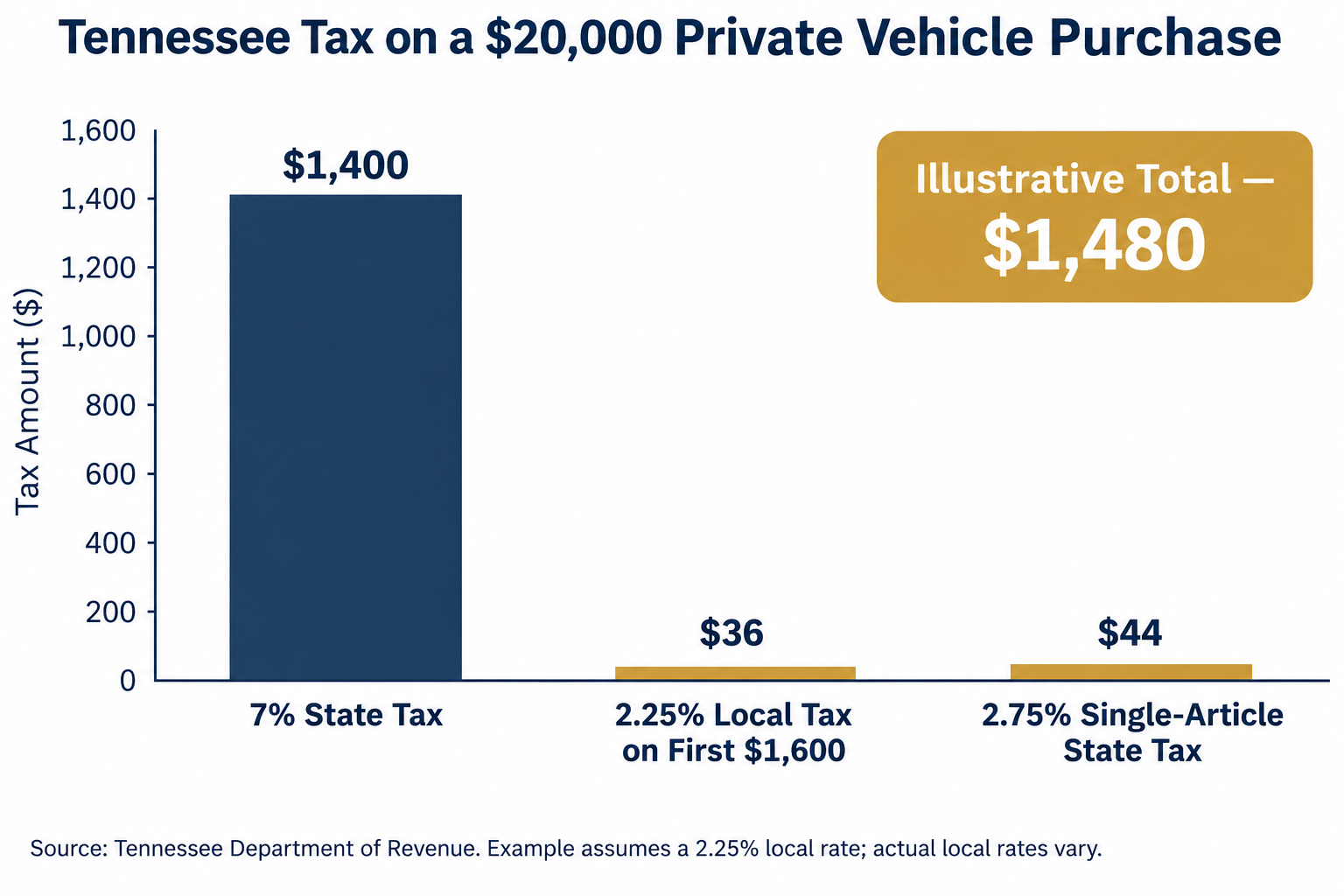
Example: $20,000 Tennessee Private Purchase
Assume:
Vehicle purchase price: $20,000.
Local rate: 2.25%.
The calculation would be:
State tax:
$20,000 × 7% = $1,400
Local tax:
$1,600 × 2.25% = $36
Additional state single-article tax:
$1,600 × 2.75% = $44
Illustrative total:
$1,480
The actual local amount depends on the applicable jurisdiction.
Use the county clerk’s final calculation for the transaction.
A Low Sale Price Can Trigger Additional Paperwork
Tennessee uses the Affidavit of Non-Dealer Transfers of Motor Vehicles and Boats for several special transactions.
The form specifically addresses:
Qualifying family transfers.
Gifts.
Vehicles sold at a low price.
For this form, Tennessee defines a low selling price as 75% or less of fair market value.
When a vehicle is legitimately sold cheaply because it has serious defects, document the reason.
Useful supporting evidence can include:
Repair estimates.
Damage photographs.
Diagnostic reports.
Tow receipt.
Mechanic’s written findings.
Detailed bill of sale.
Do not create a fake low price simply to reduce tax.
Which Family Transfers Are Tax-Exempt?
Tennessee provides an exemption for qualifying transfers without taxable consideration involving certain relatives.
The state includes transfers involving:
Spouses.
Siblings.
Parents and children.
Grandparents and grandchildren.
Great-grandparents and great-grandchildren.
Spouses of qualifying lineal relatives.
A true gift can also qualify when the giver receives no money, property, service, debt forgiveness or other consideration.
The Affidavit of Non-Dealer Transfers is required to establish the exemption.
Do not use a $1 sale price to represent a genuine gift.
Tennessee Plates Follow the Owner
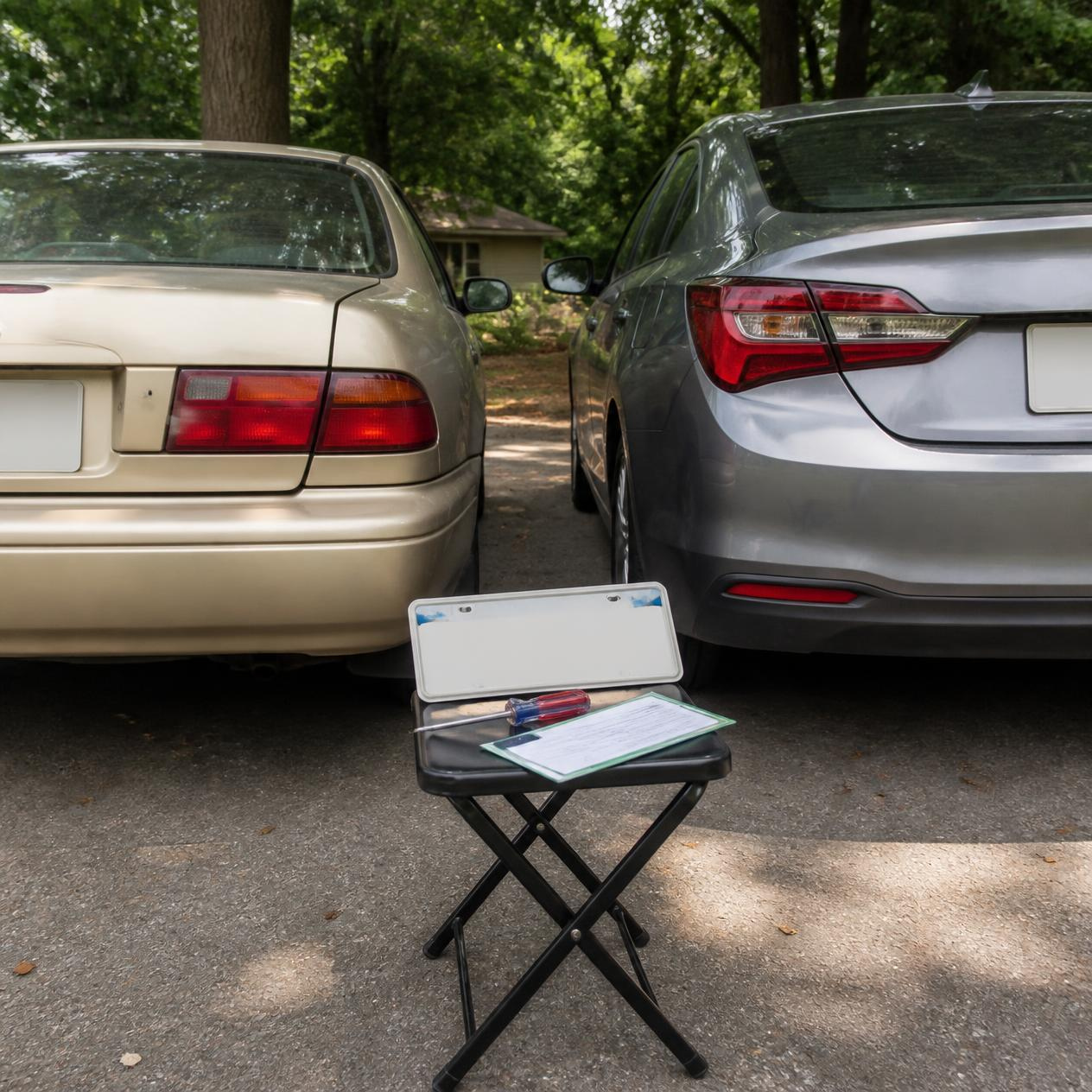
Tennessee license plates follow the owner, not the sold vehicle.
The seller removes the plate after transferring the vehicle.
The plate can be transferred to another qualifying vehicle for $1 through the county clerk.
This protects the seller from leaving an active registration identifier attached to a vehicle now controlled by someone else.
The buyer obtains:
A new Tennessee plate; or
Transfers an eligible plate already belonging to the buyer.
The official rule is published through Tennessee Department of Revenue — Surrendering a License Plate.
Current Title and Plate Fees
The standard Tennessee title fee is $11.
The regular passenger plate base amount is $26.50, although county clerk and local charges can affect the final total.
A qualifying registration transfer costs $1.
Local wheel or privilege taxes can also apply.
Do not assume that $37.50 represents the complete title-and-registration cost everywhere in Tennessee.
Tennessee No Longer Has a Vehicle Emissions Testing Program
Tennessee formerly required emissions testing in several counties.
Those programs ended.
State legislative fiscal documentation confirms that the remaining emissions programs ceased operations in 2022, leaving no vehicle emissions-testing program operating in Tennessee in subsequent fiscal years.
A current private buyer therefore does not complete a routine Tennessee emissions test as part of the normal title and registration transaction.
The buyer should still arrange an independent mechanical inspection.
Odometer Disclosure Still Matters
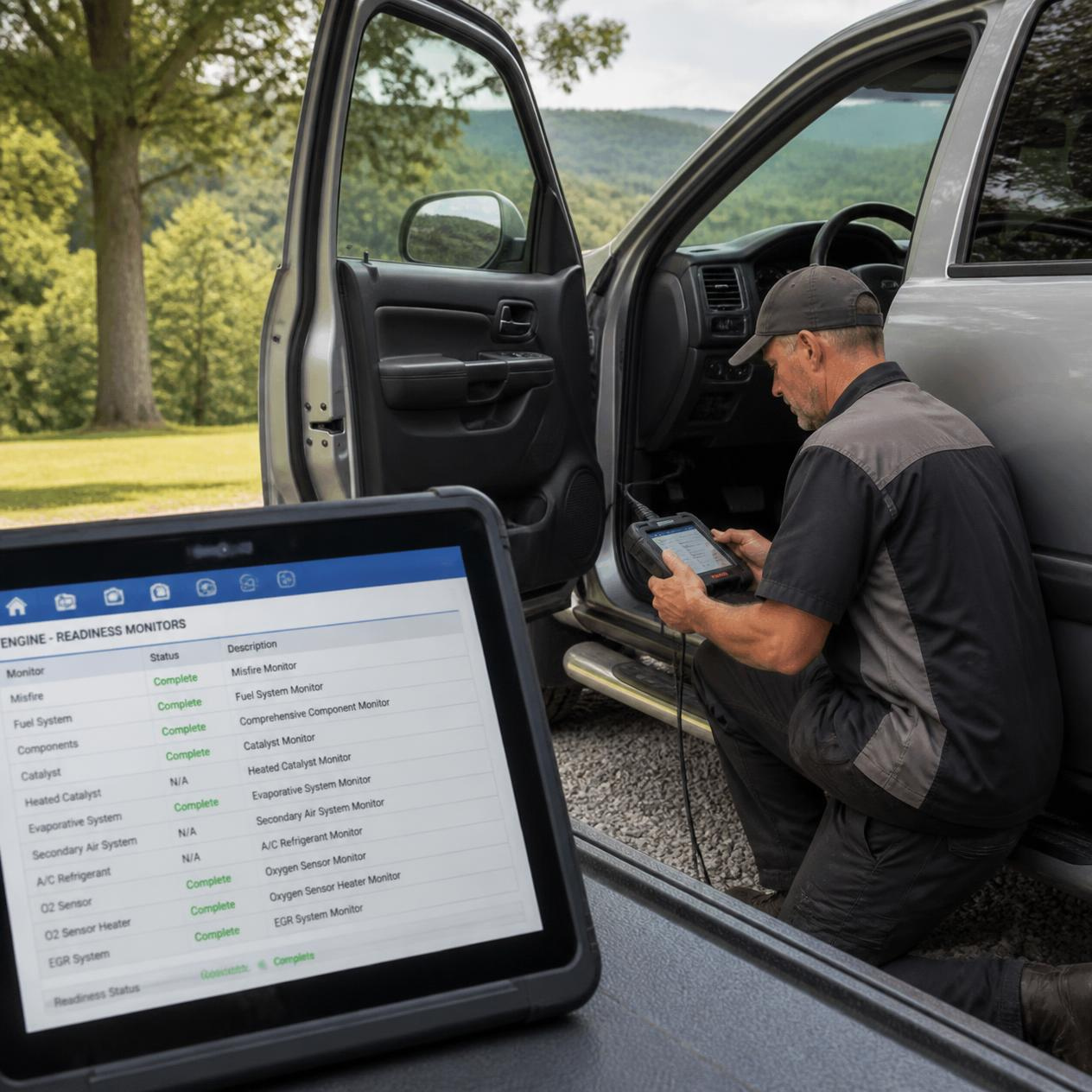
Tennessee requires odometer disclosure when applicable.
For a conforming title, mileage is normally entered directly on the assignment.
A nonconforming title can require a separate odometer statement.
Federal rules generally maintain the disclosure requirement for model-year 2011 and newer vehicles for 20 model years.
The mileage on the title and bill of sale should match.
Correct Title Errors Before Filing
Do not use whiteout on a Tennessee certificate of title.
Tennessee states that whiteout or erasure used during the ownership assignment automatically voids the certificate.
Certain minor misspellings can be corrected by drawing a line through the incorrect information and supplying a notarized statement from the party who made the error.
When the error is substantial, the seller may need to obtain a duplicate title.
This is another reason to complete the title slowly and compare it with the bill of sale before signing.
KarKiosk’s Oklahoma Bill of Sale guide covers a different neighboring-state system involving electronic titles, Form 718 and three separate registration milestones.
What If the Seller Cannot Provide a Proper Title?
Do not assume a notarized bill of sale solves the problem.
Tennessee has special procedures for vehicles lacking normal ownership evidence, including surety-bond and certification processes in qualifying cases.
These processes can require:
Evidence tracing the ownership history.
VIN verification.
Bill of sale.
Notarized seller statements.
Vehicle appraisal.
Photographs.
Additional Department of Revenue review.
The buyer should establish eligibility before handing over payment.
How to Complete a Tennessee Private Vehicle Sale
Confirm that the seller is named on the title.
Compare the VIN on the vehicle with the title.
Check for an active lien.
Complete the title assignment.
Record the actual odometer reading.
Complete a detailed bill of sale.
Complete the Affidavit of Non-Dealer Transfers when the transaction is a gift, family transfer or low-price sale.
Have the seller remove the Tennessee plate.
Take the assigned title and supporting documents to the county clerk.
Pay the state, local and single-article tax due.
Pay title, registration and applicable local charges.
Common Tennessee Private-Sale Mistakes
Treating a notarized bill of sale as proof of ownership.
Accepting an open title.
Using whiteout on the title.
Reporting a false low sale price.
Failing to complete the non-dealer affidavit for a low-price transfer.
Treating a genuine gift as a $1 sale.
Leaving the seller’s Tennessee plate on the vehicle.
Calculating tax as simply 7% and ignoring local and single-article components.
Using outdated information that says emissions testing is still required.