
Seller Guide Oct 19, 2026
Rhode Island requires a bill of sale for a private vehicle purchase. The buyer also needs the properly assigned title or acceptable previous-ownership evidence, Rhode Island insurance, tax paperwork and registration documents.
Rhode Island changed its title system in 2024. All used vehicles can now receive a Rhode Island title, while out-of-state used vehicles require a municipal police VIN inspection regardless of model year.
Download the free KarKiosk vehicle bill of sale PDF before payment and vehicle handover. It gives both parties one signed record of the VIN, mileage, price and sale date that can be kept with Rhode Island’s title and tax documents.
Rhode Island Requires the Bill of Sale With the Ownership Documents
Rhode Island DMV tells a private buyer to bring a bill of sale when registering the vehicle.
The seller should include:
Vehicle year.
Make and model.
Full VIN.
Vehicle color.
Purchase price.
Buyer’s name.
Seller’s name and address.
Sale date.
Seller’s signature.
For a model-year 2001 or newer vehicle, the seller must also properly assign the certificate of title to the buyer and record the current mileage.
The current private-sale checklist is available from Rhode Island DMV — New Registration.
A bill of sale does not cure an invalid ownership chain. The seller must have acceptable title or ownership evidence.
Rhode Island Private Vehicle Sale Rules
Item | Rhode Island Rule |
Bill of sale | Required for private-party registration |
Title for 2001+ vehicle | Seller assigns title to buyer |
All vehicles titled going forward | Yes, under the post-2024 title system |
Out-of-state used vehicle | Municipal police VIN inspection required |
Private-sale tax | 7% |
Tax deadline | 20th day of the month following purchase month |
New or transfer title fee | $53.50 |
Temporary registration | $13.50 |
Private-party plate transfer | Existing qualifying plates may be used for 30 days |
Newly registered used vehicle inspection | Within 5 days unless valid RI inspection applies |
Light-duty inspection cycle | At least every 24 months |
Standard bill-of-sale notarization | Not generally required |
Rhode Island’s 2024 Title Change Still Matters in 2026
Before January 1, 2024, Rhode Island generally did not issue titles to model-year 2000 and older vehicles.
That system changed.
Rhode Island now issues titles to vehicles regardless of model year when the applicable title and registration transaction is completed.
The ownership paperwork still depends on the seller’s existing record.
Older Rhode Island Vehicle Already Owned Before 2024
A model-year 2000 or older Rhode Island vehicle first registered to the seller before January 1, 2024 may still be supported by:
Bill of sale.
Seller’s valid previous registration.
Paid sales-tax documentation.
Other acceptable ownership evidence.
Older Vehicle Titled Under the New System
When the seller obtained a Rhode Island title on or after January 1, 2024, the seller must assign that title to the buyer along with the bill of sale.
The buyer should not assume that “old vehicle” automatically means “no title required.”
Out-of-State Vehicles Need a Police VIN Inspection
Rhode Island requires all used vehicles coming from another state to receive a VIN inspection from a local municipal police department.
The rule applies regardless of model year.
For a vehicle from a state that issued a title, the buyer needs:
Title in the seller’s name.
Proper assignment to the buyer.
VIN inspection.
Bill of sale.
Registration and tax documentation.
For a vehicle from a jurisdiction that did not issue a title for that vehicle, the buyer needs acceptable ownership evidence in the seller’s name plus the VIN inspection.
This is one of the clearest differences between Rhode Island and states such as Oregon. The Oregon Bill of Sale guide covers Oregon’s different title and sale-notification system.
Does the Rhode Island Bill of Sale Need to Be Notarized?
A normal Rhode Island private-sale bill of sale does not carry a general notary requirement.
The seller signs the bill of sale and provides the required address and vehicle information.
Notarization becomes relevant in special transfers.
A vehicle gifted by someone outside the state’s immediate-family definition generally requires:
A signed and notarized gift letter.
Gift affidavit.
Supporting ownership documents.
An absent co-owner can also create additional signature or notarization requirements on registration documents.
Do not add unnecessary notarization to the basic sale simply because some gift transactions require it.
Rhode Island Charges 7% Tax on Private Vehicle Purchases
Rhode Island’s private-party vehicle tax rate is 7%.
The taxable value depends partly on the age and classification of the vehicle.
For a vehicle seven years old or newer, Rhode Island generally calculates the tax using the higher of:
Purchase price.
NADA Clean Retail book value.
For a vehicle 8 through 29 years old, tax is generally based on the purchase price unless the vehicle appears on the state’s Cars of Particular Interest list.
Vehicles 30 years old or older and designated collectible vehicles can be subject to separate valuation rules.
See the current official tax rules at Rhode Island DMV — Vehicle Sales Tax.
The Tax Has Its Own Deadline
Rhode Island does not let the buyer postpone tax indefinitely simply because registration has not been completed.
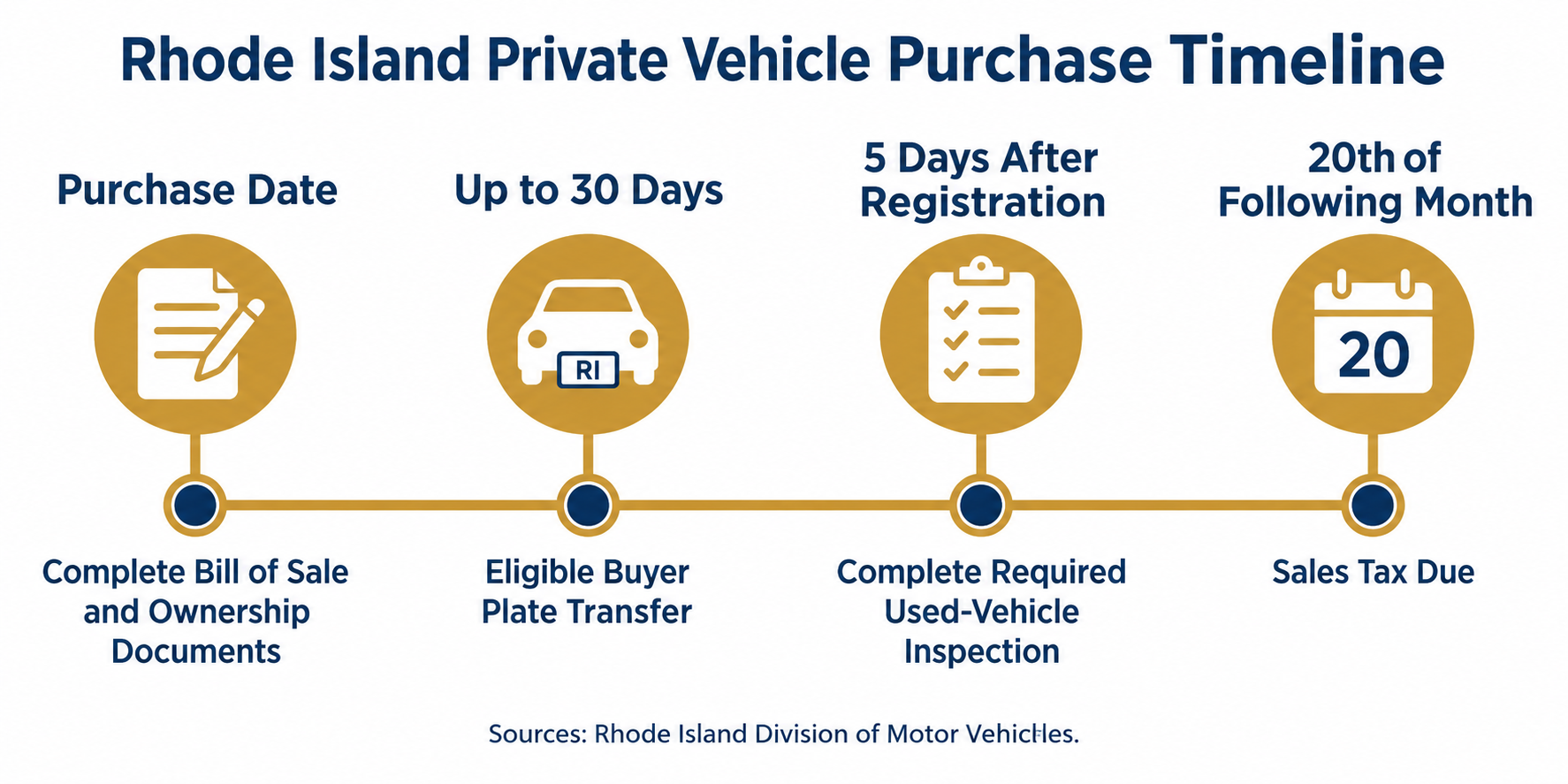
Vehicle sales tax must generally be paid by the 20th day of the month following the month of purchase.
For example, a vehicle purchased September 8 has a tax-payment deadline of October 20.
Interest and penalties can begin after the deadline.
The buyer can pay the tax through DMV during titling or registration or pay it separately through the Rhode Island Division of Taxation when necessary.
Rhode Island Title and Registration Costs
The current title fee is $53.50.
Rhode Island also lists:
Temporary registration: $13.50.
Duplicate title: $53.50.
Transfer title: $53.50.
Passenger registration: calculated mainly from vehicle weight.
Transportation-related registration surcharge: applies according to current DMV rules.
Credit-card service fees: additional when applicable.
The title and registration fee schedule was updated in June 2026.
For current amounts, use Rhode Island DMV — Registration and Title Fees.
Existing Rhode Island Plates Can Follow the Buyer to the Replacement Car
Rhode Island allows a person replacing a previously registered vehicle to temporarily use that registration and plates on the replacement vehicle when:
The registered owner remains the same.
The vehicle type remains the same.
Other registration requirements are satisfied.
For a private-party purchase, the temporary transfer period is 30 calendar days from the bill-of-sale date.
This is not permission to use the seller’s plates.
The buyer uses qualifying plates already registered to the buyer.
The seller should retain plates registered in the seller’s name unless they are being surrendered or otherwise handled through DMV.
A Temporary Plate Has a Narrow Use
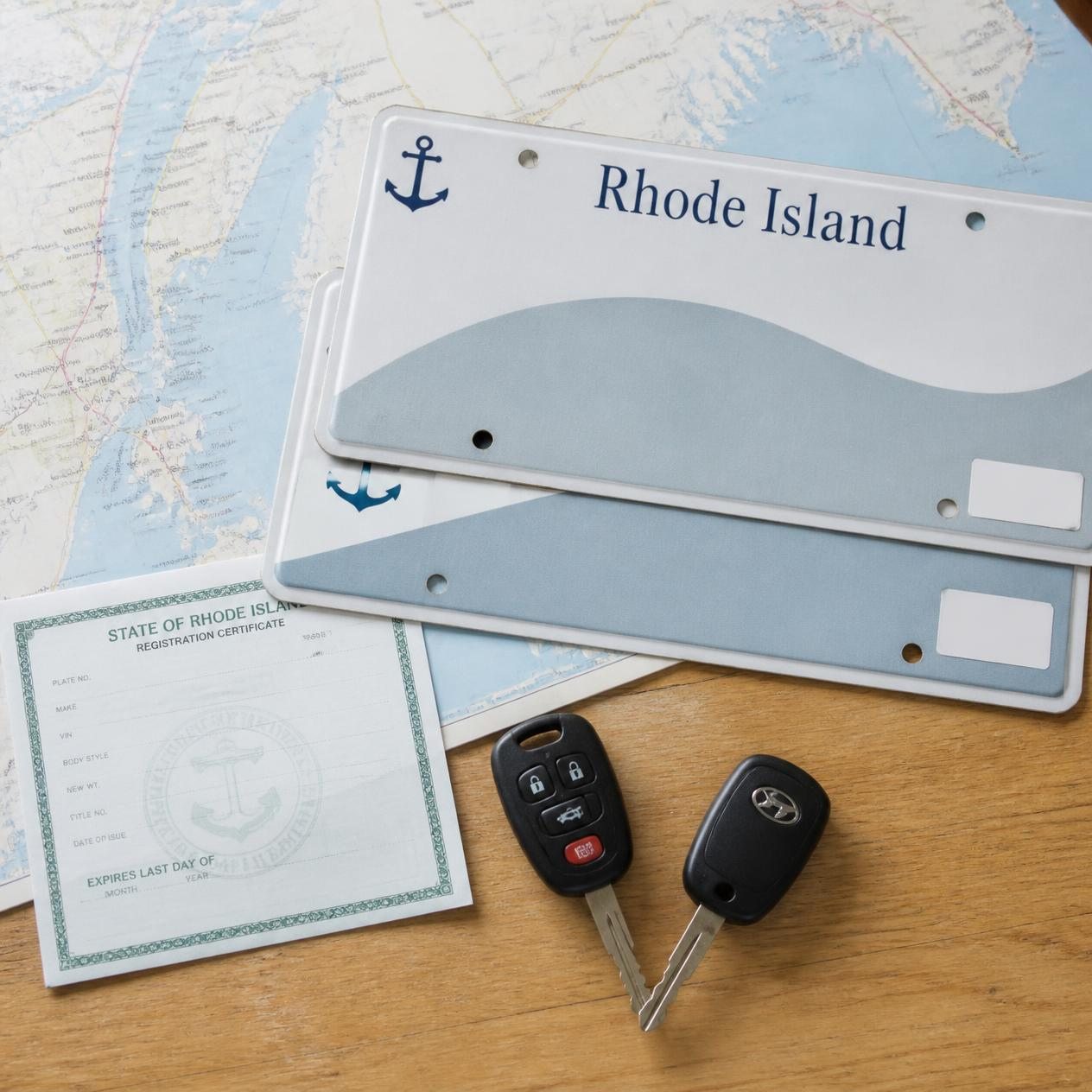
Rhode Island issues a five-day temporary plate in certain private-sale situations involving an out-of-state vehicle that needs a VIN inspection.
The buyer generally needs:
Bill of sale.
Out-of-state title.
Proof of insurance.
Rhode Island licence or acceptable residency documentation.
This temporary plate is intended to help the buyer complete the required VIN-inspection process.
It should not be treated as a general five-day plate available for every private sale.
Newly Registered Used Vehicles Have a Five-Day Inspection Rule
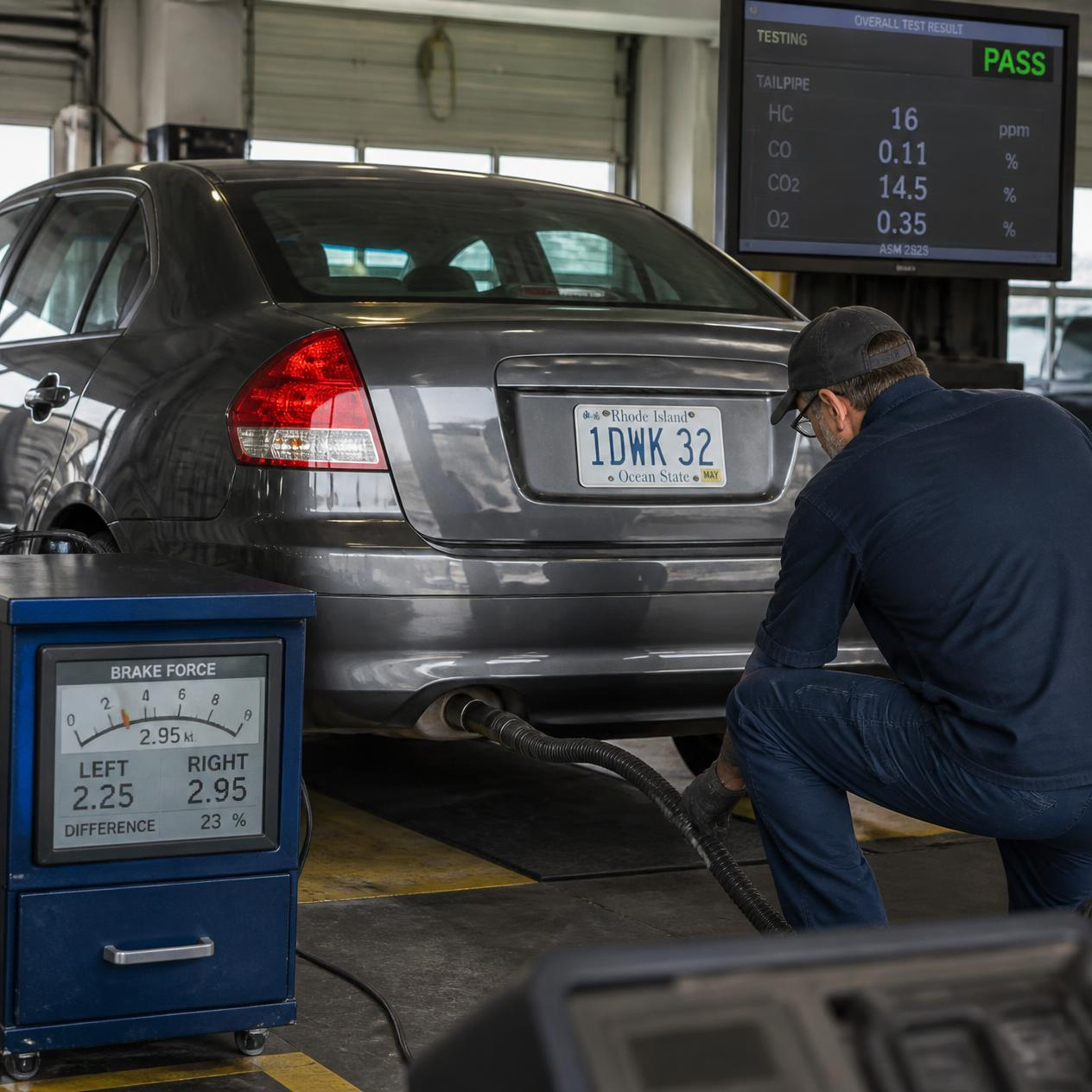
A newly registered used vehicle must either have a valid Rhode Island inspection certificate or pass the Rhode Island Safety and Emissions Inspection within five days after registration.
Failure can result in registration suspension until the vehicle complies.
Light-duty vehicles and light-duty trucks weighing 8,500 pounds GVWR or less generally receive a combined safety and emissions inspection at least every 24 months.
The current fee is $55 for the two-year light-duty safety and emissions inspection.
Fully electric light-duty vehicles still undergo safety inspection but are exempt from the emissions portion.
New vehicles are exempt for two years from purchase or until they reach 24,000 miles, whichever comes first.
Gifted Vehicles Have Different Documentation
Rhode Island exempts qualifying gifts from vehicle sales tax.
Immediate family for the state’s tax treatment includes:
Parent.
Stepparent.
Sibling.
Stepsibling.
Spouse.
Child.
Stepchild.
A signed gift letter is required.
A gift from a non-immediate family member requires a notarized gift letter and gift affidavit.
Do not put an artificial $1 price on a genuine gift.
Use the gift documentation.
What If the Title Is Missing?
A seller of a titled Rhode Island vehicle should obtain a duplicate title before completing the sale.
Rhode Island DMV warns that duplicate-title processing can take substantial time in some circumstances.
The buyer should not pay for a titled vehicle solely on the seller’s promise that the title will be found later.
A bill of sale proves that money changed hands. It does not automatically establish a clean ownership chain.
The same principle appears in KarKiosk’s New York Bill of Sale guide, although New York uses a different proof-of-sale and proof-of-ownership system.
How to Complete a Rhode Island Private Sale
Confirm the seller’s ownership documentation.
Compare the VIN with the vehicle.
Complete the title assignment when the vehicle has a title.
Complete a detailed bill of sale.
Record the current odometer reading.
Obtain valid Rhode Island insurance.
Complete a police VIN inspection for an out-of-state used vehicle.
Submit the TR-1 and tax paperwork.
Pay the 7% sales tax by the applicable deadline.
Complete the required inspection within five days after registration when applicable.
Confirm the seller’s ownership documentation.
Compare the VIN with the vehicle.
Complete the title assignment when the vehicle has a title.
Complete a detailed bill of sale.
Record the current odometer reading.
Obtain valid Rhode Island insurance.
Complete a police VIN inspection for an out-of-state used vehicle.
Submit the TR-1 and tax paperwork.
Pay the 7% sales tax by the applicable deadline.
Complete the required inspection within five days after registration when applicable.
Common Rhode Island Private-Sale Mistakes
Buying a vehicle without a bill of sale.
Assuming an old vehicle can never have a Rhode Island title.
Skipping the VIN inspection on an out-of-state used vehicle.
Calculating tax only from a low stated purchase price on a newer vehicle.
Missing the tax deadline.
Using the seller’s plates.
Confusing the five-day VIN temporary plate with the five-day post-registration inspection rule.
Assuming an electric vehicle is exempt from the safety inspection.