
Seller Guide Oct 19, 2026
Oregon provides Form 735-501 as its official Vehicle Bill of Sale, but the form does not replace a valid certificate of title when a title is required. The seller must notify DMV of the sale within 10 days, while the buyer has 30 days from the purchase date to submit the Oregon title application before late-transfer fees begin.
Oregon also differs from many states because it has no general sales tax. The buyer still pays title, registration, plate, county and possible emissions-related costs.
Download our free vehicle bill of sale PDF before the vehicle changes hands. It gives both parties a separate record of the VIN, sale price, mileage and transaction details to keep with Oregon’s title paperwork.
Oregon Form 735-501 Records the Transfer
Oregon’s official Vehicle Bill of Sale is Form 735-501.
The current form records:
Vehicle identification number.
Plate number.
Vehicle year and make.
Title number.
Buyer’s printed name and address.
Purchase date.
Seller’s printed name and address.
Seller’s original signature.
Date the seller releases interest.
The seller must use blue or black ink. Oregon DMV instructs users not to white out or strike through names and requires an original seller signature rather than a photocopy.
Use the official Oregon DMV guidance for current private-sale requirements: Oregon DMV — Buying or Selling a Vehicle
A Bill of Sale Does Not Automatically Replace the Title
The certificate of title remains the primary ownership document for a normally titled Oregon vehicle.
The seller should give the buyer the title with every owner and lienholder interest properly released.
A bill of sale becomes especially important when the immediate seller’s name is not shown on the title. Oregon DMV directs the buyer to obtain a bill of sale from that person containing at least:
VIN.
Statement releasing the seller’s interest.
Seller’s printed name.
Seller’s signature.
Date of sale.
DMV cannot process an incomplete bill of sale in this situation.
Do not buy a vehicle through an unexplained chain of signed titles and receipts. Resolve the ownership chain before payment.
Oregon Private-Sale Rules at a Glance
Item | Oregon Rule |
Official bill of sale | Form 735-501 |
Seller DMV notice | Within 10 days |
Buyer title application | Within 30 days |
Late transfer, days 31–60 | $25 |
Late transfer after 60 days | $50 |
General state sales tax | None |
Light-vehicle trip permit | $35 for 21 consecutive days |
Passenger title fee | $101–$192 depending on MPG/fuel type |
Standard two-year passenger registration | $126–$376 depending on MPG/fuel type and OReGO status |
Routine emissions testing | Portland and Medford program areas when applicable |
Standard bill-of-sale notarization | Not required |
The Seller Has 10 Days to Notify Oregon DMV
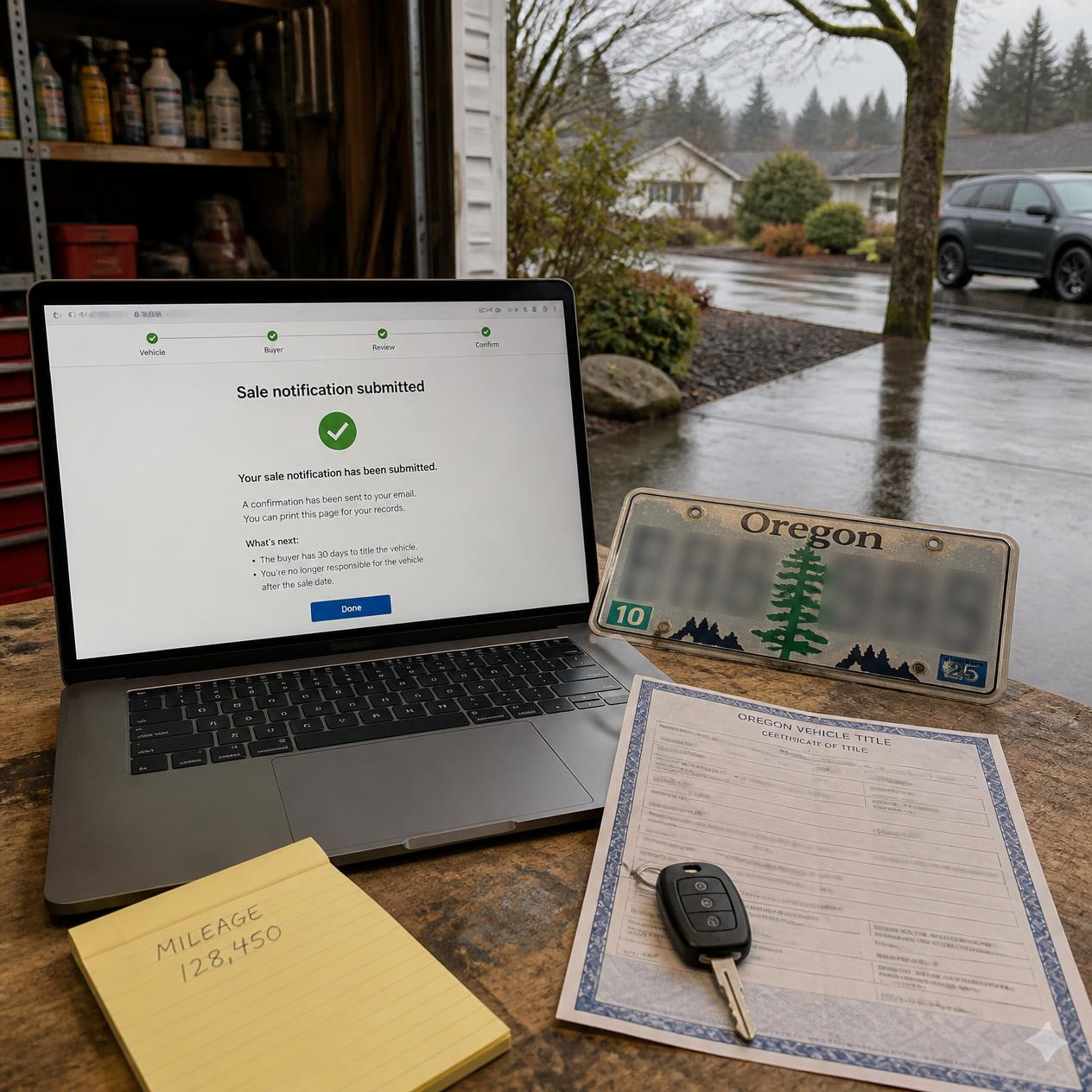
The seller must notify Oregon DMV within 10 days after the sale.
The notice can be submitted through DMV2U or by using Form 735-6890, Notice of Sale or Transfer of a Vehicle.
The notice records that the seller transferred the vehicle, but it does not itself change the legal owner shown in DMV records. The seller remains listed as the owner until the buyer completes the title transfer.
The seller should report:
Vehicle VIN.
Plate number.
Year and make.
Buyer’s name and address.
Sale date.
Seller’s identifying information.
Keep the sale-notification confirmation with the bill of sale and a copy of the assigned title.
For comparison, KarKiosk’s Ohio Bill of Sale guide uses a very different system because Ohio relies heavily on notarized title assignments.
The Buyer Has 30 Days to Apply for Title
The buyer has 30 days from the date of sale to submit the title application.
Oregon charges:
$25 when an Oregon-titled vehicle is transferred 31–60 days after the sale.
$50 when the transfer occurs more than 60 days after the sale.
The late fee is separate from the normal title and registration charges.
The title application can be submitted through an Oregon DMV office or by mail when the transaction qualifies.
Do not treat the 30-day title deadline as permission to operate an unregistered vehicle for 30 days.
Oregon Does Not Require Standard Bill-of-Sale Notarization
Form 735-501 does not contain a notarial acknowledgement.
A normal private vehicle bill of sale therefore does not need to be notarized solely because the transaction occurs in Oregon.
Special documents may have different requirements. A power of attorney, estate document, affidavit, bonded-title application or court-related ownership transfer can require additional signatures or verification.
The seller’s original signature matters more than notarization on Form 735-501. DMV specifically states that photocopied seller signatures are not acceptable.
Odometer Disclosure Applies to Covered Vehicles
Oregon requires an odometer disclosure for a model-year 2011 or newer vehicle while it remains within the federal 20-year disclosure period.
Both buyer and seller sign the odometer disclosure.
When a covered vehicle has a lost title, Oregon DMV advises the owner to obtain a replacement title before selling it.
The odometer entry should show the actual dashboard reading and the correct mileage status.
Do not estimate the mileage from service records or an online listing.
Oregon Has No General Vehicle Sales Tax
Oregon does not impose a general sales or use transaction tax on an ordinary in-state private vehicle sale.
That does not mean the transaction is fee-free.
The buyer can still owe:
Title fee.
Registration fee.
New plate fee.
Plate-transfer fee.
County registration fee.
DEQ testing fee when applicable.
Trip-permit fee when needed.
Oregon does have a vehicle use tax for certain new vehicles purchased outside Oregon, but that is different from the ordinary used private-sale transaction discussed here.
Oregon Title Fees Depend on Fuel Economy
Oregon uses the vehicle’s combined MPG rating and fuel type to determine many passenger-vehicle title and registration charges.
Current passenger title fees are:
0–19 MPG: $101.
20–39 MPG: $106.
40 MPG or higher: $116.
All-electric: $192.
Regular passenger registration is normally valid for two years.
Current standard two-year amounts include:
0–19 MPG: $126.
20–39 MPG: $136.
40 MPG or higher, not enrolled in OReGO: $216.
All-electric, not enrolled in OReGO: $376.
New passenger plates add $26. Moving eligible Oregon plates to another vehicle costs $30. County registration fees may also apply.
Use the current government fee schedule before publishing a final transaction estimate: Oregon DMV — Vehicle Title and Registration Fees
The Seller Can Remove the Oregon Plates
Oregon does not require every seller to leave the plates with the sold vehicle.
DMV specifically states that a seller may remove the license plates before selling the vehicle. Removing them can reduce the risk that later parking tickets, toll charges or towing activity are associated with the seller’s plates.
When the seller removes the plates, the buyer must obtain valid registration or another legal operating authority before driving normally.
The seller should still file the 10-day sale notice even when the plates are removed.

A 21-Day Trip Permit Can Cover Temporary Road Use
A light-vehicle trip permit allows temporary operation of an eligible unregistered passenger vehicle.
The permit costs $35 and lasts for 21 consecutive days.
It can be used for passenger vehicles weighing 10,000 pounds or less, along with several other qualifying light vehicle categories. Oregon limits a vehicle to two such permits in a 12-month period.
The permit does not extend the 30-day title deadline.
It only provides temporary operating authority.
Portland and Medford Have Emissions Requirements
Oregon does not use one statewide emissions test for every privately purchased vehicle.
Testing applies primarily within the Portland and Medford metropolitan testing boundaries.
In Portland, the program generally covers 1975 and newer gasoline, alternative-fuel and hybrid passenger vehicles, plus qualifying light-duty diesel vehicles.
In Medford, the program generally covers qualifying vehicles 20 years old or newer.
Newer model-year vehicles receive an exemption. For calendar year 2026, qualifying newer vehicles include model years 2023 through 2027 under the specific DEQ registration conditions. Fully electric vehicles are also exempt.
Check the vehicle’s registration address rather than assuming that living near Portland or Medford automatically places it inside the testing boundary.
Official testing information is available here: Oregon DEQ — Vehicle Inspection Program

What If the Seller Still Has a Loan?
A seller cannot complete a normal clean-title transfer while an unreleased lien remains.
Oregon DMV instructs sellers to ensure that the lienholder has released its interest.
When the loan remains active:
Obtain the lender’s payoff amount.
Confirm who controls the title.
Arrange payoff with the lender.
Obtain the lien release.
Complete the sale only after the ownership documents can be properly released.
A bill of sale by itself does not remove the lender’s interest.
What If the Title Is Missing?
The owner should normally obtain a replacement title before selling a vehicle that requires one.
This is especially important for model-year 2011 and newer vehicles that remain subject to odometer disclosure.
Do not rely on a generic bill of sale to solve a missing-title problem.
A buyer considering a vehicle without the expected title should confirm the exact DMV ownership process before paying the seller.
The ownership principles are similar to those discussed in KarKiosk’s North Dakota Bill of Sale guide, although North Dakota uses its own 2026 private-party form and tax system.
How to Complete an Oregon Private Sale
Match the VIN on the vehicle with the title.
Confirm that the seller is an owner shown on the title.
Obtain releases from every owner and lienholder.
Complete the title assignment.
Complete Form 735-501 or another qualifying bill of sale.
Record the odometer disclosure when required.
Decide whether the seller will remove the plates.
Have the seller notify DMV within 10 days.
Obtain a trip permit when the vehicle cannot yet be legally registered.
Have the buyer submit the title application within 30 days.
Complete DEQ testing when the registration address and vehicle require it.
Match the VIN on the vehicle with the title.
Confirm that the seller is an owner shown on the title.
Obtain releases from every owner and lienholder.
Complete the title assignment.
Complete Form 735-501 or another qualifying bill of sale.
Record the odometer disclosure when required.
Decide whether the seller will remove the plates.
Have the seller notify DMV within 10 days.
Obtain a trip permit when the vehicle cannot yet be legally registered.
Have the buyer submit the title application within 30 days.
Complete DEQ testing when the registration address and vehicle require it.
Common Oregon Private-Sale Mistakes
Treating Form 735-501 as a universal replacement for the title.
Using a photocopied seller signature.
Making whiteout corrections on the bill of sale.
Buying from a seller whose name does not appear anywhere in the ownership chain.
Missing the seller’s 10-day DMV notice.
Missing the buyer’s 30-day title deadline.
Driving on removed or invalid plates without a trip permit.
Assuming Oregon’s lack of sales tax means there are no vehicle charges.
Ignoring Portland or Medford emissions requirements.