
Buyer Guide Oct 16, 2026
North Dakota’s current private-sale form is SFN 62502, Private Party Vehicle Bill of Sale, revised in April 2026. Now North Dakota bill of sale records the selling price, vehicle condition, gift relationship and trade information, but it does not replace the assigned certificate of title or the main title and registration application.
North Dakota uses two separate 30-day requirements. The seller has 30 days from purchase to deliver the endorsed title, and the buyer has 30 days after receiving that title to apply for a new certificate. Download the free North Dakota Bill of Sale to document your private vehicle sale and keep a clear record of the transaction.
Start With the Correct North Dakota Form
North Dakota uses several forms with similar titles. They are not interchangeable.
Form | Function | Replaces the Title? |
SFN 62502 | Records a normal private sale, price, condition, gift and trade | No |
SFN 2872 | Main Application for Certificate of Title and Registration | No; it accompanies ownership evidence |
SFN 2475 | Purchaser’s Certification and tax application | No; the form expressly says it cannot replace SFN 2872 |
SFN 2888 | Seller’s Certificate and Bill of Sale for a special title problem | No; additional approval and evidence may be required |
Assigned title | Transfers the seller’s ownership interest | Primary ownership document |
The current versions are available through the North Dakota Department of Transportation forms directory.
What Makes SFN 62502 Different?
The official SFN 62502 Private Party Vehicle Bill of Sale does more than record a price and signatures.
It asks:
Whether the vehicle was drivable.
Whether it was towed, hauled or delivered.
Whether another vehicle was traded.
Whether the trade was even.
The value and VIN of the trade.
The relationship between parties in a gift.
Why the selling price is below fair market value.
The buyer’s, co-buyer’s and sellers’ identifying information.
The condition section is important because North Dakota can review a reported price that is lower than fair market value.
“If the selling price is below fair market value, provide detailed information regarding the vehicle condition.”
— North Dakota Department of Transportation
The department may request repair estimates, photographs, towing records or other evidence supporting the stated price.
Does SFN 62502 Need to Be Notarized?
No. SFN 62502 contains buyer and seller signature lines but no notarial acknowledgement.
The signatures certify that the information is true. A false or fraudulent purchaser’s certification is a Class B misdemeanor punishable by a fine of up to $1,500, imprisonment for up to 30 days, or both.
Another bill-of-sale form can have a different rule. SFN 2888, Seller’s Certificate and Vehicle Bill of Sale, requires the seller to sign before a notary or authorized officer because it is designed for a special ownership-document problem.
North Dakota Bill of Sale Quick Facts
Question | North Dakota Rule |
Current private-party bill of sale | SFN 62502, revised 4-2026 |
Is it the ownership document? | No |
Standard bill-of-sale notarization | Not required for SFN 62502 |
Seller’s title-delivery period | 30 days from purchase |
Buyer’s title-application period | 30 days after receiving the title |
Motor Vehicle Excise Tax | 5% |
Local motor vehicle sales tax | None |
Title fee | $5 |
Plate or registration-credit transfer | $5 |
Seller’s plates | Removed when ownership transfers |
Limited plate-free operation | Five days with prescribed dated ownership evidence |
Temporary registration | May be issued for up to 75 days |
The title deadlines come from North Dakota Century Code § 39-05-17, while plate and temporary-operation rules come from § 39-04-36.
What Must the Seller Complete on the Title?
The seller must endorse the assignment and warranty of title and include:
Buyer’s legal name.
Selling price, when applicable.
Sale date.
Required seller signatures.
Odometer information when applicable.
Lien information or release.
When the title identifies co-owners with “and,” the required sellers must sign. The title must not contain unexplained alterations or erasures.
A separate bill of sale cannot correct an open title or establish a valid transfer from a person who is not the titled owner.
What Does the Buyer Submit?
Document or Item | Purpose |
Properly assigned original title | Establishes the ownership transfer |
SFN 2872 | Applies for title and registration |
SFN 62502 | Documents the private transaction |
SFN 2475, when used | Certifies tax, exemptions and fees |
Lien release | Removes a satisfied lien |
Odometer or damage disclosure | Required for covered vehicles |
Proof of identity | Identifies the applicant |
Insurance certification | Required while the vehicle is operated |
Tax and fees | Completes the application |
SFN 2475 states that it must be submitted within 30 days and expressly warns that it cannot replace SFN 2872. The buyer also certifies that the vehicle is and will remain insured while being operated on public streets and highways.
The Two 30-Day Rules Are Not a 60-Day Driving Grace Period
North Dakota Century Code creates separate duties for the seller and buyer.
Seller: Deliver the Title Within 30 Days
The seller must provide the endorsed title to the buyer within 30 days from the purchase date.
A seller should normally deliver it when payment and possession are exchanged. The statutory period should not be used to postpone delivery without a valid reason.
Buyer: Apply Within 30 Days After Receiving the Title
The buyer must deliver the endorsed title to NDDOT, pay the $5 transfer fee and apply for a new title within 30 days after receiving the ownership document.
Failure can result in suspension or revocation of the vehicle’s registration. A violation of the title-transfer statute is a Class B misdemeanor.
These title periods do not authorize ordinary road use without registration or a valid temporary privilege.
How Does the 5% Excise Tax Work?
North Dakota collects a 5% Motor Vehicle Excise Tax instead of state and local sales tax on vehicles that must be registered for public-road use.
The tax is generally calculated on:
The vehicle’s taxable purchase price.
The selling price after a qualifying trade-in allowance.
Fair market value when the vehicle was not acquired through a purchase.
A reviewed value when the stated price is not supported.
No separate local motor vehicle tax is added. Title, registration, licence and document fees are not part of the taxable purchase price.
Example Tax Amounts
Taxable Amount | 5% Excise Tax |
$5,000 | $250 |
$10,000 | $500 |
$15,000 | $750 |
$20,000 | $1,000 |
$30,000 | $1,500 |
A low price written on SFN 62502 does not automatically control the tax calculation. The form specifically asks for condition information when the amount is below fair market value.
Which Family Gifts May Be Exempt?
SFN 2475 lists gift exemptions involving transfers from:
A spouse.
Parent.
Child.
Sibling.
Grandparent.
Grandchild.
The form asks the applicant to identify the relationship between all new owners. A transfer described as a gift can still be reviewed to confirm that no taxable payment, debt assumption or other consideration occurred.
What Title and Plate Fees Apply?
Charge | Amount |
Title fee | $5 |
Plate or registration-credit transfer | $5 |
Duplicate plate | $5 |
Special-request plate | $25 |
Motor Vehicle Excise Tax | 5% |
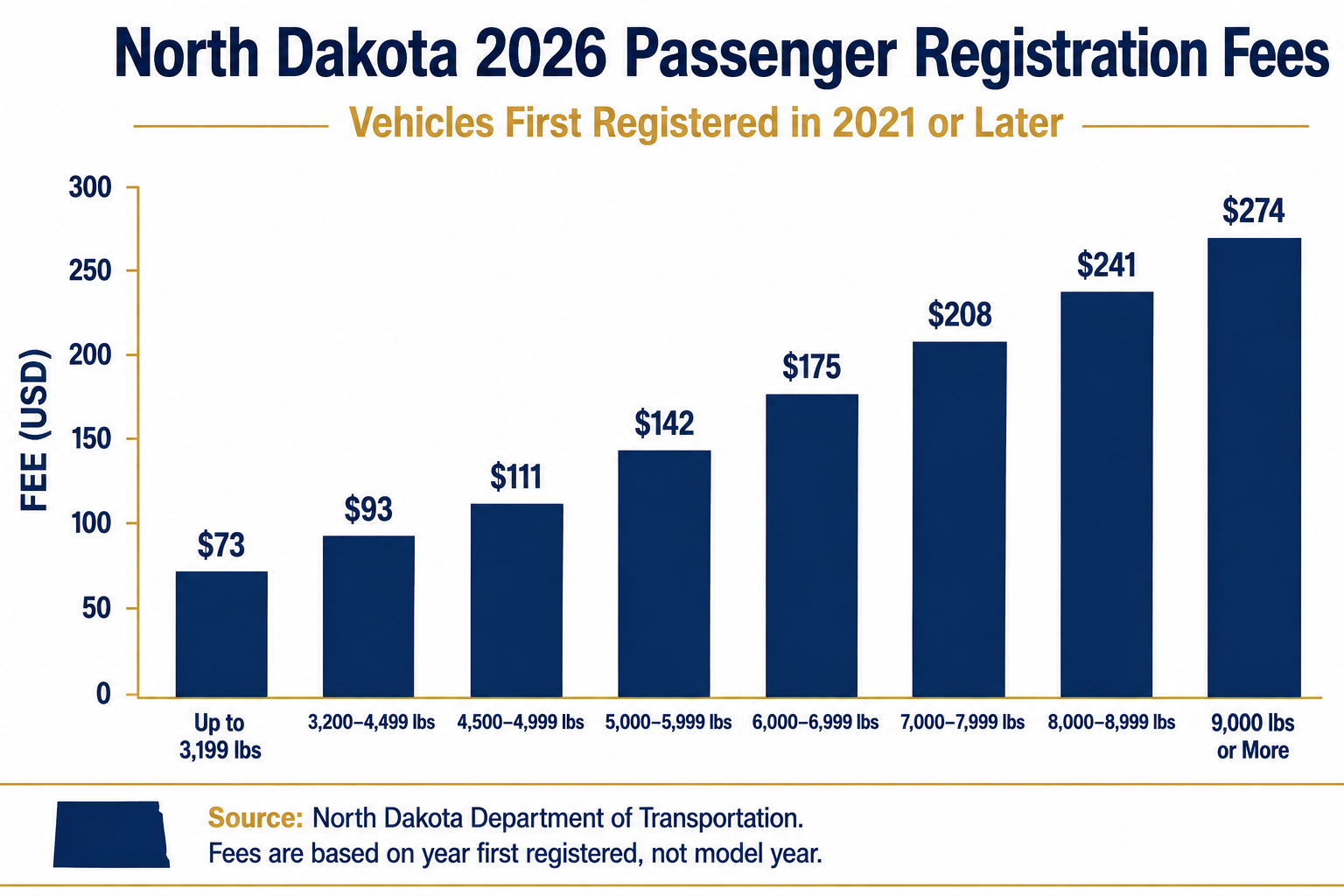
Passenger registration | Based on year first registered and vehicle weight |
Electric-vehicle road-use fee | $120 annually |
Plug-in hybrid road-use fee | $50 annually |
North Dakota’s registration schedule is unusual because the fee is based on the year the vehicle was first registered, not its model year.
The Seller Removes the Plates Immediately
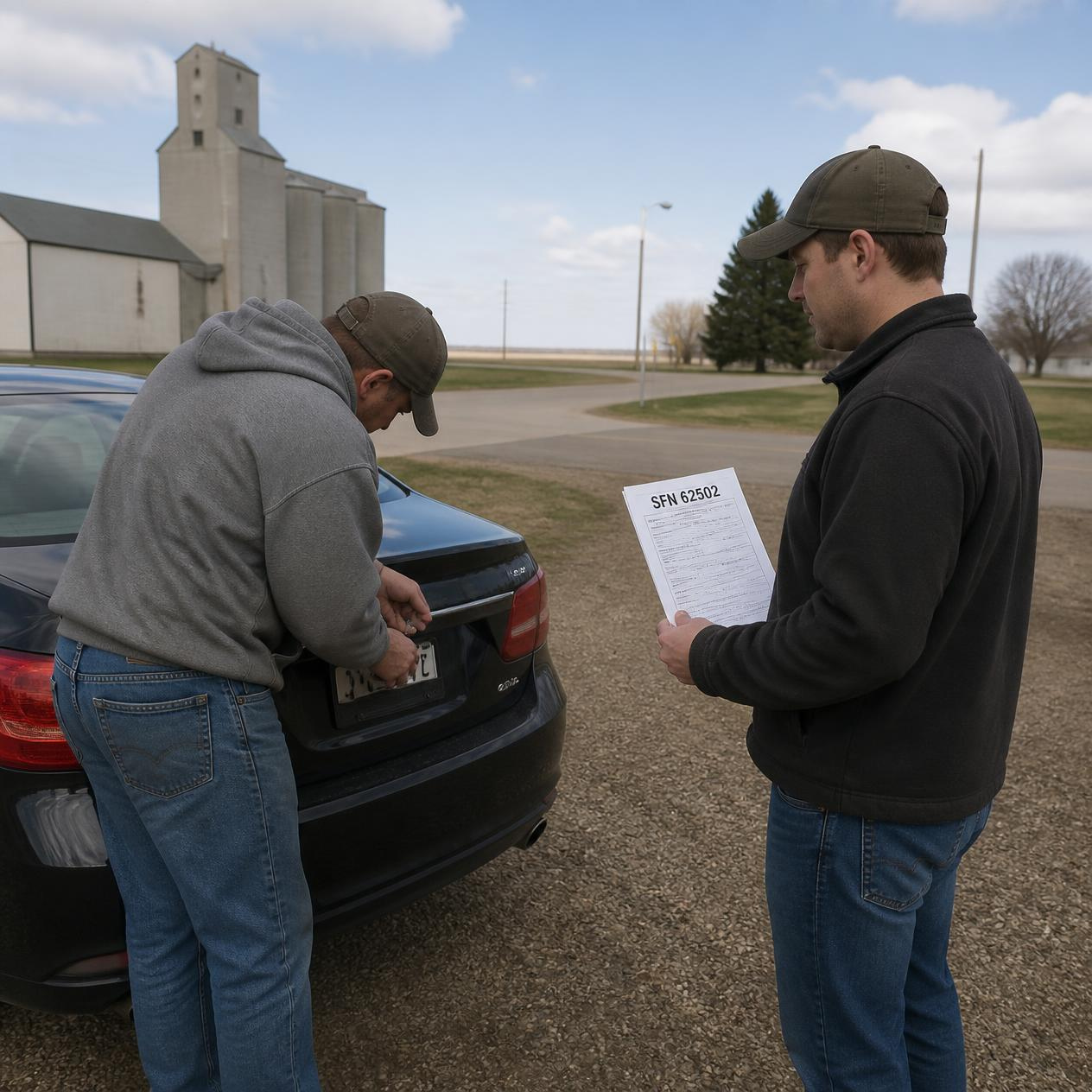
When ownership transfers, the previous registration expires and the seller removes the North Dakota plates.
The seller may transfer the plates and any eligible unused registration credit to a replacement vehicle. The transfer costs $5, and the seller generally applies within 30 days after purchasing the replacement.
The buyer should not use the seller’s plates.
Can the Buyer Drive Without Plates?
North Dakota allows limited operation for five days from the purchase date without a plate or certificate of ownership when the vehicle carries dated evidence of ownership in the form prescribed by NDDOT.
This is a narrow operating allowance, not a title deadline.
NDDOT may also issue a temporary registration certificate allowing operation for up to 75 days after acquisition. The buyer must follow the conditions printed on the permit.
The vehicle must remain insured while operating on public streets and highways.
What If the Seller Cannot Provide the Title?
SFN 62502 does not solve a missing-title problem.
North Dakota publishes SFN 2888, Seller’s Certificate and Vehicle Bill of Sale, for certain special ownership cases. It asks the seller to explain why the title cannot be furnished and includes a notarized acknowledgement.
The form does not guarantee that NDDOT will issue a title. The department can require further ownership evidence, inspections, records research or another title process.
A buyer should confirm eligibility with NDDOT before paying for a vehicle whose seller cannot produce the expected title.
When Is a Vehicle Inspection Required?
A normal private transaction does not use a routine reconstructed-vehicle inspection process.
A rebuilt salvage vehicle is different. North Dakota law requires an application for regular title to include the salvage title, the required inspection certificate and the applicable fee.
Assigned-VIN, specially constructed and other nonstandard vehicles can also require additional review. The inspection should be resolved before the transaction is treated as a routine private sale.
How to Complete a North Dakota Private Sale
Verify that the seller is named on the original title.
Compare the title VIN with the vehicle and SFN 62502.
Obtain a release for every recorded lien.
Complete the title assignment with the buyer and price.
Complete SFN 62502 with accurate condition and trade information.
Remove the seller’s plates.
Obtain insurance before public-road operation.
Use only the permitted five-day evidence or an issued temporary registration.
Submit the title application within 30 days after receiving the title.
Pay the 5% excise tax and applicable fees.
Verify that the seller is named on the original title.
Compare the title VIN with the vehicle and SFN 62502.
Obtain a release for every recorded lien.
Complete the title assignment with the buyer and price.
Complete SFN 62502 with accurate condition and trade information.
Remove the seller’s plates.
Obtain insurance before public-road operation.
Use only the permitted five-day evidence or an issued temporary registration.
Submit the title application within 30 days after receiving the title.
Pay the 5% excise tax and applicable fees.
Common North Dakota Bill of Sale Mistakes
Treating SFN 62502 as a substitute for the title.
Omitting condition details when the price is below market value.
Reporting a false gift or trade.
Using SFN 2475 instead of the main SFN 2872 application.
Assuming the two 30-day rules create 60 days of unrestricted driving.
Leaving the seller’s plates on the vehicle.
Driving after five days without registration or an authorized temporary certificate.
Using SFN 2888 without confirming eligibility for the special title process.