

Seller Guide Oct 19, 2026
Cash for Car is a vehicle-selling option where you receive a direct purchase offer instead of listing your car and waiting for a private buyer. KarKiosk lets sellers submit their vehicle information once, compare cash offers from participating buying partners, and decide which offer works for them.
KarKiosk also gives sellers the option to create a private listing and set their own asking price. The cash-offer route prioritizes speed and convenience, while a private sale provides more control over the selling price.
Get multiple cash offers through KarKiosk, compare the available options, and choose the offer that fits your vehicle and selling timeline.
What Does Cash for Car Mean?
Cash for Car means selling your vehicle directly to a professional vehicle buyer that is prepared to make a purchase offer based on its current value.
It differs from a valuation estimate. A valuation tells you approximately what a vehicle may be worth, while a cash offer tells you what a professional buyer is prepared to pay, subject to the offer terms and vehicle verification.
A typical process includes:
Identify the vehicle.
Provide mileage and condition details.
Provide title and ownership information.
Receive one or more cash offers.
Complete an inspection when required.
Review the final purchase amount.
Transfer ownership and receive payment.
“Cash” does not necessarily mean a buyer hands over physical currency. Professional vehicle buyers may pay through a business check, electronic transfer, ACH, or another verified payment method.
The exact payment method and timing should be confirmed before the title and vehicle are released.
Who Actually Gives Cash for Cars?
The buyer in a Cash for Car transaction is usually different from the consumer who responds to a private classified listing.
Professional automotive businesses actively purchase used vehicles because cars are inventory. They acquire vehicles, evaluate them, and determine whether they can resell them through retail, wholesale, auction, export, repair, or other remarketing channels.
Public filings from major U.S. automotive retailers confirm that purchasing vehicles directly from consumers is an established inventory-sourcing method. Professional buyers do not always require the seller to purchase another vehicle or complete a trade-in.
Common Cash for Car buyers include the following.
Franchised Car Dealers
A franchised dealership primarily represents one or more new-vehicle brands, but its used-car department usually sells vehicles from many manufacturers.
Dealers need a continuous supply of used cars.
They traditionally acquire vehicles through:
Customer trade-ins
Direct purchases from vehicle owners
Wholesale auctions
Other dealers
Fleet and leasing sources
A dealer can therefore make an offer for your vehicle even when you are not buying another car from that dealership.
If the vehicle fits the dealer's retail inventory requirements, the dealer may inspect, recondition, and sell it directly to another consumer.
Independent Used-Car Dealers
Independent dealerships are not tied to one new-vehicle manufacturer.
Many actively buy vehicles directly from the public to build inventory without relying entirely on wholesale auctions.
An independent dealer may be particularly interested when your vehicle matches local demand.
For example, a dealer that regularly sells affordable sedans may value a clean ten-year-old sedan differently from a business focused primarily on late-model luxury SUVs.
Inventory requirements affect offers.
Dedicated Vehicle-Buying Businesses
Some automotive companies operate specifically around acquiring vehicles from consumers.
Their process may include:
Online vehicle details
Initial valuation
Purchase offer
Vehicle inspection
Final offer
Pickup or drop-off
Payment
These companies may resell acquired vehicles through their own retail operations or other automotive channels.
They are different from an individual private buyer because acquiring cars is part of their normal business operation.
Dealer Buying Centers and Acquisition Teams
Some dealer groups operate dedicated vehicle-acquisition departments.
Their job is to buy used vehicles directly from owners, even when those owners are not purchasing another vehicle.
This helps dealerships obtain inventory without depending entirely on auctions.
A buying center may evaluate vehicles using current retail prices, wholesale values, local inventory, expected reconditioning expense, transportation cost, and the dealership's current demand for that model.
Wholesale and Remarketing Buyers
Not every vehicle purchased from a consumer eventually appears on the purchasing company's retail lot.
Some vehicles move into wholesale channels.
A professional buyer may purchase a vehicle and later sell it to:
Another licensed dealer
A wholesale automotive buyer
An auction buyer
A regional automotive business
A specialized reseller
This is especially common when the vehicle does not fit the original buyer's retail inventory requirements.
Specialty Buyers
Older, damaged, high-mileage, rebuilt, salvage, or non-running vehicles can have a different group of professional buyers.
These businesses may calculate value based on:
Repair potential
Parts demand
Wholesale demand
Export demand
Rebuild potential
Recycling value
A car does not need to qualify as premium retail inventory to have economic value.
Buyer type can therefore have a major effect on the offers available for the same vehicle.
Why Do Professional Buyers Pay Ready Cash for Cars?
Professional buyers purchase vehicles because they need inventory.
Buying directly from consumers can give a dealership or vehicle-buying business access to cars before those vehicles reach wholesale auctions.
The buyer calculates whether the car can be acquired, transported, inspected, repaired when necessary, and resold profitably.
A simplified professional purchase calculation looks like this:
Expected resale value
− Reconditioning cost
− Transportation cost
− Selling expenses
− Risk allowance
− Required margin
= Maximum purchase price
This explains why a $20,000 retail asking price does not mean a professional buyer can pay the owner $20,000.
The buyer still has costs after purchasing the vehicle.
It also explains why two professional buyers can make different offers. Their transportation costs, resale channels, current inventory, local demand, repair capabilities, and required margins can differ.
What Is the Used-Car Market Like in 2026?
Current market conditions directly influence vehicle cash offers.
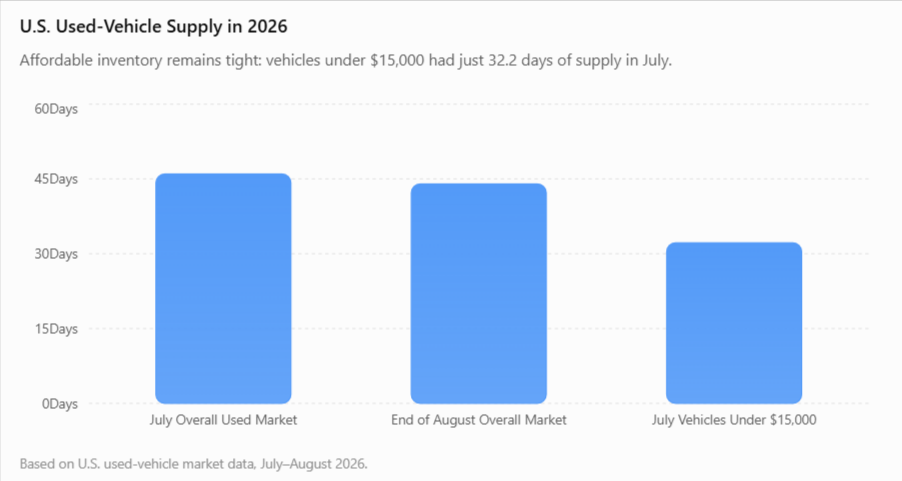
U.S. used-vehicle market data placed the average listing price at $27,028 in July 2026, approximately 6% higher than one year earlier.
Used-vehicle inventory stood at approximately 2.15 million vehicles, representing 46 days of supply.
Affordable vehicles remained tighter in supply.
Vehicles priced below $15,000 had only 32.2 days of supply, substantially below the 46-day overall used-vehicle market.
Inventory within the sub-$15,000 segment was approximately 20% lower than one year earlier.
These figures matter because limited affordable inventory can support demand for older and lower-priced vehicles.
Wholesale Values in August 2026
Wholesale used-vehicle values remained relatively firm entering September.
A major U.S. wholesale used-vehicle market index measured 208.2 in August 2026.
That represented:
0.4% growth from August 2025
0.9% decline from July 2026
Approximately 44 days of retail supply by the end of August
The numbers show that vehicle values do not move uniformly.
Age, segment, price range, condition, location, and buyer demand continue to affect individual offers.
Why Does the Age of the U.S. Vehicle Fleet Matter?
The average American vehicle is getting older.
Current U.S. fleet data places the average age of light vehicles at approximately 12.8 years. There are also roughly 289 million light vehicles in operation across the country.
This matters for Cash for Car sellers because an older vehicle is not automatically a vehicle with little market value.
A ten-year-old vehicle can still attract meaningful demand when it has:
A clean title
Reasonable mileage
Good maintenance
No major mechanical failure
Strong local demand
Affordable older vehicles can remain attractive when newer replacements cost substantially more.
Age is only one valuation factor. Mileage, maintenance history, title status, mechanical condition, and current demand also influence a professional buyer's offer.
How Does KarKiosk Cash for Car Work?
KarKiosk connects vehicle owners with participating buying partners so sellers can compare purchase offers without contacting professional buyers individually.
The current process has three core steps.
1. Enter Your License Plate or VIN
The seller starts with the vehicle's license plate or Vehicle Identification Number.
KarKiosk uses this information to identify the vehicle's:
Year
Make
Model
Trim
Correct vehicle identification improves the accuracy of the information used by participating buying partners.
2. Provide Vehicle Information
KarKiosk asks for information about:
Mileage
Features
Overall condition
Title status
Mechanical issues
Accident or cosmetic damage
Whether the vehicle runs
These details help participating partners calculate an offer based on the actual vehicle rather than only its year and model.
3. Compare Multiple Cash Offers
Available offers can then be reviewed in one place.
The seller decides whether one of those offers meets their requirements.
KarKiosk currently presents the service as free to use with no obligation to accept an offer.
This structure reduces the need for a seller to approach dealers and vehicle-buying businesses separately.
Who Are KarKiosk's Buying Partners?
KarKiosk refers to the businesses providing offers as participating partners.
The exact buyer behind an offer can depend on the vehicle and the participating network available for the transaction.
In the wider professional vehicle-buying market, businesses purchasing directly from consumers commonly include dealers, used-vehicle retailers, acquisition businesses, dealer groups, and other commercial automotive buyers.
The important distinction is that the offer comes from a professional participating buyer rather than KarKiosk purchasing the vehicle itself.
Before completing a transaction, review the identity of the participating buyer and the terms attached to that specific offer.
Does KarKiosk Buy Your Car Directly?
No.
KarKiosk's Get Offer Program connects sellers with participating partners that make offers to purchase vehicles.
KarKiosk does not purchase or resell the vehicles for profit itself. Participating partners operate independently, and the final vehicle transaction occurs between the seller and the selected participating partner.
KarKiosk facilitates the connection and offer-comparison process.
The selected professional buyer can be responsible for transaction elements including:
Final vehicle evaluation
Final purchase price
Pickup or delivery arrangements
Payment method
Loan or lien handling
Final purchase paperwork
That distinction should be understood before an offer is accepted.
Is a KarKiosk Cash Offer Guaranteed?
An initial cash offer is not automatically guaranteed.
KarKiosk's current program terms allow a participating partner to adjust the final amount after evaluating or inspecting the vehicle.
Accurate information therefore matters.
Do not report a vehicle as accident-free when it has significant previous damage. Do not understate mileage or describe a salvage or rebuilt title as clean.
The same applies to known mechanical problems.
A preliminary offer is useful only when the information submitted closely matches the actual vehicle.
What Determines a Cash for Car Offer?
A professional vehicle buyer considers several factors before setting a purchase amount.
| Factor | Effect on the Cash Offer |
|---|---|
| Year, make and model | Establishes the vehicle's basic resale market |
| Trim and equipment | Engines, drivetrains and options can change demand |
| Mileage | Higher mileage generally increases expected wear |
| Mechanical condition | Required repairs reduce the vehicle's economic value |
| Exterior condition | Damage can increase reconditioning costs |
| Interior condition | Excessive wear can reduce resale appeal |
| Accident history | Significant prior damage can affect demand |
| Title status | Clean, financed, rebuilt and salvage titles carry different risks |
| Location | Regional demand and transportation costs vary |
| Current market | Inventory and buyer demand affect purchasing decisions |
There is no universal formula such as retail value minus 10%.
Two professional buyers can value the same vehicle differently because they may have different retail networks, wholesale channels, repair costs, transportation expenses, inventory needs, and customers.
How Should You Check What Your Car Is Worth?
Establish a realistic value range before accepting an offer.
Start with vehicles that closely match your car and compare:
Model year
Trim
Mileage
Engine
Drivetrain
Major options
Condition
Location also matters.
A four-wheel-drive SUV can attract different demand in Colorado than in South Florida. A convertible can have stronger seasonal demand in warmer markets.
Do not judge your vehicle solely by the highest advertised retail price you find online.
A retail vehicle may already have been inspected, transported, repaired, reconditioned, photographed, and marketed.
The professional buyer still needs room to complete those steps and resell the vehicle.
The better approach is to establish a realistic market range and compare several actual purchase offers.
Cash Offer vs. Private Sale vs. Trade-In
These selling methods serve different priorities.
| Selling Method | Speed | Seller Work | Price Control | Best Fit |
|---|---|---|---|---|
| Cash offer | High | Low | Moderate | Seller prioritizes speed and convenience |
| Private sale | Lower | High | High | Seller wants greater control over asking price |
| Dealer trade-in | High | Low | Lower | Seller is replacing the vehicle through a dealer |
Cash for Car differs from a traditional trade-in because the seller does not necessarily need to purchase another vehicle.
A professional buyer may purchase the car as a standalone transaction.
KarKiosk supports both direct offer comparison and private selling. A seller who wants speed can compare cash offers, while a seller who wants more control over the asking price can create a private listing.
How Can You Improve Your Cash for Car Offer?
You cannot control the market, but you can present the vehicle accurately.
Record the Exact Mileage
Check the odometer immediately before submitting the vehicle information.
Do not estimate. Mileage directly affects expected wear and remaining vehicle value.
Confirm the Correct Trim
Two cars from the same model year can carry different values.
Confirm the trim, engine, drivetrain, and important factory equipment.
Gather Maintenance Records
Organize available service documentation.
Maintenance records provide useful evidence of how the vehicle has been maintained.
Find Every Key and Remote
Locate all available vehicle keys and remotes.
Replacement smart keys can cost hundreds of dollars on some modern vehicles.
Clean the Vehicle
Remove personal property and trash.
Complete a basic exterior wash and interior cleaning before an inspection. Do not automatically pay for expensive detailing because the increased offer may not cover the expense.
Disclose Damage
Report meaningful cosmetic and mechanical problems.
Examples include:
Major dents
Windshield damage
Warning lights
Transmission problems
Accident damage
Non-working air conditioning
Non-running condition
Accurate information creates a more dependable initial offer.
Should You Repair Your Car Before Requesting a Cash Offer?
Do not automatically repair every problem before requesting offers.
Calculate the potential return first.
Example
Current cash offer: $12,000
Repair estimate: $1,500
Expected offer after repair: $12,800
Additional value created: $800
The repair costs $1,500 but adds only $800 to the expected purchase price.
The seller would be approximately $700 worse off.
Requesting a Cash for Car offer before completing expensive repairs provides a useful baseline.
Low-cost repairs may make sense. Major repairs require a cost-versus-value calculation.
Can You Use Cash for Car if the Vehicle Has a Loan?
Yes.
A financed vehicle can still be sold, but the outstanding lien must be handled correctly.
Ask the lender for the current payoff amount.
The payoff amount can differ from the balance shown on a monthly statement because interest and other amounts can continue to accrue.
Positive Equity Example
Cash offer: $21,000
Loan payoff: $15,500
Positive equity: $5,500
The vehicle is worth $5,500 more than the amount required to satisfy the loan.
Negative Equity Example
Cash offer: $18,000
Loan payoff: $21,000
Negative equity: $3,000
The vehicle's purchase price is $3,000 below the current loan payoff.
Before transferring ownership, confirm:
Exact payoff amount
Lender payoff instructions
Title-release procedure
Seller contribution when negative equity exists
How positive equity will be paid
Why Does Title Status Affect a Cash Offer?
A vehicle title establishes ownership and can contain information that materially affects resale value.
Common title situations include:
Clean title
Salvage title
Rebuilt title
Flood brand
Active lien
A branded title does not automatically make a vehicle worthless.
It changes the market.
Future buyers, insurers, lenders, dealers, and wholesale channels can treat branded vehicles differently.
Professional Cash for Car buyers therefore consider title status when determining how much they can pay.
KarKiosk asks for title information as part of the offer process for this reason.
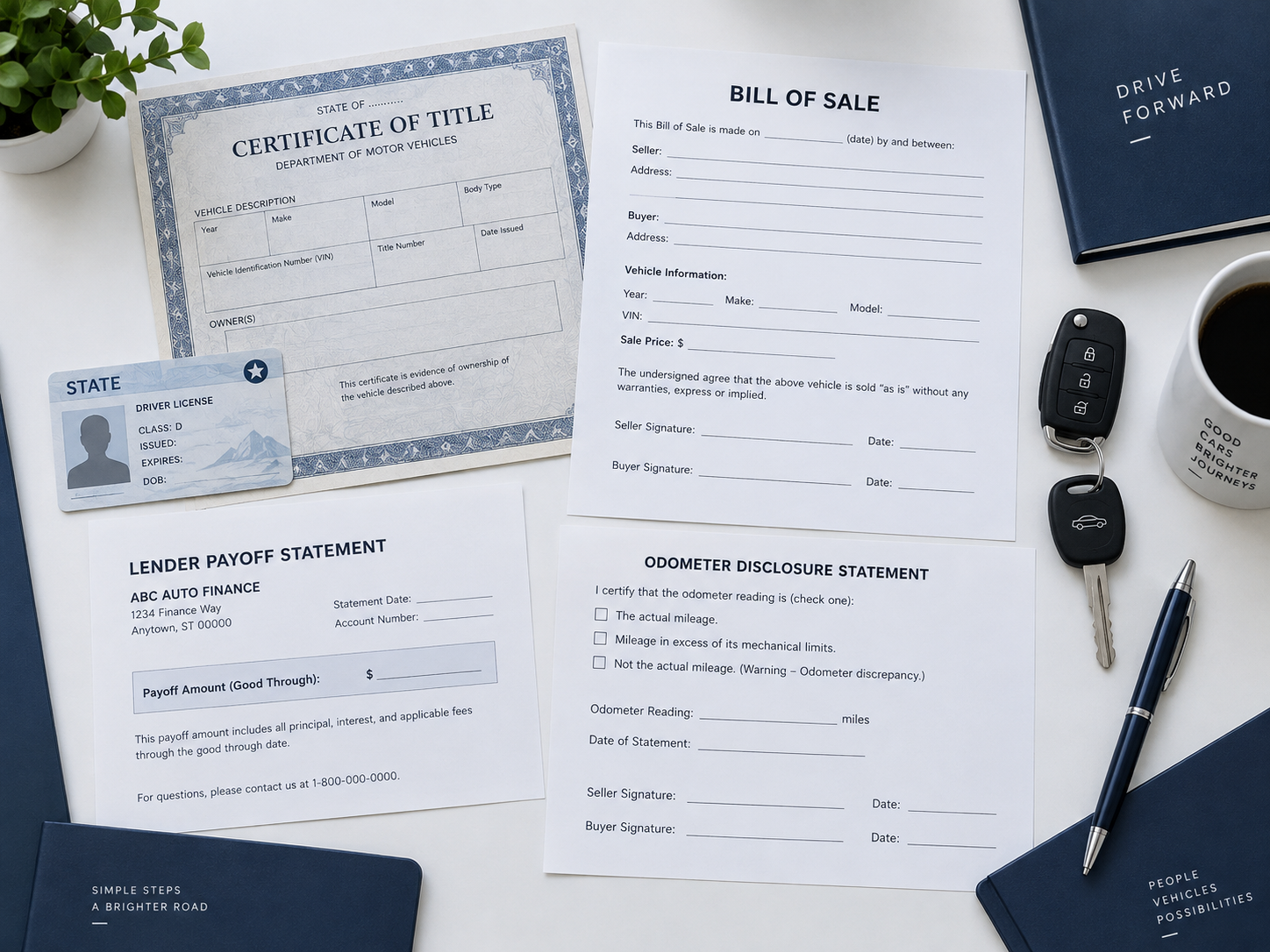
What Documents Do You Need for Cash for Car?
Vehicle-sale requirements vary by state.
Prepare the core documents before completing the transaction:
Certificate of title or electronic-title information
Government-issued identification
Current vehicle registration
Lien payoff information when financed
Lien release when applicable
Required odometer disclosure
Bill of sale when required or recommended
Some states also require a seller notice, release of liability, notice of transfer, or license-plate action.
Always follow the title-transfer rules issued by the motor vehicle agency in the state where the vehicle is titled.
Federal Odometer Disclosure Rule
Federal law requires mileage disclosure for many vehicle ownership transfers.
For Model Year 2011 and newer vehicles, odometer disclosure generally applies for the first 20 years.
Model Year 2010 and older vehicles remain exempt from the extended federal disclosure period.
Mileage should therefore be treated as both a valuation factor and a legal transfer requirement.
Can You Sell a Non-Running Vehicle Through Cash for Car?
Potentially, yes.
A non-running vehicle can still have economic value.
Its value may come from:
Repair potential
Parts
Engine or drivetrain components
Body panels
Wholesale demand
Recycling value
The reason the vehicle does not run matters.
A failed battery is different from a failed transmission. A damaged starter is different from major flood damage.
Describe the problem accurately.
KarKiosk includes running condition among the vehicle details that participating partners can use when evaluating offers.
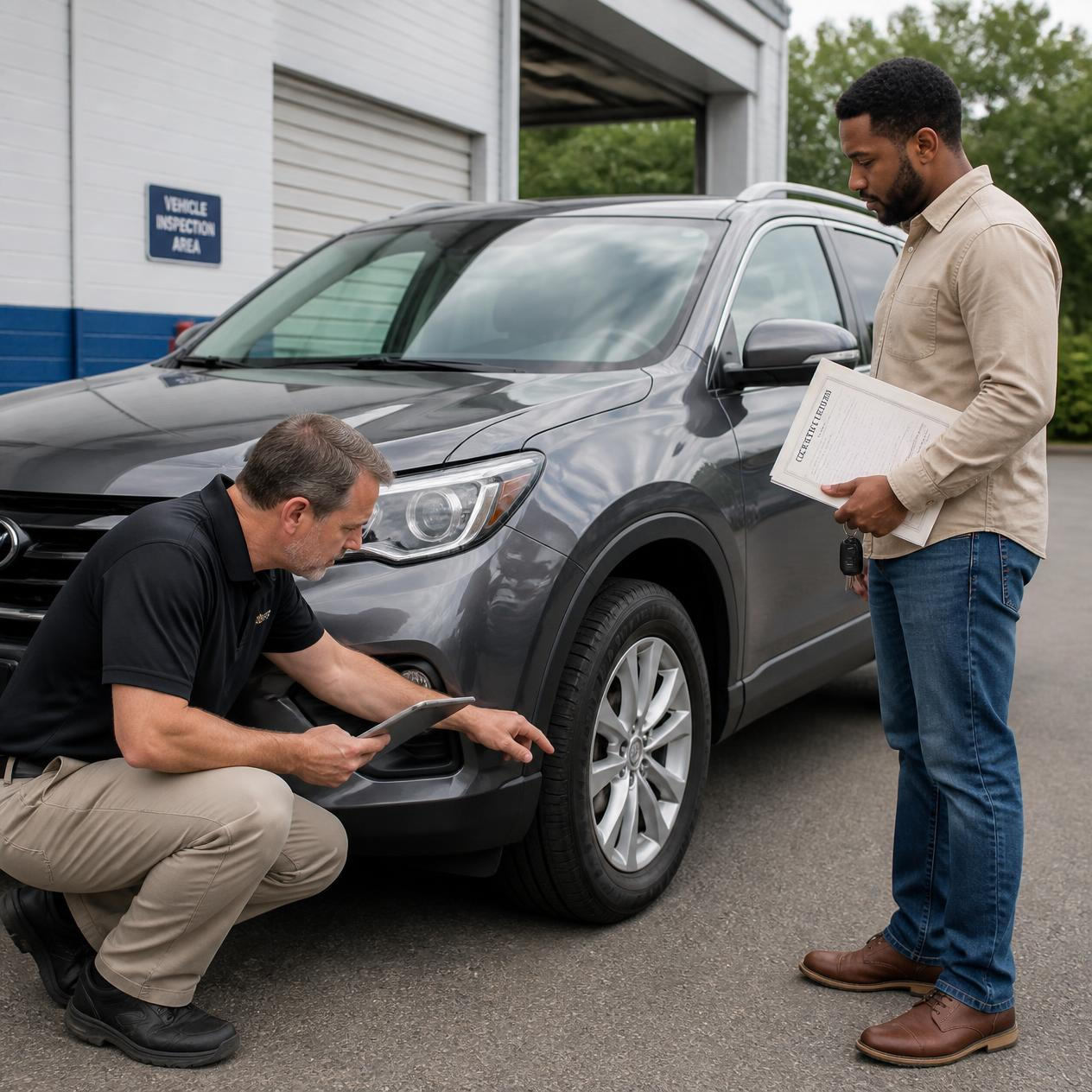
What Happens During the Vehicle Inspection?
An online cash offer is based primarily on information submitted before physical verification.
The professional buyer may inspect the vehicle to confirm:
VIN
Mileage
Exterior condition
Interior wear
Tires
Warning lights
Mechanical operation
Vehicle equipment
Title documents
Material differences can affect the final offer.
If the online description closely matches the actual vehicle, the risk of a significant adjustment is lower.
How Should You Compare Multiple Cash for Car Offers?
Do not compare only the largest headline number.
Compare the complete transaction.
Review:
Final purchase amount
Inspection conditions
Pickup requirements
Transportation costs
Other fees
Offer expiration
Payment method
Payment timing
Lien handling
Calculate your net proceeds.
Example
Offer A: $18,600
Seller-paid transportation: $700
Net proceeds: $17,900
Offer B: $18,250
Pickup included
Net proceeds: $18,250
Offer B produces $350 more even though the advertised purchase offer is lower.
The strongest Cash for Car offer is the one that gives you the best acceptable final result after costs and conditions are included.
KarKiosk's multiple-offer model helps sellers compare available partner offers before choosing one.
How Do You Avoid Scams When Selling a Car?
Payment fraud remains a real risk in vehicle transactions.
Federal consumer-protection authorities specifically warn vehicle sellers about fake-check overpayment scams.
The pattern is simple.
A supposed buyer sends a check for more than the agreed sale price and asks the seller to return the difference. The check later proves fraudulent, the original deposit is reversed, and the seller loses the money sent back.
Federal fraud guidance states:
“Never send money to anyone who says they overpaid you by check.”
Follow these basic rules:
Reject unexplained overpayments.
Never refund money from an overpaid check.
Verify the payment method before releasing the vehicle.
Confirm that funds are legitimate.
Keep copies of completed sale documents.
Professional buying channels can reduce some of the uncertainty associated with dealing with an unknown private buyer, but sellers should still verify the participating business, payment method, and transaction documents.
When Does Cash for Car Make Sense?
Cash for Car works best when speed and simplicity have measurable value to the seller.
Consider this route when:
You want to sell without creating a public listing.
You do not want to manage repeated buyer inquiries.
You want professional purchase offers to compare.
You want to establish a current cash value before deciding how to sell.
You have a financed vehicle and need a structured payoff process.
You value speed more than complete control over the asking price.
A private listing may be more appropriate when maximizing price control is the main objective and you are comfortable handling inquiries, test drives, negotiation, payment verification, and paperwork yourself.
KarKiosk gives sellers access to both routes.
Cash for Car Checklist
Complete these steps before finalizing the sale:
Confirm the VIN, model, and trim.
Record the exact mileage.
Establish a realistic market-value range.
Gather the title and ownership documents.
Request the loan payoff amount when financed.
Describe vehicle condition accurately.
Compare multiple professional offers.
Calculate net proceeds after fees.
Confirm who is purchasing the vehicle.
Verify the payment method.
Complete state-specific ownership-transfer requirements.
Keep copies of the completed transaction documents.
Final Takeaway
Cash for Car provides a direct route between a vehicle owner and professional automotive buyers that actively acquire used vehicles.
Those buyers can include dealers, used-car retailers, acquisition businesses, dealer groups, wholesale-oriented buyers, and specialty vehicle buyers. They calculate offers from the vehicle's expected resale value, condition, mileage, title status, location, reconditioning costs, and current market demand.
KarKiosk simplifies this process by allowing sellers to provide their vehicle details once and compare cash offers from participating buying partners.
The objective is not simply to choose the largest number displayed first.
Know what your vehicle is worth, understand who is buying it, compare the complete offers, calculate your net proceeds, and accept the transaction that makes financial sense.