
Seller Guide Oct 19, 2026
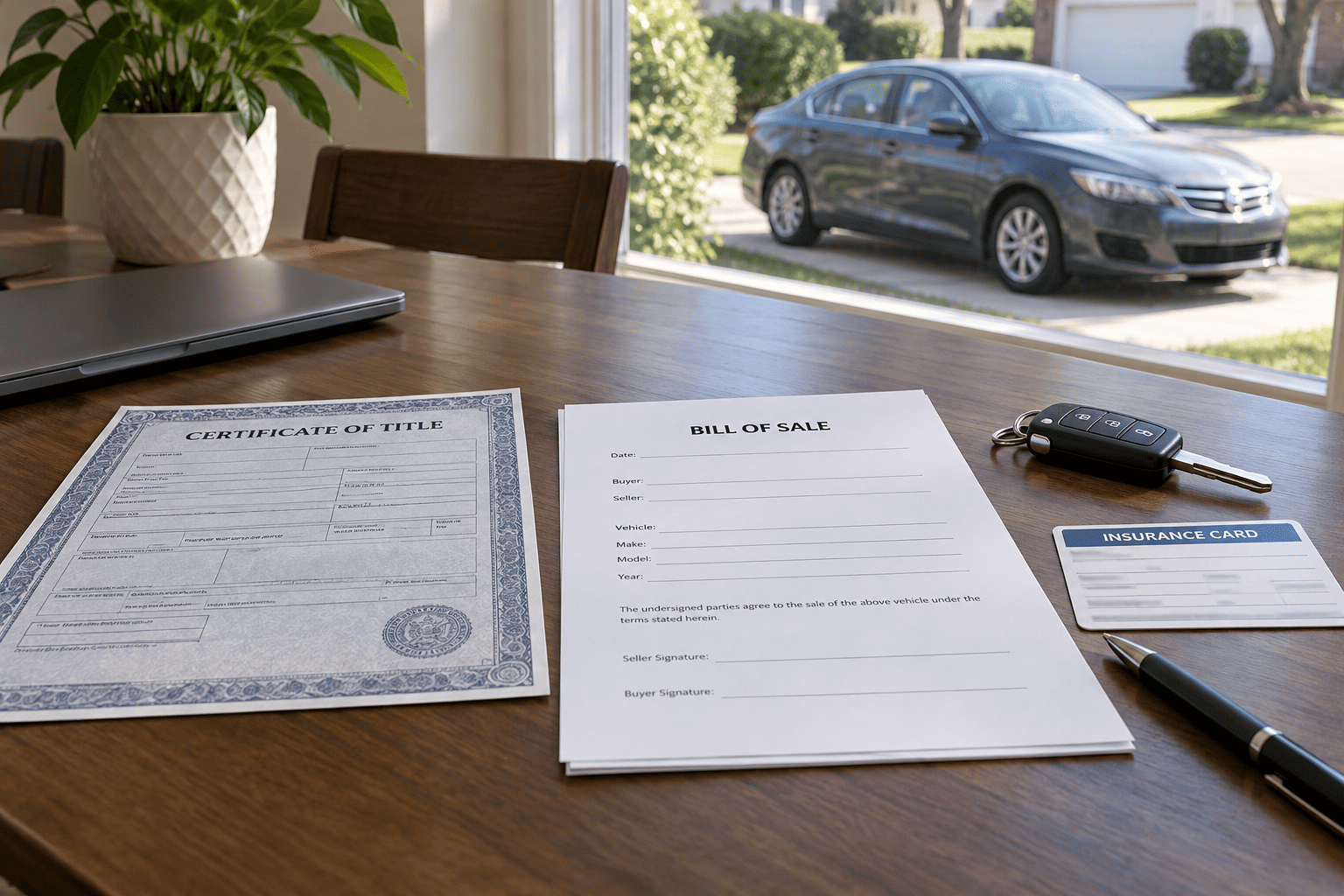
A vehicle bill of sale records who sold the vehicle, who bought it, the sale price, mileage and transaction date. It can be required paperwork in some states and supporting evidence in others, but it usually does not replace a properly assigned vehicle title. Before money or keys change hands, complete KarKiosk’s free vehicle bill of sale PDF and then follow the title, tax and registration rules of the state involved.
What Is a Vehicle Bill of Sale?
A vehicle bill of sale is a written record of a private vehicle transaction.
For most private car sales, it establishes:
Who sold the vehicle.
Who purchased it.
Which vehicle changed ownership.
How much the buyer paid.
When the transaction occurred.
What mileage was disclosed.
Which conditions or promises were part of the sale.
The document is valuable to both sides.
For the buyer, it supports the purchase price and date used during title, tax and registration processing.
For the seller, it establishes when possession changed and identifies the person who received the vehicle.
A bill of sale becomes particularly important when a buyer delays the title transfer, a tax authority questions the reported price, or the vehicle crosses state lines.
A Bill of Sale and a Vehicle Title Are Not the Same Thing
This is the most important distinction in a private sale.
The title establishes legal vehicle ownership.
The bill of sale records the transaction.
Depending on the state, the title itself may contain enough transaction information that a separate bill of sale is optional. Other states require a separate bill of sale, a state-specific form or additional documentation.
Document | Main Purpose |
Vehicle title | Transfers legal ownership |
Bill of sale | Records buyer, seller, vehicle, price and sale date |
Odometer disclosure | Certifies mileage when legally required |
Title/registration application | Requests the new state ownership and registration record |
Seller transfer notice | Tells the state the seller has disposed of the vehicle |
Tax form | Establishes or calculates tax due on the transaction |
Inspection document | Shows VIN, safety or emissions compliance when required |
Never buy a normally titled vehicle based only on a handwritten receipt because the seller says the title will arrive later.
A missing title normally requires a state-specific duplicate, bonded, conditional or alternative-title process.
What Information Should Every Bill of Sale Include?
Even when a state publishes its own form, the core information is similar.
Include:
Seller: Full legal name and address.
Buyer: Full legal name and address.
Vehicle: Year, make, model, body type and color where relevant.
VIN: Copy all 17 characters carefully.
Sale price: State the actual consideration paid.
Sale date: Use the same date on the title and other transfer forms.
Odometer: Record the mileage and correct mileage status.
Signatures: Obtain the signatures required by the state.
Special terms: Identify a gift, trade, deposit or other genuine transaction condition when relevant.
Both parties should keep a complete copy.
Do not leave the purchase price, buyer name or other critical fields blank for someone to fill in later.
Federal Odometer Rules Still Apply
State bill-of-sale rules are only part of the paperwork.
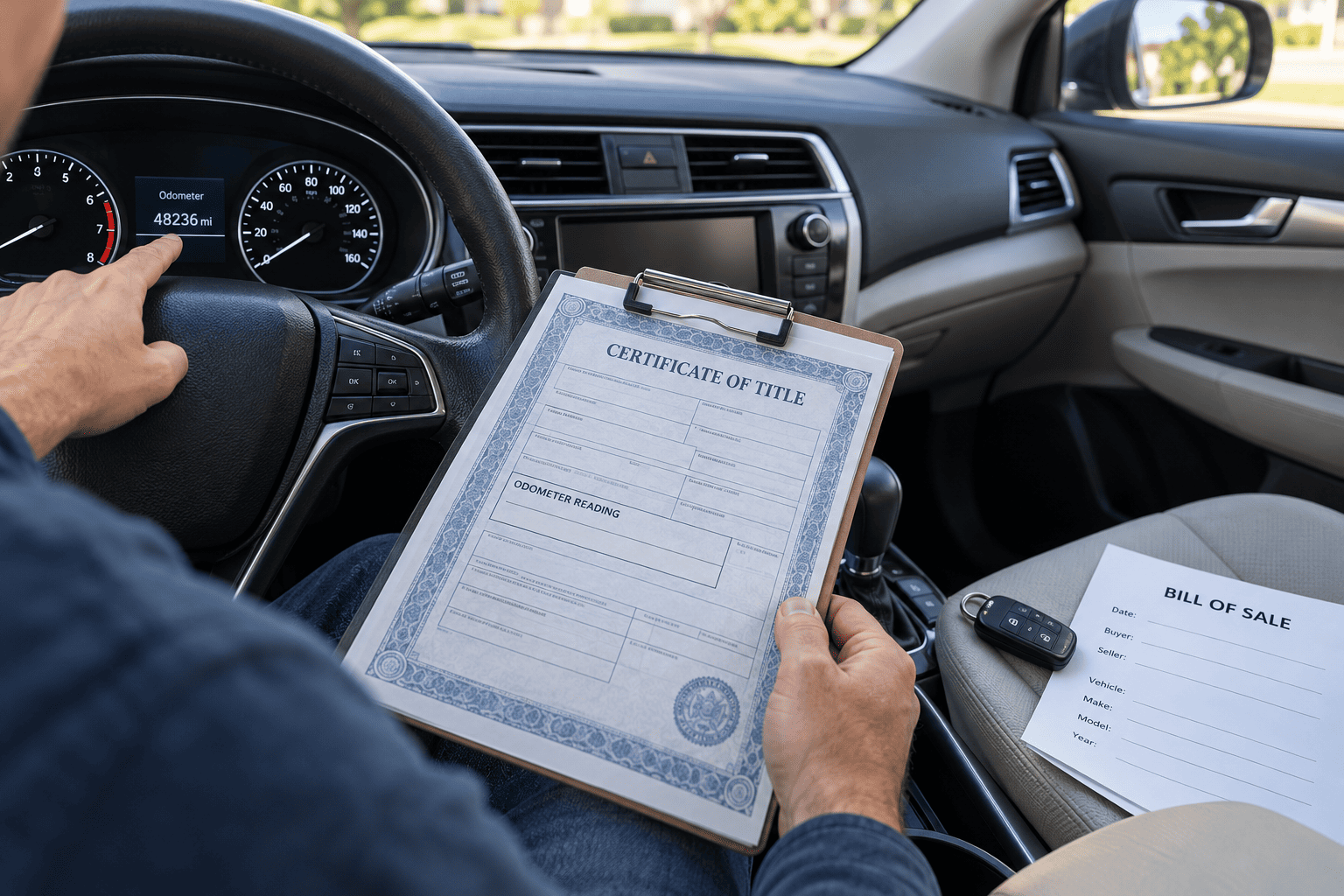
Federal odometer-disclosure requirements apply during many vehicle ownership transfers. NHTSA extended the disclosure period for model-year 2011 and newer vehicles from 10 to 20 years.
NHTSA explains:
“Model Year 2011 or newer vehicles will only be exempt from the odometer rules after 20 years.”
See NHTSA’s odometer disclosure guidance for the federal rule.
This means a 2015 vehicle sold in 2026 is still within the federal disclosure period.
The mileage normally appears on the title or an approved reassignment document. Do not alter an odometer entry after it has been completed.
If the mileage is not actual, use the appropriate discrepancy designation instead of entering an estimate as verified mileage.
Do All States Require a Bill of Sale?
No.
The 50 states use several different approaches.
Some States Require or Regularly Request a Separate Sale Record
Examples include states where a bill of sale forms a defined part of the private-transfer paperwork or becomes necessary for particular transactions.
Connecticut requires a bill of sale with proof of ownership when processing a new registration.
Rhode Island also places significant reliance on a bill of sale during private transactions.
Other states provide official forms that buyers and sellers commonly use, including Arkansas, Florida, Georgia, New Mexico, New York, North Dakota, Oregon, South Carolina, Utah and Vermont.
Some States Let the Title Carry the Sale Information
In several states, the properly completed title contains the buyer, seller, price, mileage and sale-date information needed for the normal transaction.
Louisiana, for example, does not require a separate bill of sale when the selling price is correctly shown on the title assignment.
Kansas similarly allows the title to establish the sale price when the title contains the appropriate field.
Some States Use the Bill of Sale Only in Certain Situations
A separate bill of sale can become important when:
The title does not contain a price field.
The vehicle is old enough to be title-exempt.
The vehicle comes from another state.
An intermediate ownership transfer must be documented.
The reported price needs additional evidence.
A replacement-vehicle tax credit is claimed.
A seller needs proof of the exact delivery time.
This is why one national bill-of-sale rule cannot replace checking the state requirements.
Vehicle Bill of Sale Rules Across All 50 States
The table below identifies the main difference worth checking in each state. It is a navigation guide, not a replacement for the full state transfer requirements.
State | Main Private-Sale Difference to Check |
Alabama | Title documents, casual-sale tax, local taxes and county registration requirements |
Alaska | Title transfer, state fees, municipal registration tax and possible local sales tax |
Arizona | Form 38-1306/eTitle options, 10-day Sold Notice and 15-day buyer title deadline |
Arkansas | Form 10-313, title control number, county assessment, vehicle tax bands and 60-day filing rule |
California | REG 135, five-day seller notice, 10-day buyer transfer, Smog Check and plate rules |
Colorado | Sale-price documentation, 60-day title period, 36-hour driving exception and ownership tax |
Connecticut | H-31, mandatory sale documentation, taxable-value rules, emissions and plate cancellation |
Delaware | Assigned title, document fee, 30-day title rule and replacement-vehicle credit |
Florida | HSMV 82050, electronic-title reassignment, 30-day duties, county surtax and seller-retained plates |
Georgia | T-7, seven-business-day registration, TAVT and metro Atlanta emissions |
Hawaii | County-specific transfer forms and fees, 10-day seller notice, 30-day buyer rule and safety inspection |
Idaho | ITD 3738, 30-day title filing, 6% tax, VIN inspection and seller release |
Illinois | RUT-50, 20-day title filing and private-party tax based on age or purchase-price brackets |
Indiana | Form 44237, 45-day title rule, 7% tax, VIN inspection and county-related registration charges |
Iowa | Title/bill-of-sale documentation, 30-day title rule and $10 plus 5% Fee for New Registration |
Kansas | TR-12 when price is absent from the title, 60-day filing, local tax and MVE-1 inspection |
Kentucky | Notarized title assignment, 15-day transfer and 6% Motor Vehicle Usage Tax |
Louisiana | Bill of sale when title price is missing, notarization, five-day buyer deadline and seller notice |
Maine | Title documents, sales tax, municipal excise tax and annual vehicle inspection |
Maryland | VR-181 situations, excise tax, safety inspection and state title/registration charges |
Massachusetts | Bill of sale for title-exempt or price-missing transactions, 10-day title rule and 6.25% tax |
Michigan | Title transfer, 6% use tax, plate transfer and applicable late-title charge |
Minnesota | Title application timing, motor vehicle sales tax, plate treatment and seller reporting |
Mississippi | Title paperwork, 30-day filing, state/local tax treatment and plate requirements |
Missouri | Form 1957, title deadline, tax and applicable safety or emissions inspections |
Montana | 40-day title period, current signature/notary rules and registration fees rather than general sales tax |
Nebraska | Form 6, 30-day filing, sales/use tax and VIN inspection for applicable incoming vehicles |
Nevada | VP104, title documentation, private-sale tax treatment, seller plates and emissions counties |
New Hampshire | Bill of sale importance for title-exempt vehicles, municipal permit fees and temporary plates |
New Jersey | Bill of sale, 10-working-day transfer, sales tax and seller-retained plates |
New Mexico | MVD-10009, excise tax, 30-day transfer and plate-to-owner rules |
New York | Separate proof of ownership and proof of sale, sales tax forms and seller-retained plates |
North Carolina | Notarized title, Highway Use Tax, 28-day title deadline and plate rules |
North Dakota | SFN 62502, seller title-delivery rule, buyer’s 30-day period and motor vehicle excise tax |
Ohio | Notarized seller title signature, 30-day transfer, sales/use tax and late-title charge |
Oklahoma | Paper versus electronic title rules, seller preregistration and multiple plate/title deadlines |
Oregon | Form 735-501, 10-day seller notice, 30-day buyer title period and no general sales tax |
Pennsylvania | Notarized title assignment, authorized agent processing, sales tax and inspection requirements |
Rhode Island | Bill of sale, sales tax, current title rules and post-registration inspection |
South Carolina | Form 4031, Infrastructure Maintenance Fee, title deadline and plate transfer |
South Dakota | Bill of sale, 4% motor vehicle excise tax, seller permit and 45-day title period |
Tennessee | Assigned title, supporting sale record, state/local vehicle tax and seller plate rules |
Texas | Form 130-U, 30-day buyer/seller filings, 6.25% tax and Standard Presumptive Value |
Utah | TC-843, title/registration paperwork, registration fees and county emissions requirements |
Vermont | VT-005, 6% purchase/use tax and current rules for older vehicles no longer requiring titles |
Virginia | Sale price on title, 4.15% Motor Vehicle Sales and Use Tax and electronic title options |
Washington | Bill of sale, five-day seller report, 15-day buyer title period and use tax |
West Virginia | DMV-7-TR, notarization, 6% title tax and 60-day transfer rule |
Wisconsin | No mandatory statewide bill-of-sale form for an ordinary sale, 5% tax and seller notification |
Wyoming | Notarized title, 45-day transfer, 4% state sales/use tax plus applicable local tax and county fees |
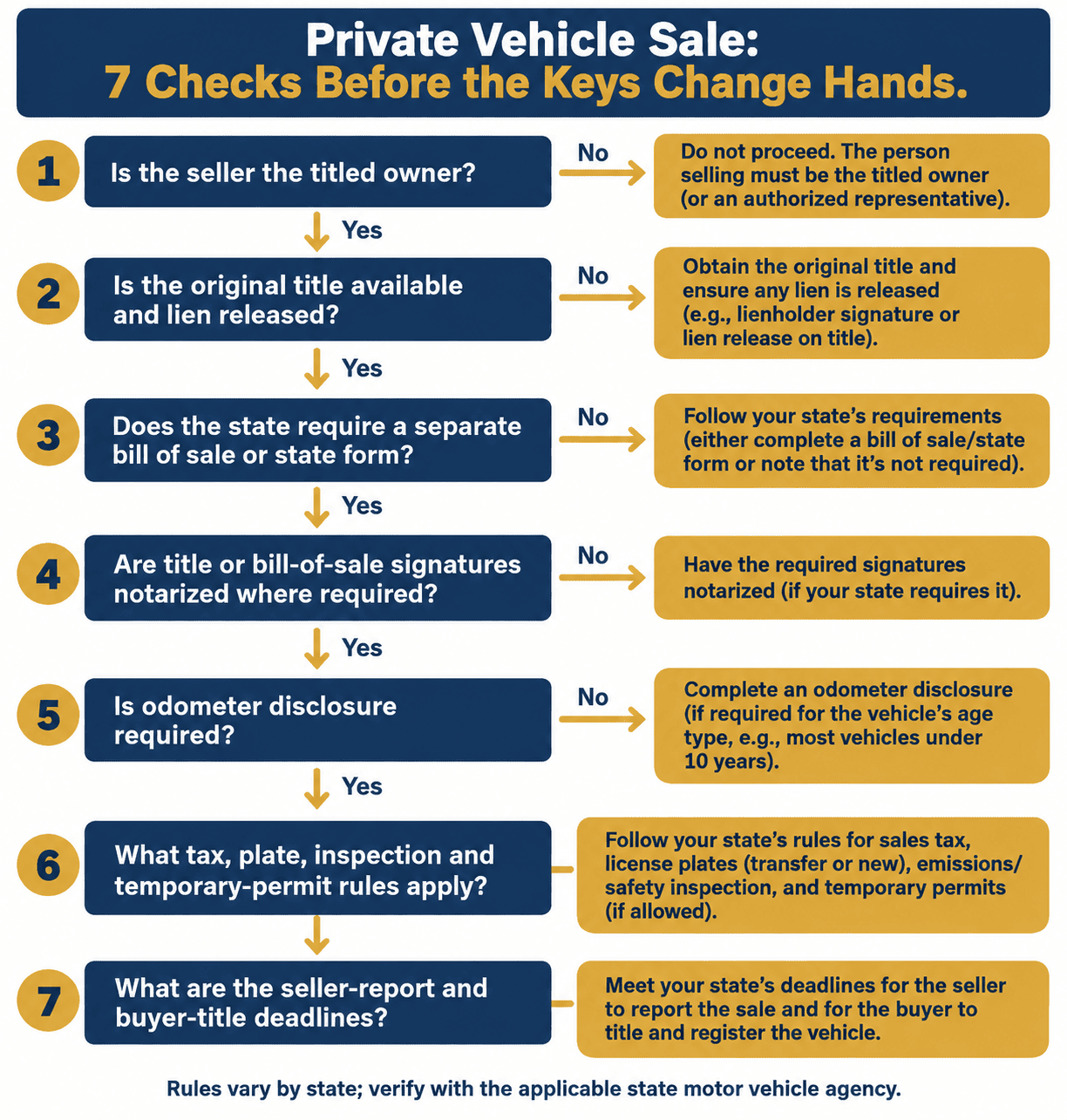
The key point is not memorizing 50 different systems. Check the same six categories every time: title, bill of sale, tax, deadline, plates and inspection.
Why State Tax Rules Matter as Much as the Bill of Sale
The sale price on the bill of sale does not always equal the amount on which the state calculates tax.
States use several systems.
Percentage of the Purchase Price
Many states impose a percentage-based sales, use, excise or vehicle tax.
Examples include Idaho at 6%, Indiana at 7% and Kentucky at 6%, subject to the applicable exemptions and valuation rules.
State-Determined Vehicle Value
Some states can disregard an unusually low reported price.
Texas can use Standard Presumptive Value in a qualifying private sale. The Texas bill of sale guide explains how its private-sale tax system differs from a simple tax-on-receipt calculation.
Georgia uses fair market value for TAVT rather than relying exclusively on the amount negotiated between buyer and seller.
Age-Based or Price-Bracket Tax
Illinois uses a private-party vehicle tax schedule that changes according to model year for lower-priced vehicles and price brackets for higher-value purchases.
Registration or Document Fees Instead of Ordinary Sales Tax
Iowa uses its Fee for New Registration.
Delaware imposes a document fee.
New Hampshire has no general sales tax but municipal registration charges can be substantial.
Montana also has no general state sales tax, while registration charges still apply.
Never reduce the reported price simply to lower tax. State agencies can request additional evidence and apply their own valuation rules.
Notarization Rules Also Vary by State
Do not assume that “this state requires notarization” means the bill of sale itself must be notarized.
The required notarized document may instead be the certificate of title.
Examples include Kentucky, North Carolina, Ohio and Wyoming, where title-signature requirements are especially important.
West Virginia publishes a notarized bill-of-sale form for applicable transactions.
Louisiana can require an original notarized bill of sale when the necessary selling price is absent from the title assignment.
In other states, an ordinary sale receipt does not require notarization at all.
Check the actual form or title instructions before scheduling the transaction.
Seller Notices and Buyer Deadlines Are Separate
Many states create two independent responsibilities.
The seller may need to report the sale.
The buyer must apply for title and registration.
One filing usually does not replace the other.
Examples include:
Arizona: seller Sold Notice and buyer title application.
California: seller Notice of Transfer and Release of Liability and buyer title transfer.
Washington: seller report and buyer title application.
Florida: seller Notice of Sale and buyer title application.
Louisiana: seller transfer notice and buyer title filing.
A seller should not assume the vehicle has left their state record merely because the buyer drove away with the signed title.
Likewise, a buyer should not assume the seller’s notification puts the title into the buyer’s name.
What Happens to the License Plates?
Plate handling is one of the easiest mistakes to make when crossing state lines.
In many states, plates belong to the seller.
The seller removes them and may transfer, retain, cancel or surrender them.
Examples include Arizona, Florida, Idaho, Illinois, Indiana, Kansas, Kentucky, New York and Texas.
Other states can keep ordinary plates with the vehicle or apply different rules to standard versus personalized plates.
California is a useful example: ordinary plates generally stay with the vehicle, while personalized and certain special plates follow different procedures. See the California bill of sale and transfer guide for the state-specific process.
Never copy another state’s plate rule simply because the transaction otherwise looks similar.
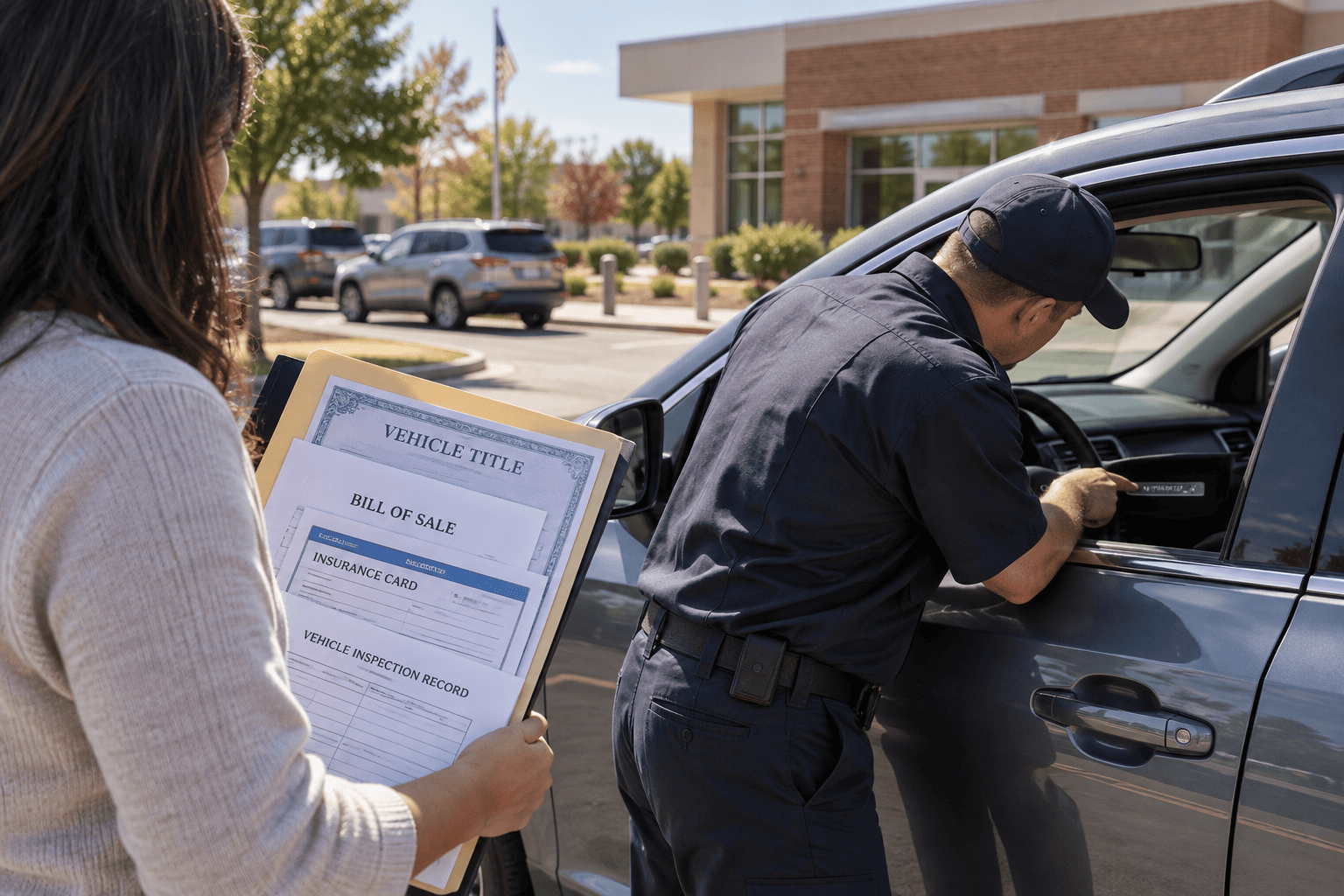
Safety, Emissions and VIN Inspections Are Three Different Things
These checks are often confused.
VIN Inspection
A VIN inspection verifies the vehicle’s identity.
States such as Idaho, Indiana, Kansas and Kentucky require VIN-related inspections for many vehicles entering with out-of-state ownership documents.
Safety Inspection
A safety inspection checks physical components such as lights, tires or brakes.
Hawaii uses an annual safety-inspection program. Other states have their own inspection schedules or transaction-related requirements.
Emissions Inspection
Emissions programs can apply only in certain counties or metropolitan areas.
Examples include:
Arizona — Phoenix and Tucson testing areas.
California — Smog Check rules with statutory exemptions.
Colorado — Denver and North Front Range areas.
Georgia — specified metro Atlanta counties.
Illinois — Chicago and Metro-East testing areas.
Indiana — Lake and Porter counties.
A car can require a VIN inspection without needing an emissions test.
What If the Buyer and Seller Live in Different States?
Start with the seller’s ownership document and finish with the buyer’s registration state.
The seller must provide a title that is correctly assigned under the issuing state’s rules.
The buyer then follows the destination state’s requirements for:
Title application.
Tax or tax credit.
VIN inspection.
Emissions or safety testing.
Registration.
License plates.
Temporary permits.
A generic bill of sale does not override either state.
This is particularly important when one state requires notarization and the other does not. Complete the seller’s title correctly before the vehicle leaves the originating state.
How Do You Find the Correct State Motor Vehicle Office?
DMVs use different names across the country: DMV, BMV, MVD, MVC, DOR, county clerk, county treasurer or tax collector.
The federal government maintains an official state motor vehicle services directory that routes users to the appropriate state agency.
Use the agency responsible for the vehicle’s title or registration rather than relying on a driver-license office simply because it carries the DMV name.
County-level processing is common in states such as Colorado, Iowa, Kansas, Kentucky and Florida.
Buyer Checklist Before Paying
Before the buyer releases payment:
Match the VIN on the vehicle to the title.
Verify that the seller is the titled owner.
Check for unreleased liens.
Confirm whether signatures require notarization.
Record the actual mileage.
Complete the bill of sale and title together.
Confirm taxes, plates, inspection and temporary-driving requirements.
Do not accept a promise that missing ownership documents will be fixed later unless you fully understand the state’s alternative-title procedure.
Seller Checklist Before Handing Over the Keys
Before releasing the vehicle:
Complete every required title-assignment field.
Record the buyer’s full legal information.
Keep a copy of the bill of sale.
Keep evidence of payment.
Remove or retain plates when required.
File the seller’s notice or release where applicable.
Cancel registration or insurance only in the order required by the state.
The seller should retain transaction records even after the buyer confirms that the title has been transferred.