Seller Guide Oct 19, 2026
An Alaska bill of sale does not transfer vehicle ownership. The seller must give the buyer the properly assigned original title when the vehicle is delivered, and the buyer must obtain an Alaska title within 30 days of the sale.
The bill of sale still protects both parties by recording the vehicle, sale date, buyer, seller, and signatures. The seller must also report the sale or transfer to Alaska DMV.
Download the free KarKiosk vehicle bill of sale PDF and complete it before the original title and keys change hands. Use it as a dated transaction record alongside—not instead of—the assigned Alaska title.
Alaska States Directly That the Bill of Sale Is Not the Ownership Document
Alaska DMV states:
“A Bill of Sale is not valid for ownership transfer.”
The original title must be properly released by the owner or owners named on the front and assigned to the buyer.
The bill of sale should still contain:
Vehicle serial number or VIN.
Complete vehicle description.
Buyer’s printed legal name.
Seller’s printed legal name.
Date of sale.
Actual purchase price.
Buyer’s signature.
Seller’s signature.
It can help show when possession changed and who controlled the vehicle after the sale.
Illinois does not require the same original-title-plus-Alaska-notice process. See KarKiosk’s Illinois Bill of Sale guide for that state’s separate private-party title and tax rules.
Alaska Private Vehicle Sale Rules
Item | Alaska Rule | Why It Matters |
Main ownership document | Properly assigned original title | Bill of sale alone cannot transfer ownership |
Buyer title deadline | 30 days from sale | Alaska resident must obtain title in buyer’s name |
Main application | Form V1 | Used for title and registration |
Seller transfer report | Required after the sale | Stops renewal and creates a transfer record |
Statewide sales tax | None | Municipal sales or use tax can still apply |
Vehicle title fee | $15 | Paid with title application |
First lien recording | $15 | Added when financing is recorded |
Passenger registration | $100 for 24 months | Municipal registration tax can be added |
Personalized/specialty plates | Seller removes them | Buyer receives new plates after transfer |
Temporary registration | Available with V1 and purchase proof | Full title and registration fees remain due |
Standard emissions test | No statewide program | Ordinary registration does not require emissions testing |
Complete Every Section of the Original Title
The seller completes the first ownership-assignment section and gives the original title to the buyer.
Do not leave blanks.
The title must show the required:
Buyer information.
Seller signatures.
Sale date.
Odometer disclosure.
Vehicle information.
Only a licensed dealer can reassign a title that was previously transferred.
A private individual or business must obtain title in its own name before selling the vehicle to another buyer.
“AND” and “OR” Control the Required Signatures
Read the ownership line on the front of the title.
Owner A AND Owner B: all owners must sign.
Owner A OR Owner B: one listed owner can sign.
When no conjunction appears, Alaska’s mailed-title guidance generally requires all listed owners to release their interests.
The buyer should not pay until every required owner can complete the assignment.
The Buyer Has 30 Days to Obtain an Alaska Title
An Alaska resident who purchases a vehicle must transfer it into the buyer’s name within 30 days from the date of sale.
The buyer normally submits:
Assigned original title.
Form V1, Vehicle Transaction Application.
Odometer disclosure.
Lien release when applicable.
Title and registration fees.
Municipal registration tax when applicable.
Other documents required for the transaction.
The vehicle must have valid registration or valid temporary registration before it is operated on public roads.
The Seller Must Report the Sale
Alaska law requires the seller to notify DMV after transferring the vehicle.
The seller can:
Submit the Notice of Vehicle Sale for Transfer attached to the title.
Report the sale online.
Contact DMV through the approved reporting process.
The report includes the vehicle, buyer’s name and address, and sale date.
The seller should submit it as soon as possible and keep the confirmation.
The seller report does not replace the buyer’s title application.
Alaska Has No Statewide Sales Tax
The State of Alaska does not impose a statewide sales tax.
Cities and boroughs can impose local sales or use taxes under their own ordinances.
A buyer should check:
Buyer’s residence.
Municipality where the transaction is taxable.
Local sales-tax rules.
Local use-tax rules.
Any municipal motor vehicle registration tax.
The absence of a state sales tax does not mean the transaction has no local tax or registration cost.
Indiana uses a different system involving state vehicle tax and its own bill-of-sale documentation. See KarKiosk’s Indiana Bill of Sale guide.
Alaska Title, Lien and Registration Fees
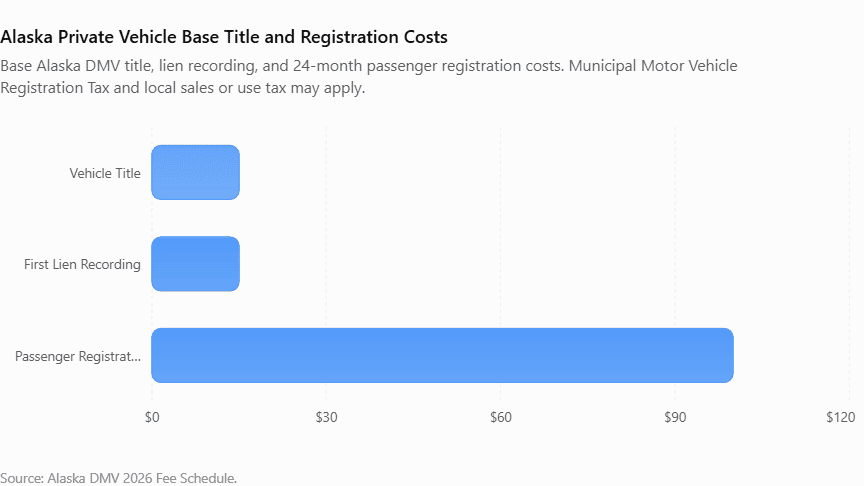
The 2026 Alaska fee schedule lists:
Vehicle title: $15.
First lien recording: $15.
Noncommercial passenger vehicle registration: $100 for 24 months.
A municipal motor vehicle registration tax can be added when the owner lives in a taxable location.
The MVRT amount can depend on:
Municipality.
Vehicle type.
Vehicle model year.
Local sales tax and MVRT are separate charges.
Temporary Registration Is Available for a Private Purchase
A private-sale buyer can request temporary registration while the title and registration application is being processed.
The buyer provides:
Completed Form V1.
Proof of purchase, such as a bill of sale.
Full title and registration fees.
Temporary registration is operating authority.
It does not replace the original title or extend the 30-day title-transfer obligation.
Plate Handling Depends on the Plate Type
Alaska’s current seller guidance specifically requires the seller to remove personalized and specialty plates.
The buyer receives a new set of plates after completing the transfer.
Standard issue plates cannot be transferred by the former owner to another vehicle.
Personalized plates can be transferred to another vehicle owned by the same person when the DMV requirements are met, including the applicable transfer fee and ownership match.
Do not assume that a specialty or personalized plate belongs to the buyer simply because it was attached to the vehicle.

Odometer Disclosure Applies for 20 Years to Model-Year 2011 and Newer Vehicles
The current Alaska title guidance applies the federal 20-year odometer-disclosure period to model-year 2011 and newer vehicles.
The seller records the mileage on the assigned title or the applicable odometer disclosure form.
Exemptions include:
Vehicles with a gross vehicle weight rating of 16,000 pounds or more.
Non-self-propelled vehicles.
Model-year 2011 and newer vehicles once they are at least 20 years old.
An incomplete disclosure can result in the mileage being recorded as “Unknown.”
Alaska warns that once mileage has been recorded as unknown, restoring a numbered reading is generally not possible unless DMV made the error.
What If the Title Is Missing?
The titled owner must obtain a duplicate before ownership can be transferred.
If another state issued the title, the owner must request the duplicate from that state.
A bill of sale does not replace the missing title.
A buyer should not complete final payment based on a promise that the title will arrive later.
Alaska Does Not Require a Routine Emissions Test
Alaska does not operate a statewide passenger-vehicle emissions inspection program as part of ordinary title and registration.
A special vehicle can still require inspection or VIN verification.
When no normal title or Manufacturer’s Certificate of Origin is available, Alaska DMV can require Form 811, Verification of Vehicle, or another ownership-review process.
How to Complete an Alaska Private Vehicle Sale
Confirm that the seller is named on the original title.
Compare the VIN on the title and vehicle.
Verify the conjunction between multiple owners.
Obtain a lien release when required.
Complete every field in the title assignment.
Complete a separate bill of sale.
Record the correct odometer disclosure.
Remove personalized or specialty plates.
Have the seller report the sale promptly.
Complete Form V1.
Obtain temporary registration before driving when needed.
Apply for the Alaska title within 30 days.
Pay title, registration, lien, and applicable local charges.
Common Alaska Private-Sale Mistakes
Treating a bill of sale as proof of ownership.
Accepting a photocopy instead of the original title.
Leaving blanks in the assignment.
Missing one owner’s signature when the title uses “and.”
Failing to report the sale.
Missing the buyer’s 30-day title deadline.
Allowing incomplete odometer disclosure.
Paying before an active lien is resolved.
Assuming Alaska has no municipal vehicle tax because it has no statewide sales tax.