
Bill of Sale Sep 22, 2026
A Hawaii bill of sale records the transaction, but a normal private vehicle transfer still requires the properly endorsed title, registration and safety-inspection documents. County motor vehicle offices handle the transfer, and the buyer generally has 30 calendar days to submit the paperwork. Keep the agreed price and sale details in KarKiosk’s free vehicle bill of sale PDF, alongside any county-specific forms your transaction requires.
Hawaii Bill of Sale Quick Facts
Requirement | Hawaii Rule |
Transfer office | The appropriate county motor vehicle office; satellite city halls handle transactions on Oahu |
Separate bill of sale | Not routinely listed for a straightforward transfer with a properly endorsed Hawaii title; required in certain situations |
County bill-of-sale form | Maui County provides DMVL590 |
Notarization | Depends on the document and transfer circumstances |
Buyer’s usual transfer deadline | 30 calendar days |
Seller’s Notice of Transfer | Within 10 days |
Late ownership-transfer charge | Generally $50 in addition to the applicable transfer fee |
Safety inspection | Current certificate required, or an accepted temporary inspection document where permitted |
Qualifying casual private sale | Excluded from Hawaii’s general excise tax; qualifying casual purchases are also excluded from use tax |
The transfer deadlines come from Hawaii Revised Statutes §286-52. County ownership-transfer instructions determine the supporting documents and local charges.
Is a Separate Hawaii Bill of Sale Required?
For a straightforward transfer, the endorsed title does most of the ownership-document work. County checklists generally ask for the title, last-issued registration and safety-inspection certificate rather than a separate receipt in every transaction.
The Honolulu vehicle ownership-transfer requirements identify an important exception. For incoming out-of-county or out-of-state transfers, a notarized bill of sale is required when the title has not been released by the recorded owner.
That is an additional documentation requirement—not permission to purchase a vehicle with an unexplained ownership history. Have the county review an incomplete title chain before payment.
A separate receipt remains useful for recording the actual price, payment arrangements and any written promises that do not appear on the title.
Which Form Should You Use, and Does It Need Notarization?
Hawaii’s title-signature rules and bill-of-sale rules are not identical.
Honolulu’s seller instructions state:
“Notarization of seller’s signature(s) is optional.”
That statement concerns the seller’s signature on the title. Honolulu explains that notarization can help prevent rejection when a signature differs from the one on file or the transfer is recorded in another county.
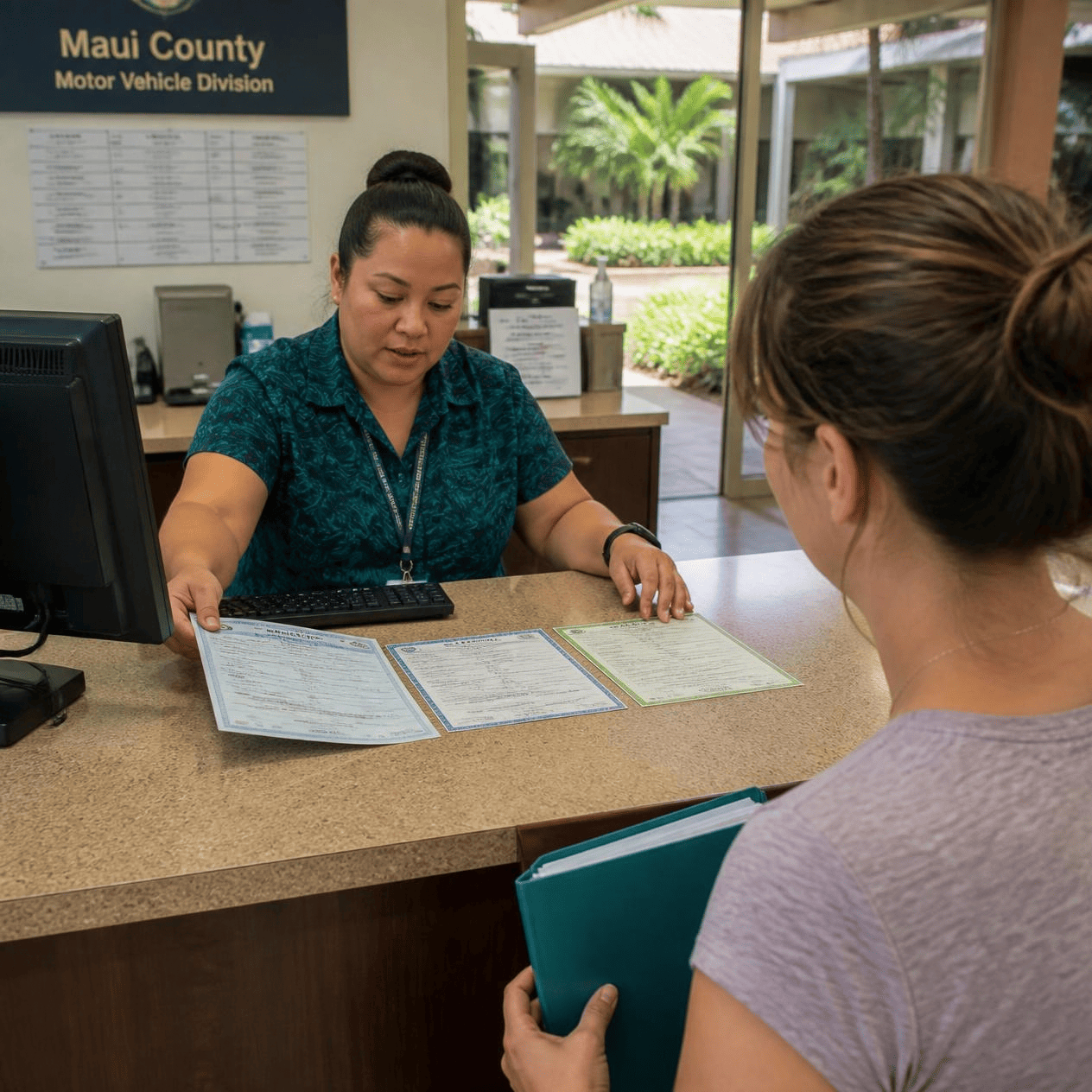
Maui County’s Bill of Sale, Form DMVL590, contains a notary section. It records the vehicle, consideration paid, buyer, seller, lien information and odometer declaration. Complete its acknowledgment when using that form.
For an ordinary supporting receipt, record the vehicle’s year, make, model and VIN; buyer and seller details; actual price; sale date; mileage; and signatures. A generic receipt does not replace a notarized document specifically requested by the county.
What Documents Must the Buyer Collect?
Hawaii County, Maui County and Kauai County ownership-transfer checklists center on the following documents:
Properly endorsed title: Include the required seller, buyer and lienholder signatures.
Last-issued registration: Obtain the vehicle’s registration certificate, not just a photograph of its plate.
Safety-inspection certificate: Provide a current certificate or a temporary document accepted for the transaction.
Lien release: Obtain the lender’s endorsement or accepted release documentation when a lien appears.
Identification and special authorizations: Bring identification and any required power of attorney or business authorization.
On the commonly used Hawaii title, the seller completes Section A, the existing lienholder releases its interest in Section B, and the buyer completes Section D. A new lienholder uses Section E, where applicable.
Follow the actual document’s labels. Both owners must complete the required signatures when the vehicle is jointly owned or being registered jointly.
What Are Hawaii’s Buyer and Seller Deadlines?
Buyer: Submit the Transfer Within 30 Calendar Days
Under HRS §286-52(b), the usual deadline is 30 calendar days after the transfer. Missing it generally adds $50 to the applicable transfer charge.
The statute allows 60 days when the recorded lienholder does not have an office in Hawaii. Do not assume that exception applies merely because the buyer or seller is visiting another state.
Seller: File the Notice of Transfer Within 10 Days
Under HRS §286-52(j), a private seller must notify the county within 10 days.
Send the notice to the county where the vehicle was last registered. Honolulu uses CS-L(MVR)53 when the notice attached to the title is unavailable; other counties provide their own versions.
The notice and the buyer’s application are separate filings. Keep a copy showing the buyer’s name, address, vehicle identification and transfer date.
How Much Does a Hawaii Ownership Transfer Cost?
Published county instructions list these charges for ordinary local ownership transfers:
Hawaii County: $5.
Honolulu: $10.
Kauai County: $10.
Maui County: $20.
These are transfer charges, not complete registration totals. First-time Hawaii registration, replacement plates and other special transactions can follow different fee rules.
The counties also require registration renewal when the existing registration has expired or will expire within 45 days. Outstanding registration taxes can increase the amount due, so inspect the registration record before agreeing on the final cost.

Does a Private Car Sale Have Hawaii Sales Tax?
Do not automatically add 4% or 4.5% to an ordinary private-sale price. Hawaii’s general excise tax is a tax on business activity, and qualifying casual sales receive different treatment.
The Hawaii Department of Taxation’s casual-purchase exemption guidance explains that a qualifying sale by someone who is not in the business of selling that property is excluded from general excise tax. Property acquired through a qualifying casual purchase is also excluded from use tax.
A dealer sale or a business regularly disposing of inventory is not automatically a casual sale simply because the vehicle is used.
The exemption does not eliminate county transfer fees, annual vehicle taxes, registration charges or inspection expenses. Keep the sale record identifying the actual seller and transaction.
What Happens if the Safety Inspection Has Expired?
A used passenger vehicle generally needs an annual Hawaii safety inspection. New vehicles receive an initial two-year period before moving to annual inspections, according to Honolulu’s inspection guidance.
Check the certificate itself, not just the sticker on the vehicle.
Registration Problems Can Require Two Visits
Maui’s registration instructions allow a temporary safety-inspection certificate when all defects except registration have been corrected.
The practical sequence is to obtain the inspection, complete the county registration transaction with the accepted temporary document, and then finish the inspection process with the updated registration.
Bring the required insurance identification card to the inspection station. A failed inspection for brakes, tires or another safety defect is not equivalent to a registration-only failure.

What Changes When the Vehicle Comes From Another State?
An incoming vehicle needs more than the seller’s receipt. County out-of-state registration instructions generally call for the original ownership documents, Hawaii safety inspection, registration application and bill of lading or shipping receipt showing the arrival date.
A weight certificate may also be necessary when the manufacturer’s established vehicle weight is unavailable.
For a Washington-titled purchase, review the Washington bill of sale and title guide before shipping. Collect the seller’s ownership documents before the car leaves the mainland.
Maui’s checklist also requires Form G-27, Motor Vehicle Use Tax Certification, for specified recent-model vehicles bought outside Hawaii. A tax exemption and the need to document that exemption are separate questions.
Moving Between Islands Is Not an Out-of-State Transfer
A vehicle already registered in another Hawaii county follows the receiving county’s intercounty process.
For example, Honolulu requests its registration application, the properly endorsed title, last-issued registration and current safety certificate for a vehicle arriving from another county. Do not assume the existing Hawaii registration eliminates the county update.
Do Hawaii License Plates Stay With the Vehicle?
Under the ordinary framework in HRS §249-7, standard plates generally remain assigned to the vehicle when ownership changes. Plate reassignment and personalized plates require separate county handling.
Honolulu’s personalized-plate instructions provide procedures to store, transfer or retire those plates. A seller should not promise the buyer the right to keep a personalized combination without arranging it through the county.
For a vehicle leaving Hawaii for Alaska, the Alaska bill of sale guide covers the destination-state sale documentation. Complete the Hawaii transfer notice separately and retain the shipping records.