
Bill of Sale Sep 22, 2026
Georgia uses Form T-7 to document a private vehicle sale, but it does not replace the required title for most model-year 1986 and newer vehicles. Georgia’s statewide registration guidance gives private buyers seven business days to register the purchase. Use KarKiosk’s free vehicle bill of sale PDF for a separate transaction record, alongside the ownership documents and required state forms.
Georgia Bill of Sale Quick Facts
Requirement | Georgia Rule |
Official bill of sale | T-7 |
Title and registration application | MV-1 |
Standard T-7 notarization | No notarial acknowledgment on the form |
Ordinary passenger vehicles requiring titles | Model year 1986 and newer |
Private-purchase registration deadline | Seven business days under statewide registration guidance |
Standard Title Ad Valorem Tax | 7% of the vehicle’s fair market value |
Standard title fee | $18 |
Standard passenger registration | $20 |
Emissions testing | Applies to covered vehicles in 13 metro Atlanta counties |
Seller’s plate | Retained by the seller; registration canceled separately |
These requirements are set out in Georgia’s registration guidance, DOR’s casual-sale checklist, Form T-7 and its motor vehicle tax and fee schedules.
When Is a Georgia Bill of Sale Required?
Form T-7 provides evidence of the sale, the agreed price and the mileage declaration. Georgia’s official seller instructions identify it as proof of the transaction.
Its role becomes particularly important for a title-exempt vehicle from model year 1985 or earlier. DOR’s casual-sale checklist requires a bill of sale for that transaction.
For a vehicle that requires a title, the seller must provide the properly assigned original title. A completed T-7 cannot replace a missing title simply because both parties agree to use it.
What Information Goes on Form T-7?
The Georgia Department of Revenue’s T-7 instructions divide the form into vehicle, seller, buyer, lienholder and certification sections.
Complete the applicable information:
Vehicle details: VIN, year, make and model.
Transaction details: Actual purchase price and sale or transfer date.
Mileage: Odometer reading without tenths, or the applicable exemption.
Buyer and seller details: Full legal names and addresses.
Liens and certification: Existing lienholder information and the required signatures.
The form carries a specific warning:
“ANY CORRECTION OR ALTERATION WILL VOID THIS FORM.”
Prepare a clean replacement when information is entered incorrectly. Do not use correction fluid or overwrite a disputed price or sale date.
Does T-7 Need to Be Notarized?
The standard T-7 contains buyer and seller certifications but no notarial acknowledgment. Complete the required signatures rather than treating notarization as part of the ordinary form.
Other documents can have separate requirements. An out-of-state title or an affidavit used to correct ownership paperwork must follow its own instructions.
What Does the Buyer Take to the County Tag Office?
DOR’s Title and Register a Vehicle Purchased in a Casual Sale checklist calls for:
Georgia driver’s license or identification card.
Properly assigned original title, or accepted documents for a title-exempt vehicle.
Completed MV-1 Title/Tag Application.
Sale and lien documents, including applicable releases.
Insurance evidence, such as coverage filed electronically by the insurer or an accepted insurance binder.
Passing emissions documentation, when required.
Payment for the applicable title, registration and tax charges.
Complete the transaction at the County Tag Office where the buyer lives. Do not assume a driver-license office handles the title application.
For a South Carolina-titled purchase, collect the seller’s documents using the South Carolina bill of sale and title guide. Georgia then applies its own registration and tax requirements.
What Changes for a Title-Exempt Older Vehicle?
For a qualifying 1985 or older vehicle, the bill of sale supports registration when a title is not required.
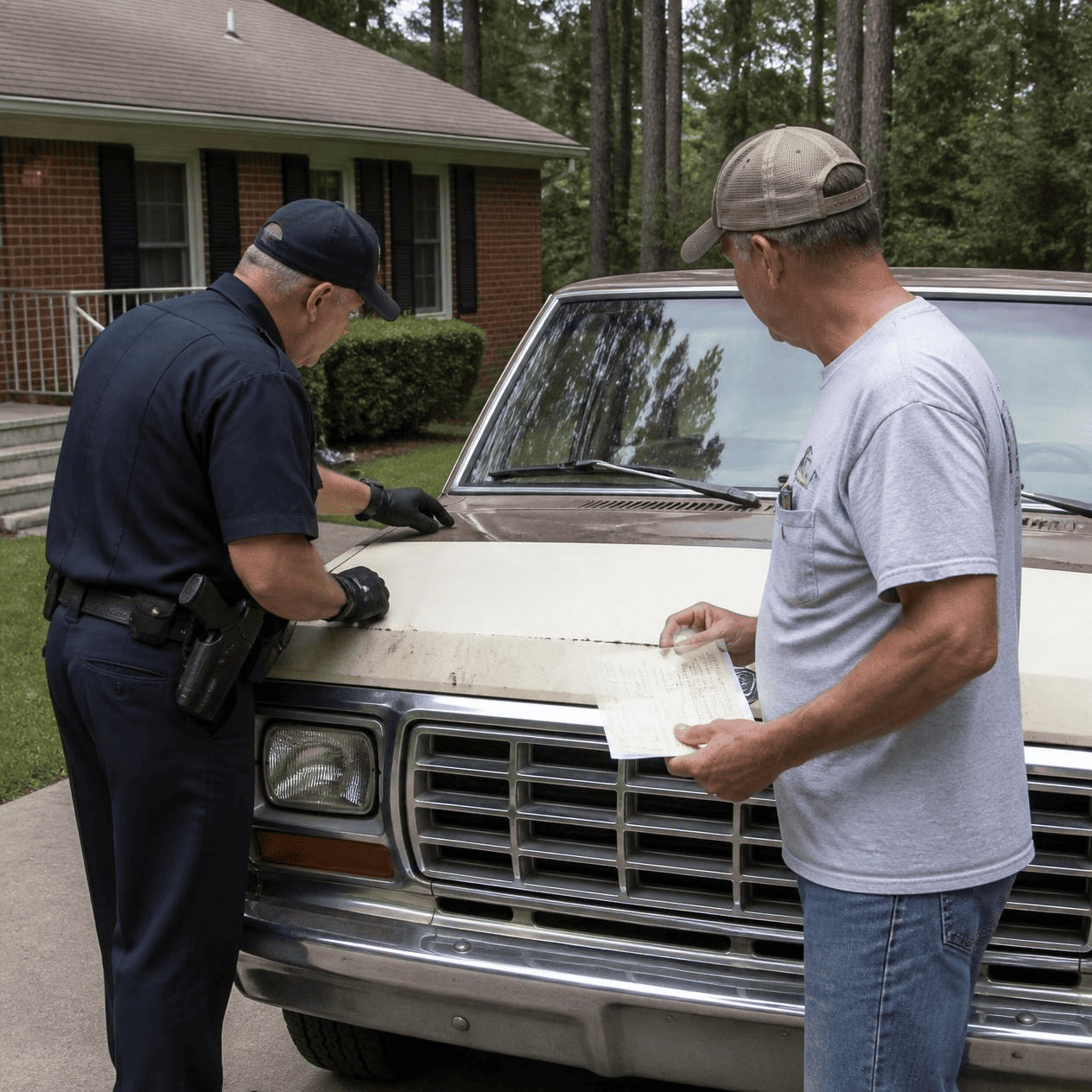
DOR also requires T-22B, Certification of Inspection, when that vehicle has not previously been registered in Georgia. This is completed through the applicable law-enforcement inspection process.
An older-car exemption is not a workaround for a newer vehicle with missing ownership paperwork.
Is the Georgia Deadline Seven Days or 30 Days?
The Georgia registration requirements specify seven business days for a resident who buys from another individual.
DOR’s separate casual-sale checklist instructs buyers to complete title and registration within seven days. Arrange the complete application during the first week rather than waiting for the later penalty thresholds.
The 30-Day Penalty Rules Do Not Extend Registration Time
DOR’s Motor Vehicles Fees, Fines, and Penalties schedule lists:
Late title application after 30 days: $10.
Unpaid casual-sale TAVT after 30 days: A penalty of 10% of the tax.
Continued TAVT delinquency: An additional 1% for each subsequent month.
These are separate from the earlier private-purchase registration requirement. A reference to “30 days” on a title-fee page does not give a private buyer a general 30-day registration window.
How Much TAVT Applies to a Georgia Private Car Sale?
The Georgia Department of Revenue’s vehicle-tax guidance sets the standard Title Ad Valorem Tax, or TAVT, at 7% of fair market value.
For vehicles subject to TAVT, it replaces ordinary sales tax and annual vehicle ad valorem tax. It is generally due when ownership transfers—not just when the vehicle is sold new.
The Bill-of-Sale Price Does Not Necessarily Set the Tax
DOR’s TAVT FAQ explains that used-vehicle fair market value generally comes from the state’s motor vehicle assessment manual.
For example, a car purchased privately for $15,000 but assessed at $20,000 produces $1,400 in standard TAVT, before other charges or qualifying adjustments.
Record the actual price on T-7, but budget using the state valuation rather than assuming a negotiated discount creates an identical tax reduction.

What Other Fees Does the Buyer Pay?
DOR’s standard fee schedule lists an $18 title fee and $20 registration fee for a regular passenger car or lightweight pickup.
For a vehicle assessed at $20,000, standard TAVT plus these two charges totals $1,438:
$1,400 TAVT + $18 title + $20 registration.
This example excludes emissions testing, specialty-plate charges, penalties and any other applicable fees.
Paying TAVT does not remove the requirement to renew the vehicle’s registration in later years.
Does the Vehicle Need a Georgia Emissions Test?
Georgia’s Environmental Protection Division administers testing for covered vehicles in 13 metro Atlanta counties:
Cherokee, Clayton, Cobb, Coweta, DeKalb, Douglas, Fayette, Forsyth, Fulton, Gwinnett, Henry, Paulding and Rockdale.
For 2026 registration, official county guidance identifies covered gasoline-powered cars and light-duty trucks from model years 2002 through 2023, with a gross vehicle weight rating of 8,500 pounds or less, subject to applicable exemptions.
The buyer’s registration county matters. Purchasing from someone outside the testing area does not automatically eliminate the requirement.
Who Must Provide the Passing Test?
Under Georgia Rule 391-3-20-.18, a covered vehicle intended for highway use must have a current passing emissions certificate when sold for registration in a covered county.
Check the actual inspection record before completing the purchase. Writing “as is” does not itself create an emissions exemption.
The state’s inspection rules cap the standard test charge at $25.

What Must the Georgia Seller Do After the Sale?
Georgia’s official Sell a Motor Vehicle instructions separate the seller’s responsibilities into ownership, plates and registration.
Complete the title assignment and give the required ownership documents to the buyer. Keep copies of the assigned title and bill of sale.
Then:
Remove and retain the license plate.
Cancel the sold vehicle’s registration, using the applicable state or county process.
Cancel the vehicle’s insurance after registration cancellation.
A retained plate may be transferred to another eligible vehicle through the proper process. It does not transfer automatically to the buyer.
For a buyer taking the car to North Carolina, the North Carolina bill of sale and title guide covers destination-state requirements. The Georgia seller must still complete the Georgia cancellation steps.