Seller Guide Oct 19, 2026
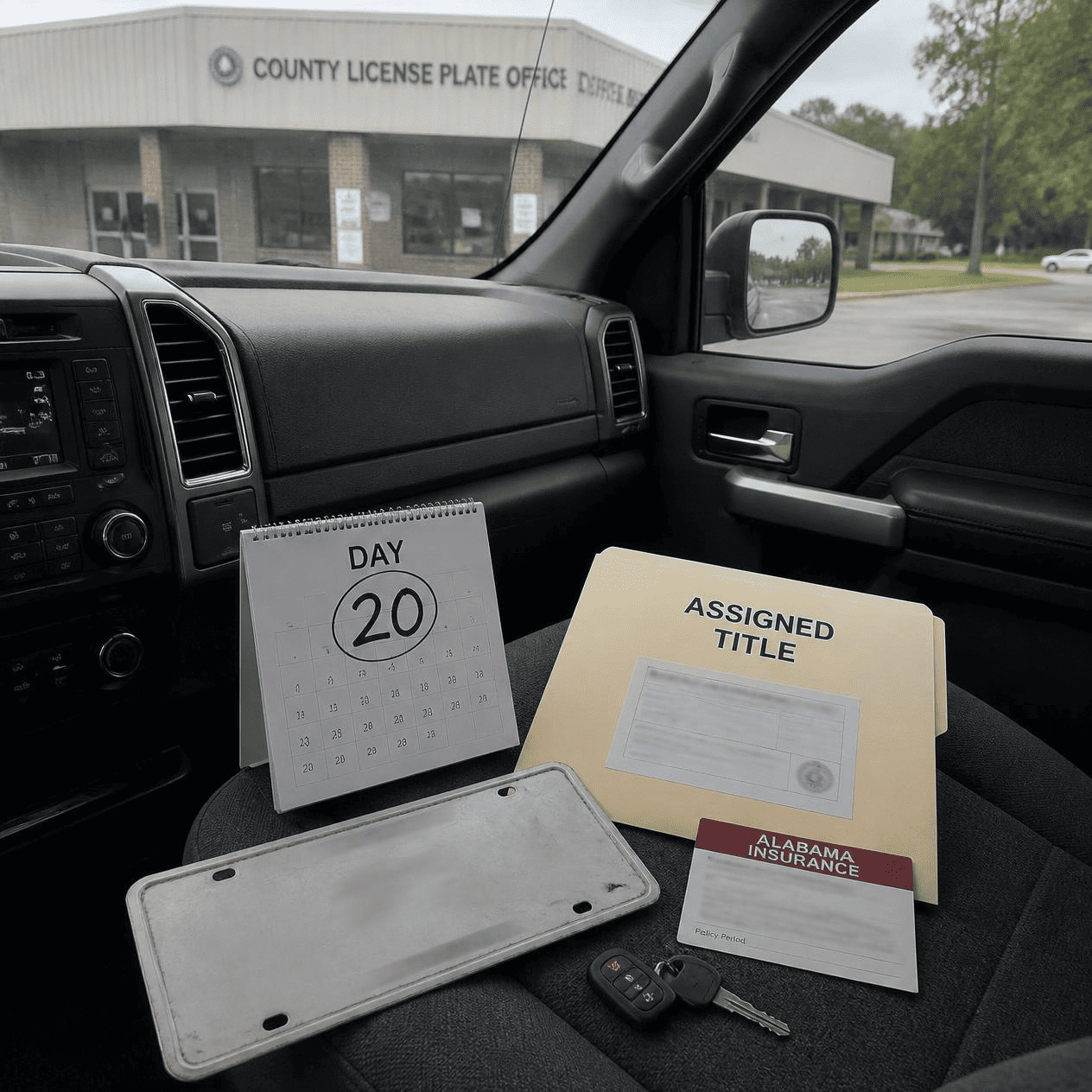
An Alabama bill of sale records the buyer, seller, vehicle, price, and acquisition date, but it does not replace a properly assigned title when the vehicle is subject to Alabama title law. The buyer must complete the title process and obtain an Alabama license plate within 20 calendar days after acquiring the vehicle.
A bill of sale becomes particularly important when the vehicle is old enough to fall outside Alabama’s title requirement. Alabama requires specific buyer, seller, vehicle, price, and signature information in a qualifying sales document.
Download the free KarKiosk vehicle bill of sale PDF before payment and vehicle handover. It gives both parties a signed record of the VIN, mileage, actual price, addresses, and sale date to keep with the title or registration documents.
The Title and Bill of Sale Perform Different Jobs
The certificate of title establishes and transfers ownership when Alabama requires a title.
The bill of sale records the financial and practical terms of the transaction.
A buyer should not accept only a bill of sale when the vehicle should have a valid title. The seller should provide the original title with the buyer information, sale date, odometer information, and required owner signatures completed.
Alabama generally applies its title requirement to motor vehicles that are 35 model years old or newer. A certificate of title or title application must be in place before a license plate can be issued for a vehicle subject to the title law.
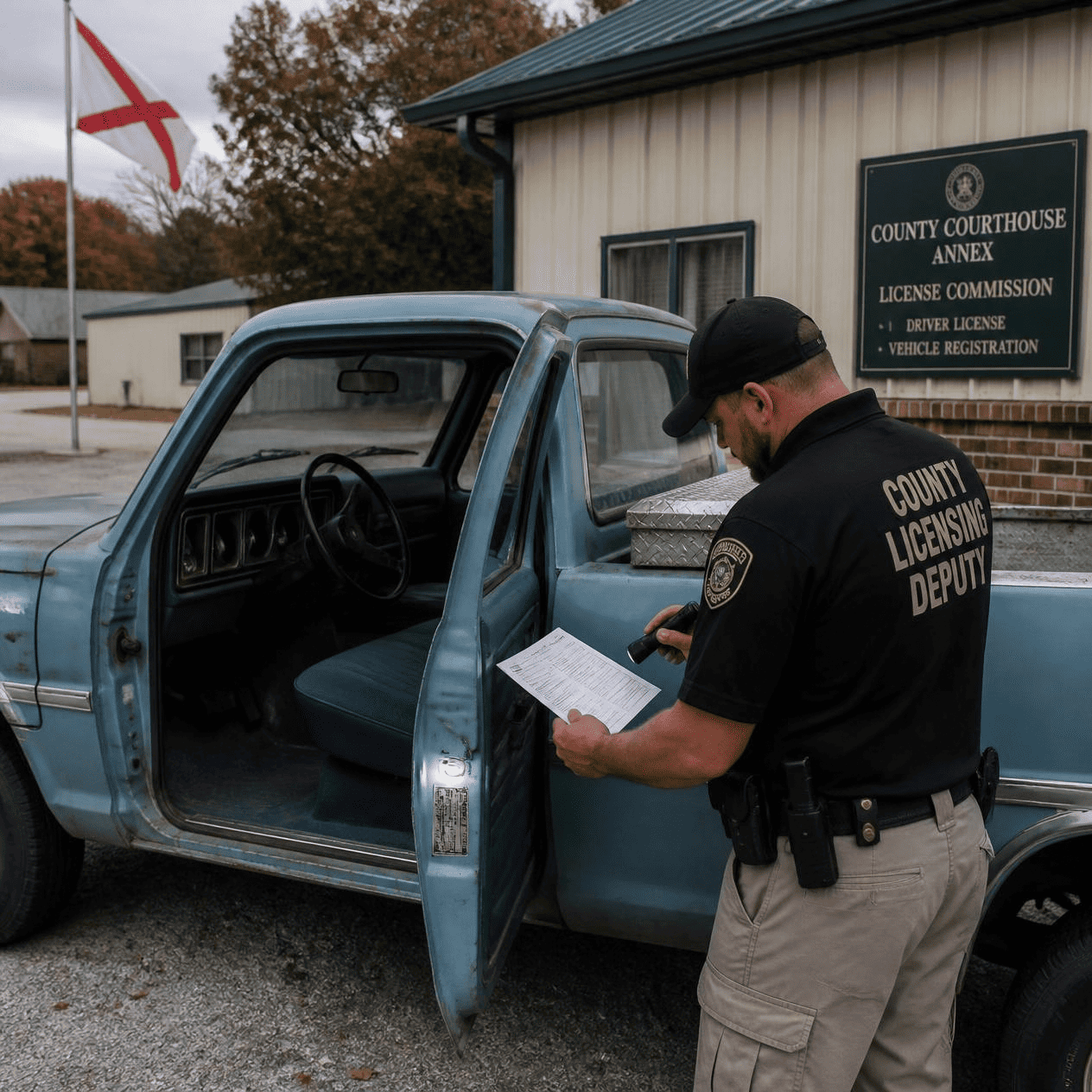
For a vehicle that does not require an Alabama title, the licensing official issues registration after reviewing the ownership evidence and inspecting the vehicle.
For comparison, KarKiosk’s Hawaii Bill of Sale guide explains a county-administered system with different title-release and seller-reporting rules.
Alabama Private Vehicle Sale Rules
Item | Alabama Rule | Why It Matters |
Main ownership document | Properly assigned title when title law applies | Transfers the seller’s ownership interest |
Bill of sale | Required ownership evidence in specified non-title transactions | Records the parties, vehicle, date, and price |
Buyer registration deadline | 20 calendar days | Late registration can trigger a penalty and interest |
State casual sales tax | 2% | County and municipal rates can be added |
State title fee | $15 | Processing and local charges can also apply |
Standard passenger registration | $23 | Plate issuance, local fees, tax, and ad valorem charges are additional |
Standard plate issuance | $1.25 | Collected with the registration transaction |
Plate transfer | $1.25 state transfer fee | Local issuance charges can be added |
Title assignment notarization | Not required | Standard Alabama title assignment can be signed without a notary |
Plates after sale | Seller removes them | Plate can sometimes transfer to the seller’s replacement vehicle |
Emissions testing | Not required statewide | Alabama does not make emissions testing a registration prerequisite |
What an Alabama Bill of Sale Must Contain
Alabama’s administrative rule sets minimum information for a valid motor vehicle bill of sale or equivalent sales document.
Include:
Buyer’s full legal name.
Buyer’s complete physical address.
Exact sale or acquisition date.
Full VIN.
Vehicle make.
Vehicle year.
Model or series.
Body type.
Seller’s full name.
Seller’s complete address.
Buyer’s and seller’s signatures.
Actual purchase price.
A post-office box alone does not provide the buyer’s required physical address.
The vehicle information should match the title, dashboard VIN plate, and driver-door certification label.
Do not reduce the written price to lower the buyer’s tax.
Does an Alabama Title Need to Be Notarized?
No. Alabama does not require the standard assignment of a certificate of title or Manufacturer’s Statement of Origin to be notarized.
Notarization can still appear in special transactions involving:
A power of attorney.
An estate.
A court order.
A title correction.
A disputed ownership claim.
The ordinary buyer and seller should focus on completing the correct title sections without erasures, whiteout, or blank purchaser information.
Joint Owners Must Follow the Title Wording
The conjunction between the owners’ names controls who must sign.
Owner A AND Owner B: both owners must sign.
Owner A OR Owner B: one listed owner can generally sign.
Do not assume one spouse can sign for another when the title uses “and.”
When the assignment contains an error, Alabama can require the appropriate title-correction affidavit rather than a handwritten change on the title.
The Buyer Has 20 Calendar Days
The buyer must obtain an Alabama license plate within 20 calendar days from the acquisition date.
For a titled vehicle, the title application must be completed before registration can be processed.
The buyer also needs Alabama liability insurance. Licensing officials verify coverage electronically and can request proof when the state system cannot confirm it.
If the twentieth day falls on a Sunday, legal holiday, or a day when the licensing office is closed, the next working day becomes the last day to register without the delinquent charge.
A buyer who registers late can owe a $15 penalty plus interest.
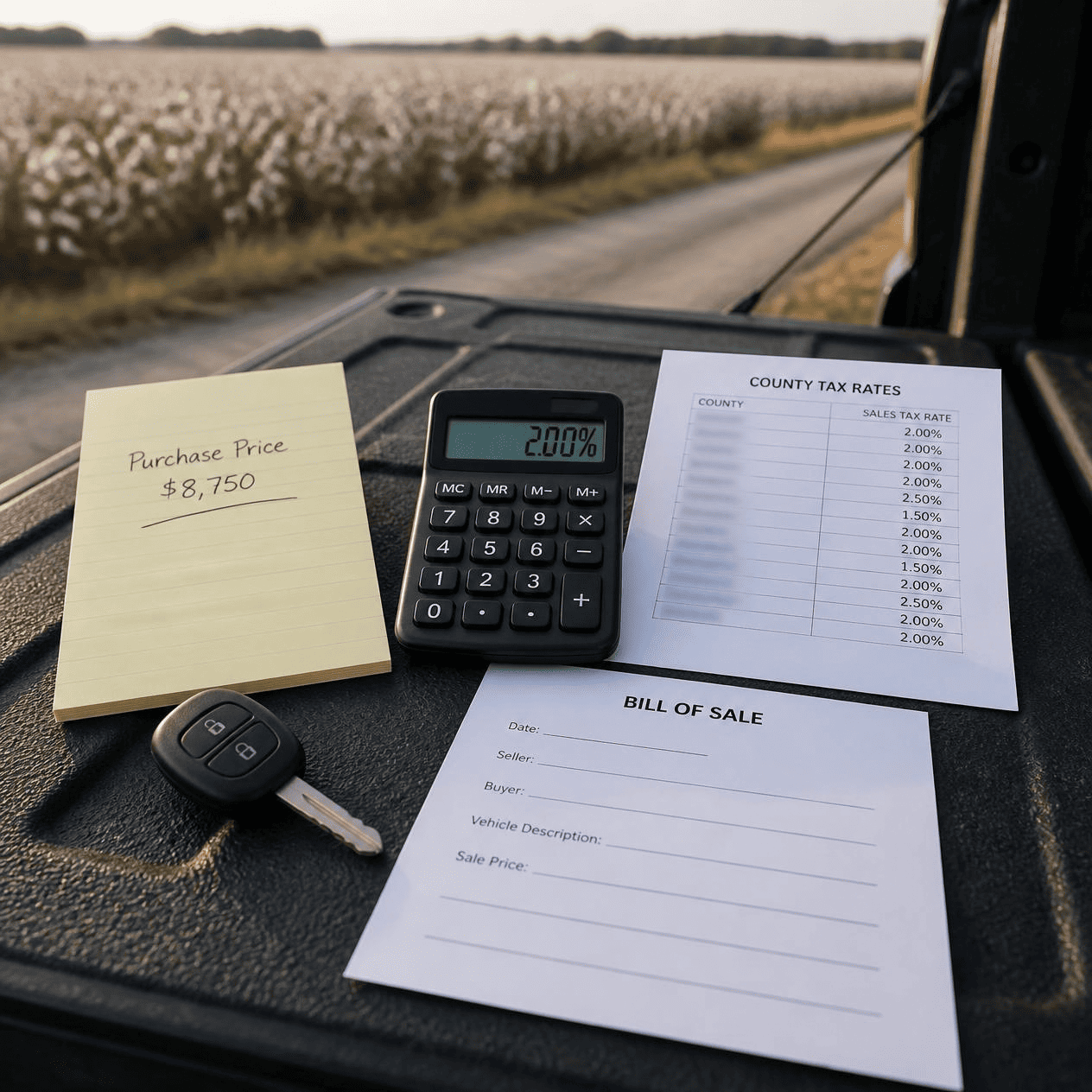
Alabama Charges 2% State Casual Sales Tax
A private purchase from someone who is not a licensed vehicle dealer is generally subject to Alabama casual sales tax.
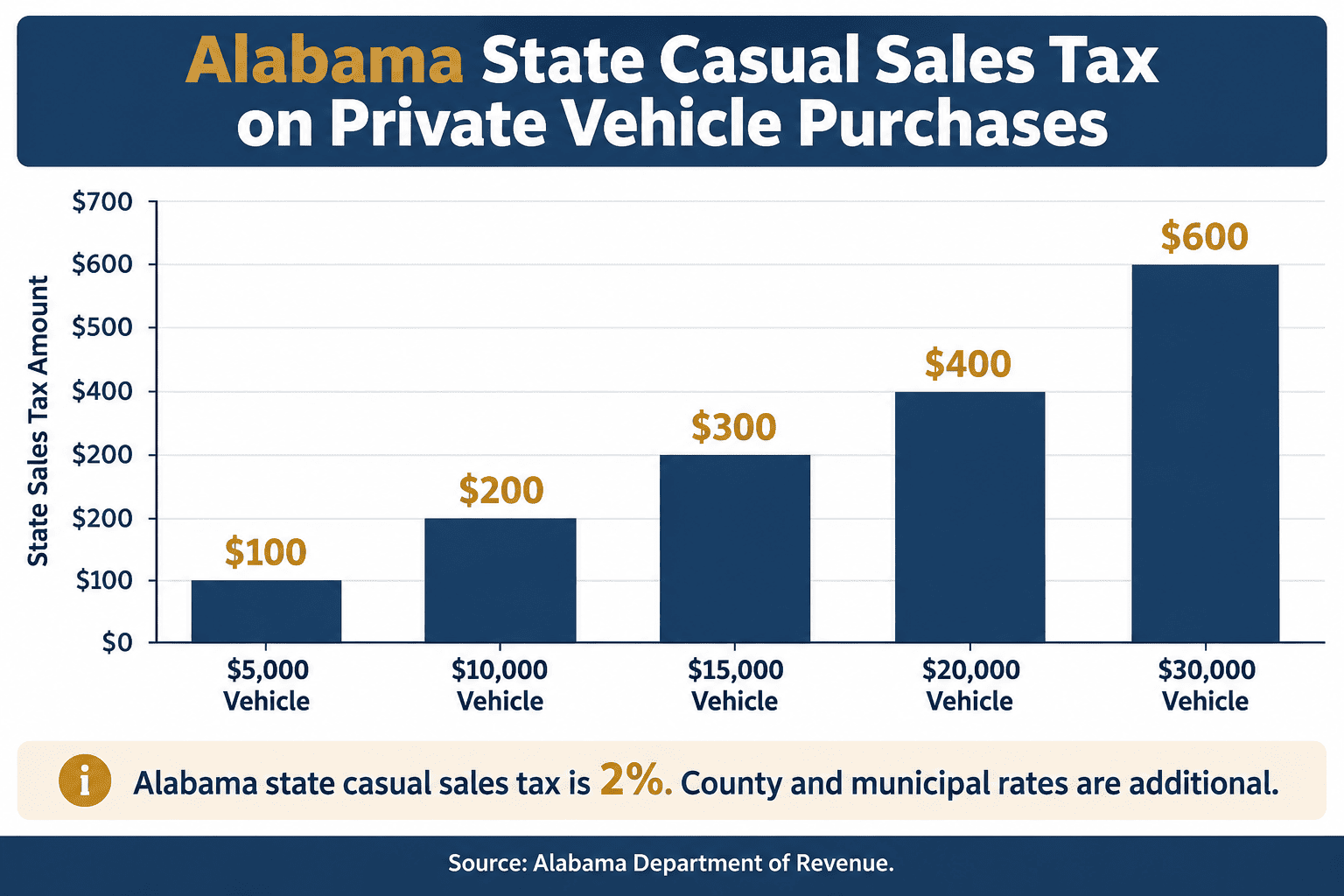
The state rate is 2%.
Applicable county and municipal casual sales-tax rates are added to the state rate.
Tax Examples Before Local Rates
$5,000 purchase: $100 state tax.
$10,000 purchase: $200 state tax.
$15,000 purchase: $300 state tax.
$20,000 purchase: $400 state tax.
$30,000 purchase: $600 state tax.
These examples show only the 2% state portion.
The county licensing office calculates the complete amount due for the buyer’s location.
Title and Registration Charges Are Separate From Tax
The state title fee is $15.
A standard passenger registration is $23, and the standard plate issuance charge is $1.25. Local fees, ad valorem tax, processing charges, and sales tax can increase the total.
The state plate-transfer fee is $1.25, although individual counties can add local issuance charges.
The buyer should request a complete county calculation rather than adding only the title and plate amounts.
The Seller Removes the Alabama Plate
The plate does not automatically stay with the sold vehicle.
Alabama requires the registrant to remove the plate when the vehicle is sold or otherwise disposed of.
The seller may be able to transfer that plate to another vehicle.
The buyer should not leave using registration credentials belonging to the seller.
The seller should retain:
Signed bill of sale.
Copy or photograph of the assigned title.
Buyer’s name and address.
Payment record.
Date and time of vehicle handover.
Idaho’s approach is different because its official bill-of-sale form and title process have their own requirements. See KarKiosk’s Idaho Bill of Sale guide.
Alabama Does Not Require Emissions Testing
Alabama does not require emissions testing as a prerequisite to registration.
A routine in-state transfer involving a current Alabama title also does not require a new physical VIN inspection.
A vehicle being processed without a required certificate of title is different. The licensing official or an appointed deputy must inspect the vehicle and ownership evidence before registration is issued.
Out-of-state and first-title transactions can also require physical vehicle and VIN verification under Alabama title rules.
What If the Alabama Title Is Missing?
A standard bill of sale does not replace a missing title when Alabama title law applies.
The titled owner should obtain a replacement title before completing the private sale.
The buyer should not accept:
A title signed to someone else.
A photocopy offered as the ownership document.
A promise that the title will be supplied later.
A bill of sale from a seller who does not appear in the ownership chain.
Resolve the title before final payment.
How to Complete an Alabama Private Vehicle Sale
Confirm whether the vehicle requires an Alabama title.
Match the seller’s identity with the title.
Compare the VIN on the title and vehicle.
Obtain a lien release when required.
Complete the title assignment.
Complete a detailed bill of sale.
Record the actual purchase price and mileage.
Have all required owners sign.
Remove the seller’s Alabama plate.
Obtain Alabama insurance.
Complete title and registration within 20 calendar days.
Pay casual sales tax, title, registration, and local charges.
Common Alabama Private-Sale Mistakes
Treating the bill of sale as a universal substitute for the title.
Leaving the purchaser section blank.
Omitting the buyer’s physical address.
Reporting a false purchase price.
Letting the buyer use the seller’s plate.
Missing the 20-day registration deadline.
Assuming the standard title assignment needs notarization.
Ignoring inspection requirements for a non-title vehicle.