
Bill of Sale Sep 22, 2026
An Iowa private vehicle sale requires a properly assigned title and a record of the transaction, although newer Iowa titles can contain the bill-of-sale information directly in the transfer section. The buyer must transfer the title within 30 days of purchase. Use KarKiosk’s free vehicle bill of sale PDF to keep a separate record of the VIN, price, mileage, sale date and parties.
Iowa Bill of Sale Quick Facts
Requirement | Iowa Rule |
Main ownership document | Properly assigned certificate of title |
Bill of sale | Required unless the applicable Iowa title itself contains the accepted sale information |
Title application | Form 411007 |
Buyer’s title deadline | 30 days after purchase |
Fee for new registration | $10 plus 5% of the vehicle’s sales price |
Odometer disclosure | Required for model-year 2011 and newer vehicles through 2030, unless exempt |
Damage disclosure | Required for applicable recent-model vehicles |
Seller’s plates | Removed from the sold vehicle |
Seller’s Notice of Sale | Form 411107; optional but useful |
Plate-free operation | Limited 30-day rule when the vehicle remains currently registered and required proof is carried |
Does Iowa Require a Separate Bill of Sale?
Iowa DOT tells private sellers to give the buyer a bill of sale along with the assigned title and other applicable disclosures.
However, whether that means a separate sheet of paper depends on the version of the Iowa title.
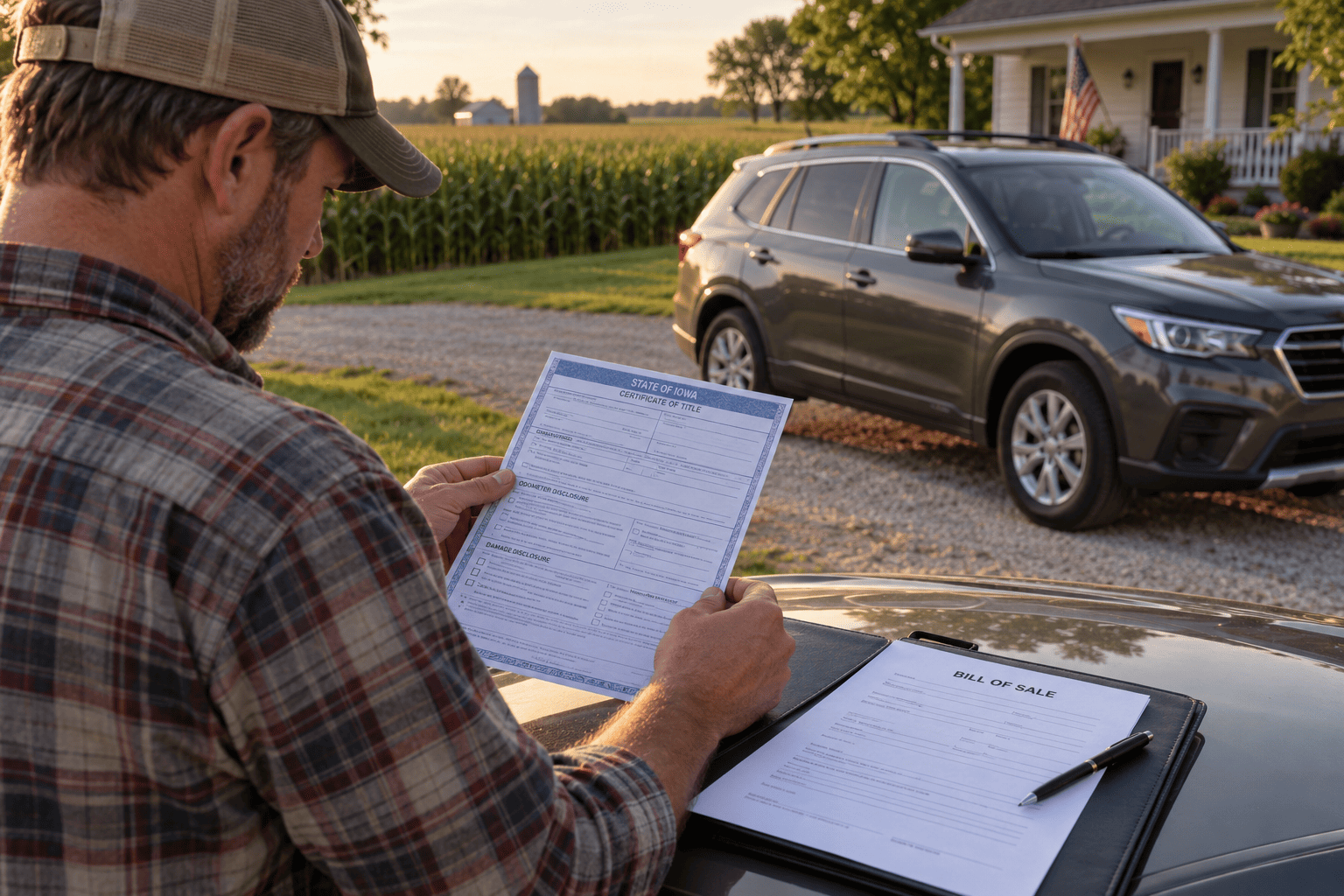
The Iowa DOT private vehicle sale guidance explains that an updated Iowa Certificate of Title can itself serve as the bill of sale when its Transfer/Sale Date section contains the necessary transaction information.
If the title does not include that section, prepare a separate bill of sale.
A good sale record should identify:
Buyer and seller.
Vehicle year, make and model.
Complete VIN.
Actual purchase price.
Sale and delivery date.
Current mileage.
Buyer and seller signatures.
The bill of sale supports the transaction. It does not replace a title that should legally exist.
For a vehicle purchased across the Missouri border, review the Missouri bill of sale requirements before collecting the seller’s title and disclosure documents.
What Documents Should an Iowa Buyer Receive?
For an ordinary Iowa-titled used vehicle, the buyer should collect:
Properly assigned title: The seller completes the transfer information on the reverse.
Bill of sale or accepted sale section: Shows the transaction details and price.
Odometer disclosure: Required when the vehicle falls within the federal and Iowa mileage-disclosure period.
Damage disclosure: Required when the vehicle falls within Iowa’s applicable age rules.
Lien release: Required when an unreleased security interest appears on the title.
County and registration information: The seller provides the county where the vehicle was last registered and the registration expiration date.
The buyer then submits the title application and supporting documents through a county treasurer.
Does the Iowa Bill of Sale Need Notarization?
Iowa DOT’s normal private-sale instructions do not list notarization as a standard requirement for the ordinary bill of sale.
Buyer and seller signatures still matter. Both parties should keep matching copies rather than relying on an unsigned payment receipt.
Special ownership documents, estate transactions or another state’s title can carry separate signature requirements.
Iowa Gives the Buyer 30 Days to Transfer the Title
Iowa requires the buyer to transfer the title within 30 days after purchase.
The seller should deliver the title at the time of sale rather than promising to provide it later. A bill of sale without the ownership document can leave the buyer unable to complete a normal transfer.
Iowa DOT states that:
“the title needs to be transferred by the buyer within 30 days”
Do not treat the 30-day title period as permission to postpone collecting a properly assigned title.
The buyer should also verify that:
The VIN on the title matches the vehicle.
The seller’s identity matches the titled owner.
Recorded liens have been released.
The sale date is consistent across all documents.
Mileage and damage disclosures are completed where required.
How Does Iowa Tax a Private Vehicle Purchase?
Iowa does not apply ordinary state sales tax to a vehicle that is subject to registration.
Instead, the state charges a Fee for New Registration.
The Iowa Department of Revenue’s current tax and fee guidance sets that charge at:
$10 + 5% of the sales or lease price.
The fee also applies when the vehicle is sold between private individuals.
For example:
$5,000 vehicle → $260
$10,000 vehicle → $510
$15,000 vehicle → $760
$20,000 vehicle → $1,010
$30,000 vehicle → $1,510
These figures exclude title, annual registration, plate and other applicable charges.
Iowa Does Not Add Local Option Sales Tax to the Vehicle
Registered vehicles subject to the Fee for New Registration are not also charged Iowa local option sales tax as ordinary retail property.
That makes the private vehicle tax structure different from states that combine state and local sales-tax percentages at registration.

Iowa Has a Separate Damage Disclosure Rule
Iowa places unusual emphasis on vehicle damage disclosure during ownership transfers.
For vehicles subject to the rule, the seller must disclose qualifying prior damage at or before the sale.
The key threshold is 70% of the vehicle’s fair market value before it was damaged.
For example, if a vehicle was worth $22,000 before the loss and qualifying repairs cost $16,000, the repair cost exceeds 70% of the former value and the required damage disclosure must reflect that fact.
The calculation includes applicable repair expenses such as:
Labor.
Replacement parts.
Other repair materials.
Sales tax included in repair charges.
Do not assume that a repaired vehicle has no disclosure issue because the damage is no longer visible.
Which Iowa Vehicles Need an Odometer Disclosure?
For transfers occurring through December 31, 2030, Iowa requires odometer disclosure for model-year 2011 and newer vehicles, unless another exemption applies.
Beginning in 2031, the requirement moves to the federal 20-model-year formula.
The mileage is generally completed in the title assignment. If the odometer does not show the vehicle’s actual mileage, use the applicable mileage-status designation rather than entering an estimate as actual mileage.
Alterations to mileage information can delay the transfer.

What Happens to the Iowa License Plates?
The seller removes the plates from the vehicle.
If the seller purchases another vehicle within 30 days, Iowa allows eligible plates to be placed on the replacement vehicle while the transfer and required fees are handled.
If there is no replacement vehicle, the plates should be turned in to the county treasurer.
The seller may also be able to receive credit for unused registration fees when the vehicle is replaced within the applicable period. Iowa provides separate rules for refunds when no replacement is purchased.
Do not hand the old plates to the buyer simply because the registration has not expired.
Can an Iowa Buyer Drive Without Plates After a Private Sale?
Iowa has an unusually useful private-sale rule.
When the purchased vehicle is currently registered and the buyer does not have plates to transfer, Iowa permits operation for up to 30 days without plates if the driver carries either:
A bill of sale describing the vehicle and signed and dated by buyer and seller; or
The assigned title, or a photocopy of both sides of the assigned title.
This does not apply the same way when the vehicle’s registration is no longer current.
Iowa DOT recommends completing the county treasurer transaction promptly rather than relying on the plate-free period unnecessarily.
A 30-day temporary permit is also available through a county treasurer for $25 where appropriate.

Should the Seller File an Iowa Notice of Sale?
Iowa provides Form 411107, Notice of Sale of Vehicle and Delivery of Title.
The seller may file it with a county treasurer to create a record that:
The vehicle was sold or transferred.
Ownership was assigned.
The certificate of title was delivered to the buyer.
The filing is especially useful when buyer and seller do not complete the county transaction together.
Keep a copy of the assigned title or obtain a receipt showing that the buyer accepted both the vehicle and title.
What If the Vehicle Comes From Another State?
An out-of-state purchase still requires the properly assigned foreign title plus Iowa’s application and transaction documentation.
Odometer, lien and damage documentation can also apply.
Unlike some states, Iowa does not impose a routine VIN inspection on every normal out-of-state passenger vehicle solely because its title came from another state. Special title, reconstructed or identity questions can trigger additional review.
A buyer bringing in a Nebraska-titled vehicle should collect the seller’s documents using the Nebraska bill of sale guide before completing Iowa’s title process.