
Buyer Guide Oct 16, 2026
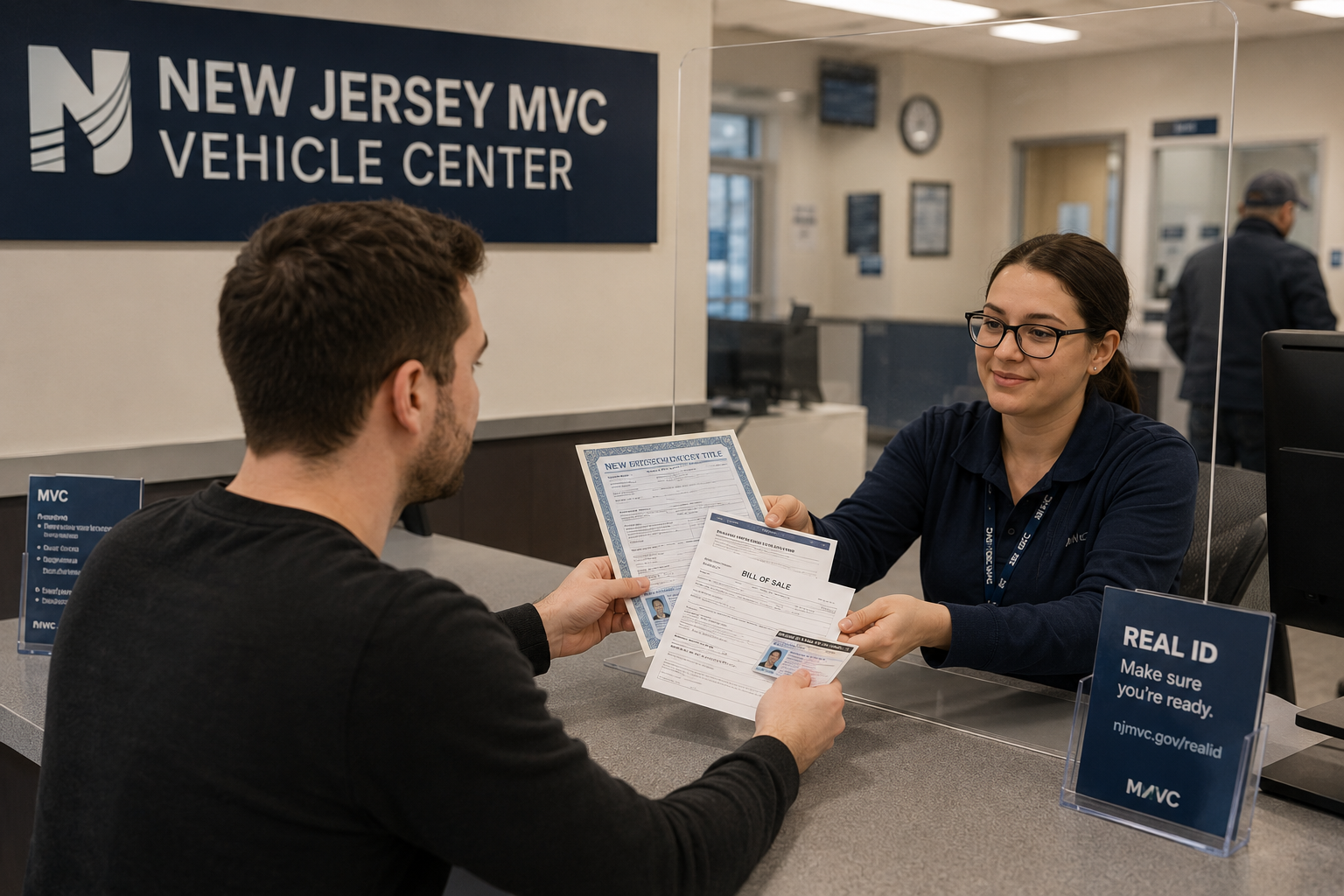
A New Jersey private vehicle sale requires both a properly assigned title and a bill of sale. The buyer must complete the ownership transfer in person at an MVC Vehicle Center within 10 working days to avoid a $25 late-transfer penalty.
Buyers and sellers can use KarKiosk’s free bill of sale PDF to prepare a clear written record of the vehicle, sale price, mileage, date, and parties involved.
The seller removes the plates before handing over the vehicle. The buyer then presents the title, identification, New Jersey insurance, registration application, tax payment, and applicable fees to MVC.
A New Jersey Sale Happens in Two Stages
The private handover does not complete the government transfer. The seller and buyer first complete the transaction documents, and the buyer then finishes the transfer at MVC.
Stage | Seller or Buyer Action |
Private sale | Seller assigns the title and gives the buyer a bill of sale |
Plate removal | Seller removes the New Jersey plates |
Buyer title acceptance | Buyer signs the reverse of the title and adds a driver licence or entity number |
MVC visit | Buyer appears at a Vehicle Center |
Registration | Buyer completes Form BA-49 when applicable |
Payment | Buyer pays sales tax, title fee, registration, and other charges |
New plates | MVC issues or transfers plates to the buyer |
Ownership transfers cannot be completed by mail. New Jersey requires the buyer to visit a motor vehicle agency.
New Jersey Does Not Use a Standard Numbered Bill-of-Sale Form
For an ordinary in-state private transaction, MVC provides content requirements instead of directing sellers to a numbered state bill-of-sale form.
MVC says the bill of sale accompanying the title must include:
Buyer’s name and address.
Date of sale.
Odometer reading.
Sale price.
The seller must also sign the seller section on the reverse of the title and deliver that title to the buyer.
A more complete bill of sale should also include:
Seller’s full legal name and address.
Vehicle year, make, model, and VIN.
Title number.
Payment method and payment status.
Any written condition or warranty terms.
Buyer’s and seller’s signatures.
The added information makes the document more useful if MVC or the Division of Taxation later asks the parties to prove the transaction.
What Must Be Completed on the Title?
For a New Jersey-titled vehicle, the assigned title must contain:
Seller’s and buyer’s names and addresses.
Seller’s and buyer’s signatures.
Date of sale.
Purchase price.
Buyer’s driver licence number or Entity Identification Number.
Accurate odometer reading.
The original assigned title is required. An incomplete bill of sale does not correct a missing buyer, missing signature, or improper assignment on the title.
What Does the Buyer Take to MVC?
Document or Payment | Purpose |
Properly assigned original title | Transfers ownership |
Bill of sale | Records the sale price, date, buyer, and mileage |
Form BA-49 | Applies for registration |
Buyer’s actual driver licence or identification | Confirms identity |
Proof of New Jersey insurance | Required for registration |
Lienholder and financing information | Required when the vehicle is financed |
Title fee | Pays for the new title |
Registration fee | Pays for plates and road registration |
Sales tax | Pays tax on the purchase |
A financed transaction can also require the Universal Title Application, Form OS/SS-UTA, and lienholder details.
Does a New Jersey Bill of Sale Need to Be Notarized?
A standard bill of sale for an ordinary New Jersey-titled private transaction is not listed as requiring notarization.
Notarization does apply in specific situations.
Vehicle From a State That Does Not Issue Titles
When the vehicle came from a state that does not issue titles, the buyer needs a notarized seller-to-buyer statement containing:
Vehicle year.
Make.
VIN.
Sale date.
Purchase price.
Both parties must sign the statement before it is notarized. The buyer must also provide the seller’s last registration card and a pencil tracing or printed photograph of the VIN plate.
Someone Else Signs for the Buyer or Seller
A person signing title or registration documents for someone else needs a general, durable, or limited power of attorney.
The power of attorney must be notarized and identify the person granting authority, the representative, and the powers granted. A limited power of attorney must also identify the specific vehicle and transaction.
The Buyer Has 10 Working Days
A New Jersey or dealer-reassigned title must be transferred within 10 working days from the sale date.
A $25 penalty applies when the buyer misses that deadline. The time period uses working days, not calendar days.
The buyer should arrange the MVC appointment immediately after the sale rather than assuming that weekends and holidays will create sufficient extra time.
How Much Sales Tax Does the Buyer Pay?
New Jersey applies a 6.625% sales tax to the purchase price of a new or used motor vehicle.
Private-Sale Purchase Price | State Sales Tax at 6.625% |
$5,000 | $331.25 |
$10,000 | $662.50 |
$15,000 | $993.75 |
$20,000 | $1,325 |
$30,000 | $1,987.50 |
These examples apply the official 6.625% rate to the stated purchase price. They do not include title or registration charges.
What If the Price Is Far Below Market Value?
The Division of Taxation can review whether tax was paid on the vehicle’s actual purchase price.
When the buyer paid less because the vehicle was damaged or in poor condition, supporting evidence can include:
Repair invoices.
Repair estimates.
Accident reports.
Photographs.
Seller’s affidavit confirming the price.
Bank or payment records.
Without adequate proof, the state may assess tax using its vehicle-value information.
Is a Gift Tax-Free?
A genuine gift that is free and clear of a lien is not subject to New Jersey sales tax.
When the recipient assumes a loan and was not already a co-owner, sales tax is due on the principal loan balance assumed. A barter, vehicle swap, service exchange, or transfer involving other consideration does not qualify as a tax-free gift.
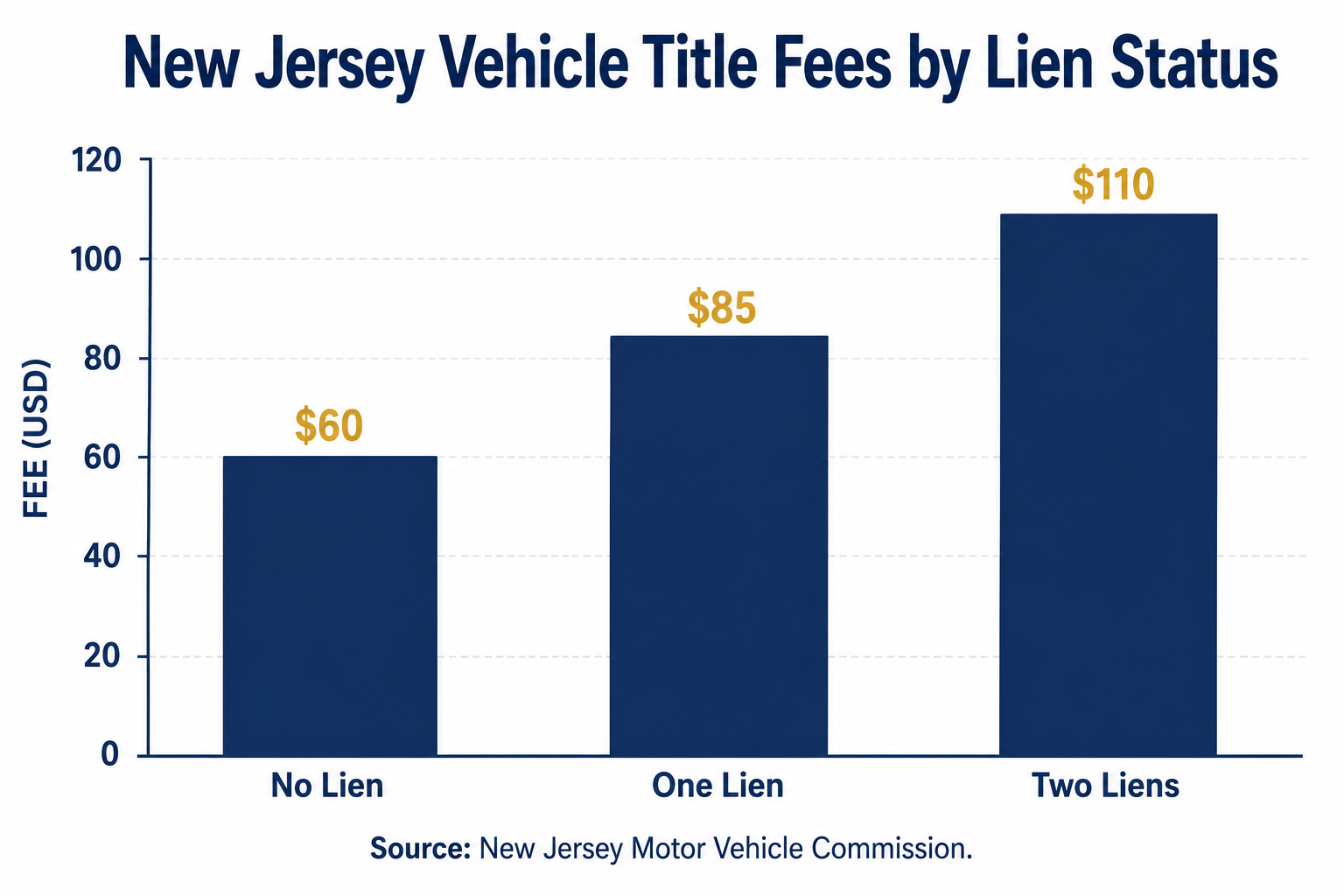
Title Fees Depend on the Number of Liens
Title Situation | Fee |
Standard title with no lien | $60 |
Financed title with one lien | $85 |
Financed title with two liens | $110 |
The buyer also pays registration and sales tax.
Registration Charges Depend on Age and Weight
New Jersey passenger registration fees vary according to the vehicle’s age and weight.
Common Passenger-Vehicle Category | Registration Fee |
More than two years old, under 3,500 pounds | $46.50 |
Within two model years, under 3,500 pounds | $59 |
More than two years old, over 3,500 pounds | $71.50 |
Within two model years, over 3,500 pounds | $84 |
Registration transfer | $4.50 plus any prorated increase |
Older vehicles from 1979 or earlier use separate fee categories. Zero-emission vehicles can also carry an additional statutory annual fee.
The Seller Must Remove the Plates
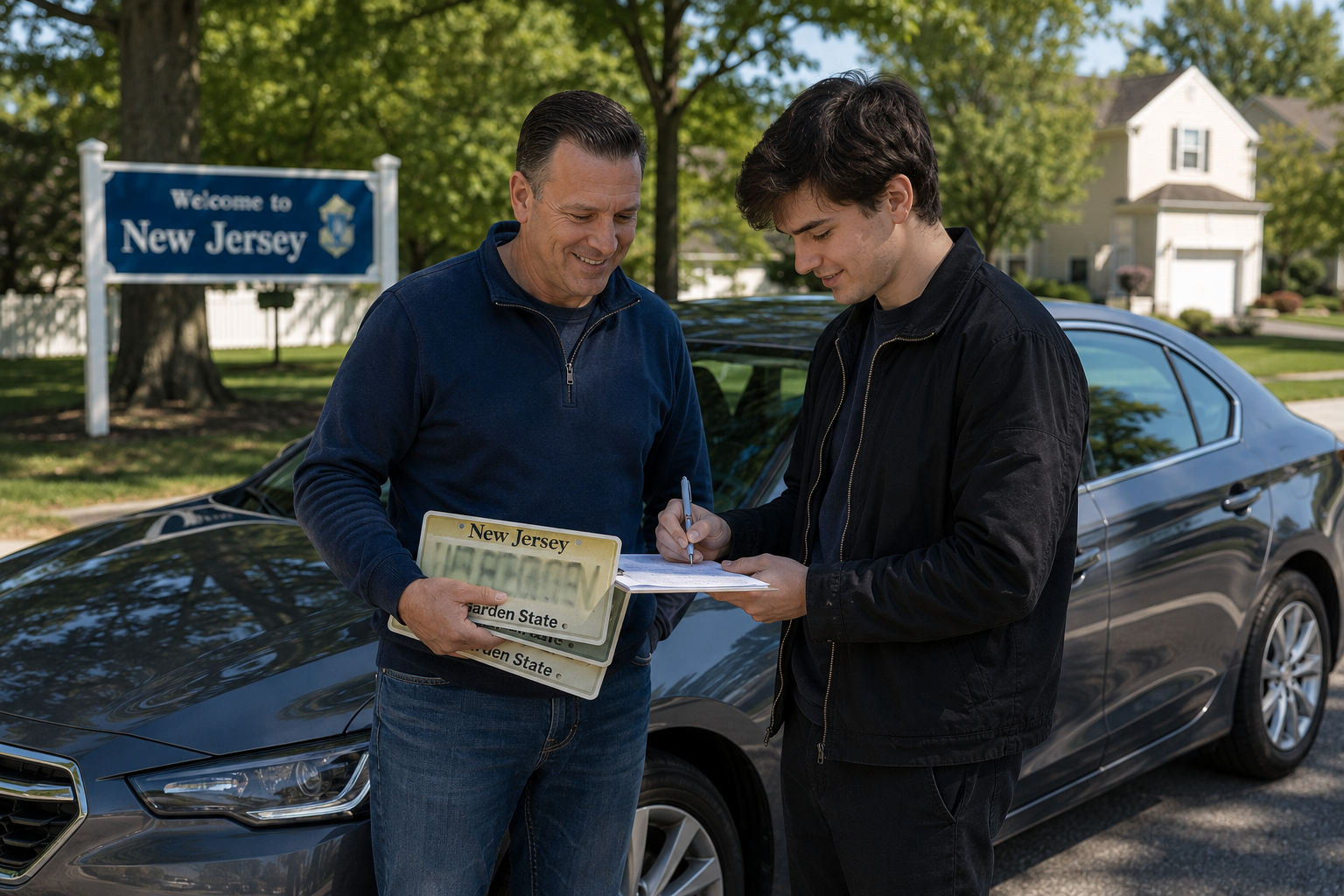
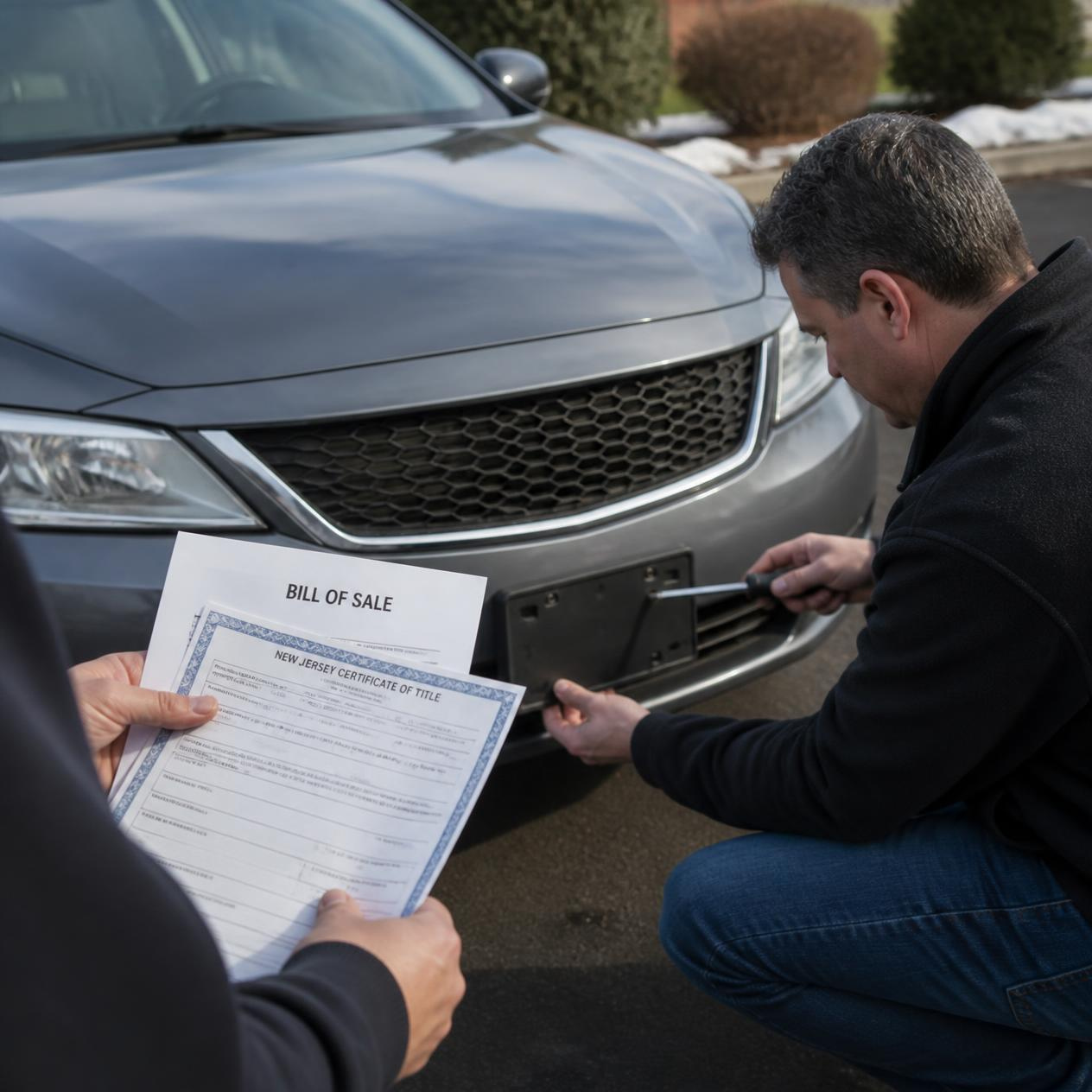
The seller removes the plates before transferring possession and either surrenders them to MVC or transfers them to another qualifying vehicle owned by the seller.
“Plates can be transferred to another vehicle, but not to another owner.”
— New Jersey Motor Vehicle Commission
The buyer cannot use the seller’s plates to drive the car. New plates are issued or transferred when the buyer completes registration at MVC.
Does the Vehicle Need an Inspection After the Sale?
Basic noncommercial vehicles are generally inspected once every two years. New vehicles receive a five-year inspection period.
The inspection schedule follows the expiration date on the windshield sticker. The registered owner must bring:
A valid driver licence.
The original vehicle registration.
A New Jersey insurance identification card.
New Jersey allows inspections up to two months before the sticker expires.
The basic passenger-vehicle program focuses on onboard diagnostic and emissions-system checks. It should not be treated as a substitute for an independent mechanical inspection before purchase.
What Changes for an Out-of-State Vehicle?
Vehicle From a State That Issues Titles
The buyer generally needs the assigned out-of-state title, the documents required for a New Jersey pre-owned vehicle, and a completed Universal Title Application.
Dealer reassignment records may also be needed when a dealer appears in the ownership chain.
Vehicle From a State That Does Not Issue Titles
The buyer needs:
Notarized seller-to-buyer sale statement.
Seller’s last registration card.
VIN tracing or printed photograph.
Universal Title Application.
Standard identity, insurance, tax, title, and registration documents.
The notarized statement and last registration help establish the ownership chain when no certificate of title exists.
How to Complete a New Jersey Private Sale
Verify that the seller’s name matches the New Jersey title.
Compare the title VIN with the vehicle.
Confirm that every lien has been released or properly carried into the new financing.
Complete the seller and buyer sections on the title.
Prepare a bill of sale showing the buyer, date, mileage, and price.
Have the seller remove and retain the plates.
Obtain New Jersey insurance in the buyer’s name.
Visit an MVC Vehicle Center and transfer the title within 10 working days.
Pay the 6.625% tax and applicable title and registration charges.
Verify that the seller’s name matches the New Jersey title.
Compare the title VIN with the vehicle.
Confirm that every lien has been released or properly carried into the new financing.
Complete the seller and buyer sections on the title.
Prepare a bill of sale showing the buyer, date, mileage, and price.
Have the seller remove and retain the plates.
Obtain New Jersey insurance in the buyer’s name.
Visit an MVC Vehicle Center and transfer the title within 10 working days.
Pay the 6.625% tax and applicable title and registration charges.
Common New Jersey Mistakes
Assuming the bill of sale can replace the assigned title.
Waiting more than 10 working days to visit MVC.
Entering an incorrect odometer reading.
Letting the buyer use the seller’s plates.
Attempting to complete the ownership transfer by mail.
Claiming a vehicle is a gift when the recipient assumes a loan or gives something of value.
Failing to document why the purchase price was substantially below market value.
Forgetting the notarized statement for a vehicle from a non-title state.