
Buyer Guide Oct 16, 2026
A New Hampshire bill of sale is essential when the vehicle is exempt from the state’s title requirement. For a vehicle that must be titled, the properly assigned certificate of title remains the main ownership document, and the buyer must submit the title application and supporting documents within 20 days of the sale.
For title-exempt transfers or additional transaction records, buyers and sellers can use KarKiosk’s free bill of sale PDF to document the sale details.
A buyer cannot legally drive a privately purchased vehicle home using no plates or the seller’s plates. New Hampshire offers a $20 temporary registration that is valid for 20 days.
First Determine Whether the Vehicle Needs a Title
New Hampshire has two different paperwork paths. The vehicle’s model year and type determine which path applies.
Vehicle Situation | Main Ownership Documents |
Standard vehicle, model year 2000 or newer | Properly assigned certificate of title |
Standard vehicle, model year 1999 or older | Bill of sale plus acceptable prior ownership or VIN evidence |
Trailer weighing less than 3,001 pounds | Bill of sale and qualifying registration or VIN evidence |
Heavy truck with three or more axles and over 18,000 pounds | Title required regardless of age |
Truck tractor over 18,000 pounds | Title required regardless of age |
New Hampshire generally does not title model-year 1999 or older vehicles. Heavy trucks and truck tractors meeting the statutory weight rules remain titled regardless of age.
Path 1: The Vehicle Has a Title
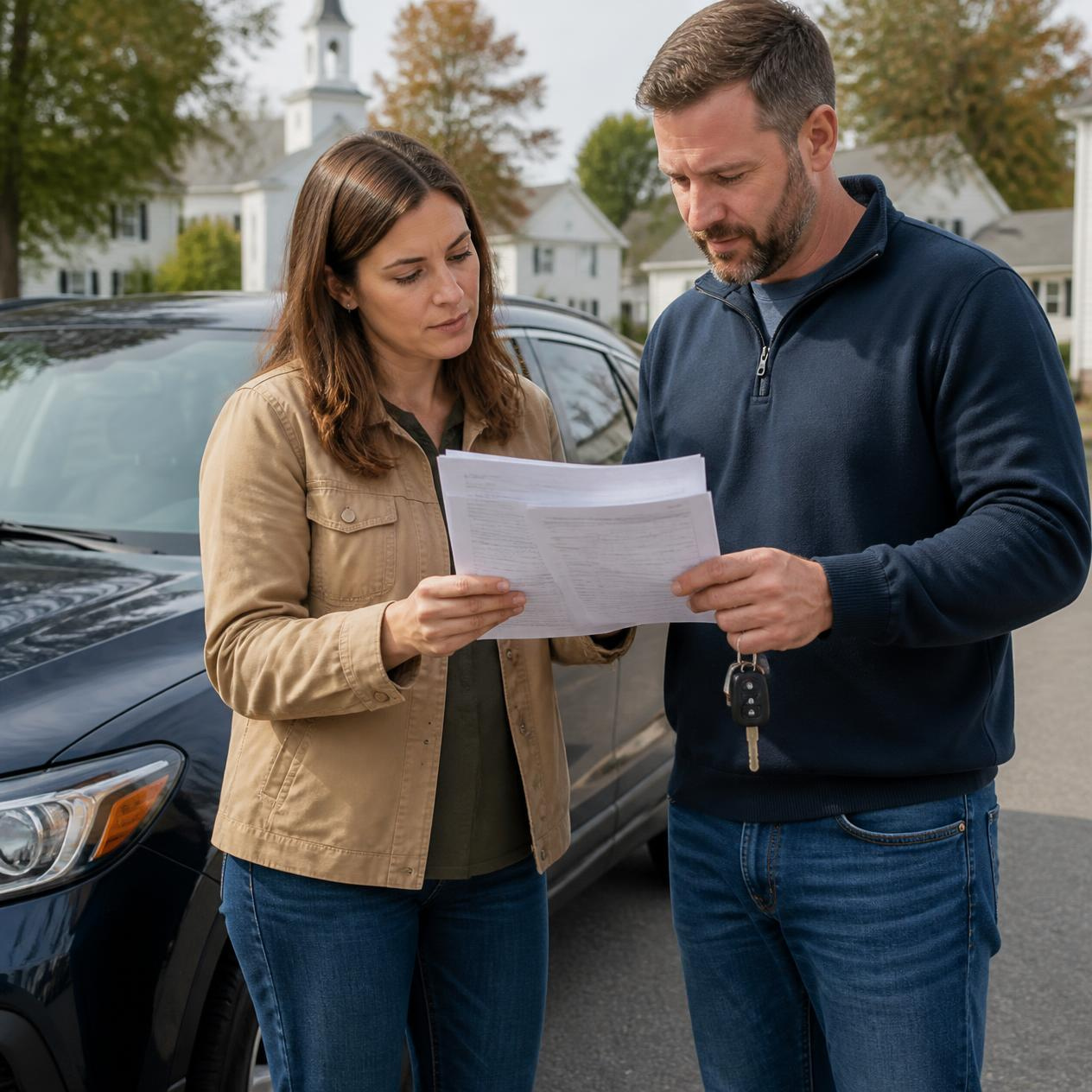
The seller completes the transfer section on the reverse of the title. The assignment should include the buyer’s name, buyer’s address, current odometer reading, and buyer’s and seller’s signatures.
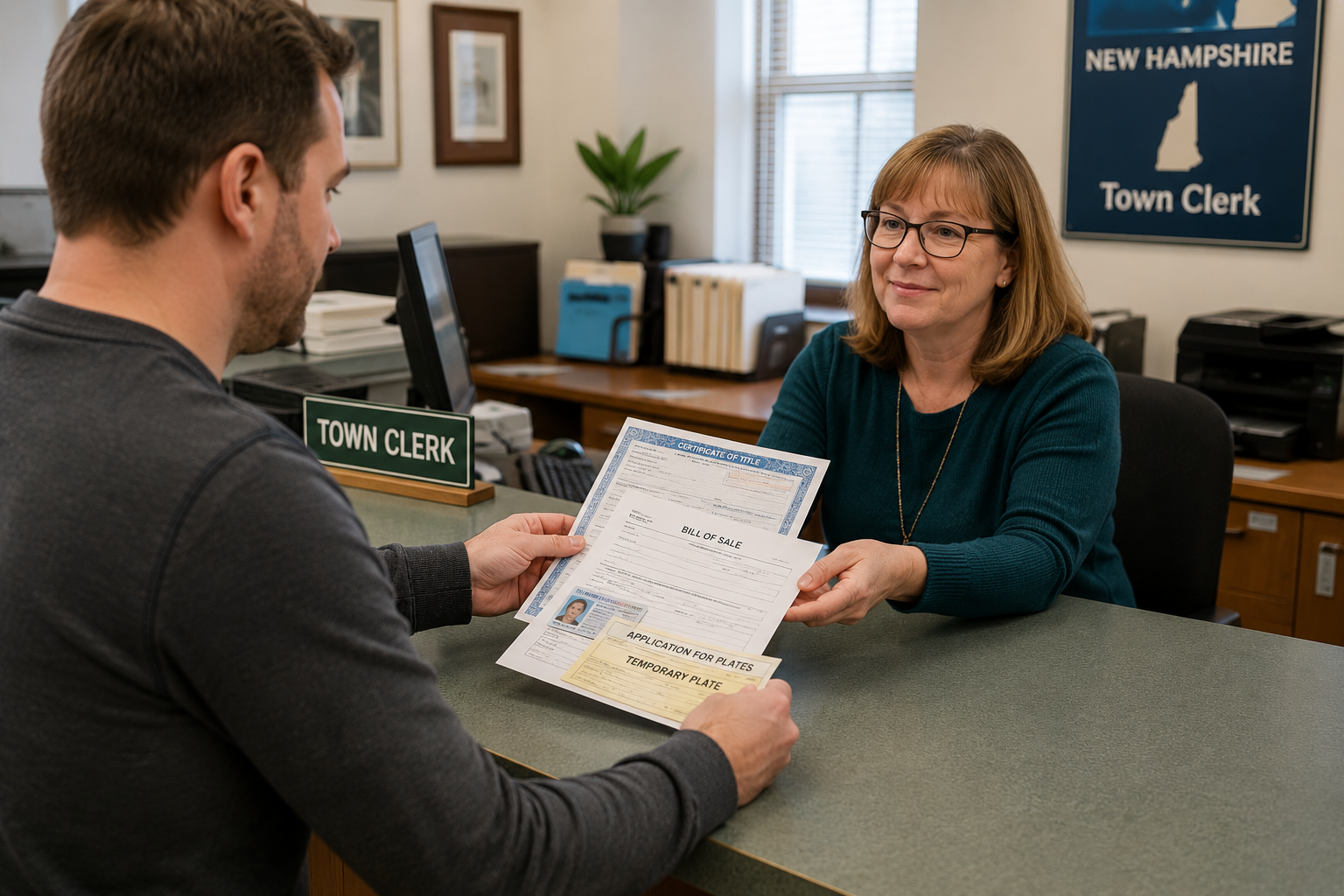
The seller then gives the original title to the buyer. The buyer presents it to the town or city clerk where the buyer resides.
A separate bill of sale is still useful because it records the purchase price, payment status, sale date, vehicle condition, and any written promises that do not appear on the title.
Path 2: The Vehicle Is Title-Exempt
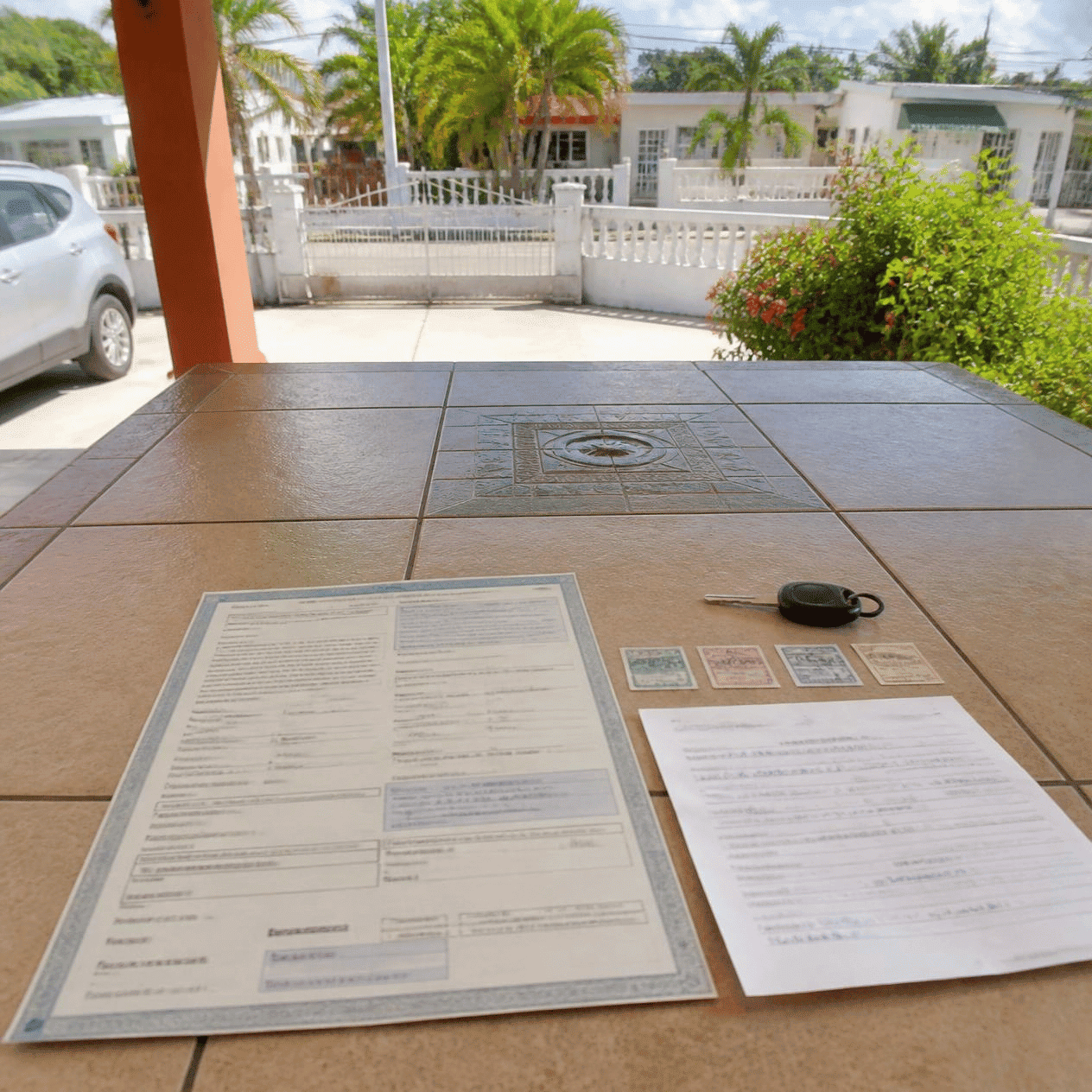
For a title-exempt private sale, the buyer must present a proper bill of sale and proof of the VIN.
Acceptable VIN or ownership evidence can include:
A previous New Hampshire registration.
A copy of a prior registration.
An original or copy of a title.
A properly completed VIN Verification form.
Other documentation accepted by the town or city clerk.
New Hampshire DMV also provides Form TDMV 22A, the Report of Sale or Transfer of a Non-Titled Motor Vehicle.
What Must a New Hampshire Bill of Sale Include?
New Hampshire law requires considerably more detail than a simple receipt showing a price and signature.
A compliant vehicle bill of sale must contain:
Exact date of sale.
Vehicle make, model, and color.
Full VIN.
Model year and year of manufacture.
Body type.
Number of cylinders.
Buyer’s legal name, signature, and legal street address.
Seller’s legal name, signature, and legal street address.
A post-office box does not satisfy the legal-address requirement. The official requirements appear on the New Hampshire DMV Bill of Sale page.
The bill of sale should also record the purchase price and odometer reading, even though the DMV’s general statutory list focuses on the vehicle description and parties. Price and mileage provide important evidence of the transaction.
What Should the Seller Hand to the Buyer?
Seller Provides | Why It Matters |
Properly assigned original title | Required for a titled vehicle |
Detailed bill of sale | Required for a title-exempt vehicle and useful in every sale |
Prior registration or other ownership evidence | Supports a title-exempt transfer |
Lien release | Confirms that a recorded loan has been satisfied |
Odometer disclosure | Records mileage when required |
Keys and agreed vehicle records | Completes the physical handover |
For a non-titled vehicle, DMV guidance may require Form TDMV 22A together with a previous registration, title copy, or VIN verification.
Does the Bill of Sale Need to Be Notarized?
The standard New Hampshire bill-of-sale requirements and ordinary title-assignment instructions do not impose a general notarization requirement.
The buyer and seller should sign the document directly and use their legal street addresses. A special document may still require notarization. For example, when someone other than the purchaser collects a private-sale temporary plate, that person must present a notarized authorization from the purchaser.
An out-of-state certificate written in another language must be accompanied by a notarized English translation. Powers of attorney, estates, court transfers, and bonded-title cases can also involve separate acknowledgement requirements.
Two Different 20-Day Rules Apply
New Hampshire uses the same number of days for two different parts of the transaction.
The Title Paperwork Is Due Within 20 Days
For a vehicle purchased from someone who is not a dealer, the buyer must mail or deliver the title application and supporting documents to the state within 20 days of the sale.
This is the buyer’s filing deadline. It should not be confused with the temporary plate’s validity period.
The Temporary Plate Is Valid for 20 Days
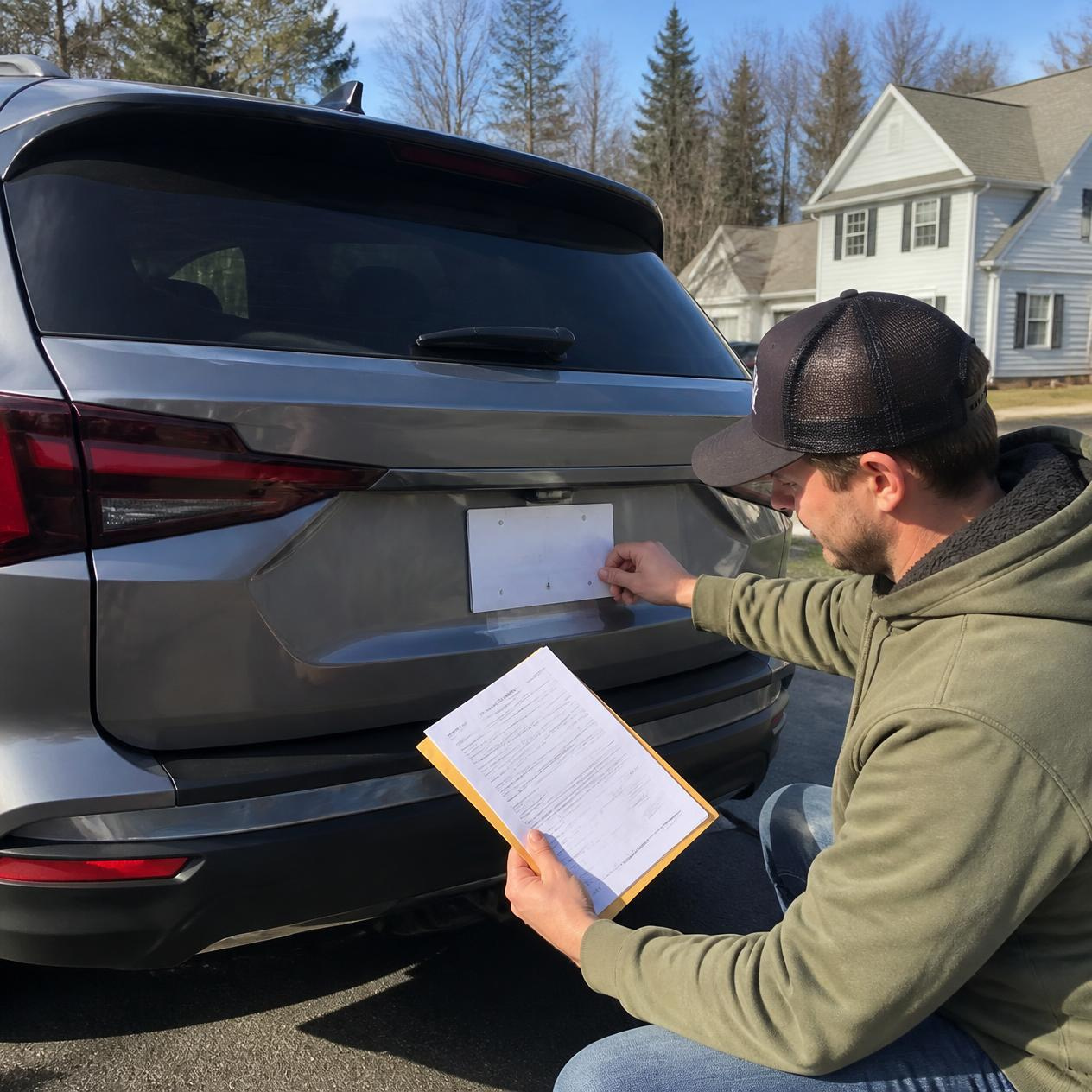
A New Hampshire resident who buys a vehicle privately can apply for a 20-day temporary registration.
The buyer must provide:
A copy of the front and back of the title signed by buyer and seller; or
A bill of sale containing the required vehicle and party information.
A driver licence or non-driver identification card.
The $20 temporary-plate fee.
The temporary registration is valid for 20 days from issuance.
“No, 20 day temporary plate is required.”
— New Hampshire Division of Motor Vehicles, answering whether a private-sale buyer may drive home without plates.
The temporary registration is not a substitute for the permanent title and registration process.
The Seller’s Registration Ends When the Vehicle Is Sold
The registration attached to the vehicle expires when ownership transfers.
The former owner retains the expired registration certificate and may receive transfer credit when registering another qualifying vehicle. The buyer should not use the seller’s plates or registration after the transaction.
The seller should keep:
A copy of the completed bill of sale.
A copy of the assigned title.
The former registration certificate.
Payment records.
The license plates unless they are being handled through an approved registration transfer.
New Hampshire Registration Is a Two-Part Process
Vehicle registration starts with the town or city clerk where the buyer resides. The transaction includes a municipal permit charge and a separate state registration charge.
Many municipal clerks can complete both parts, but fees are still calculated separately.
Charge | Current Amount or Method |
Original title | $35 |
Duplicate title | $35 |
Private-sale 20-day plate | $20 |
First standard plate set | $8 |
Municipal permit | Based mainly on original list price and model year |
State registration | Based on vehicle type and weight |
Local or municipal-agent charges | May apply |
The $35 title fee, $20 temporary plate, and $4-per-plate charge took effect January 1, 2026.
A properly submitted title application normally takes approximately 30 to 50 calendar days to produce the physical title.
New Hampshire Has No General Sales Tax
A private vehicle buyer does not pay a New Hampshire general sales tax merely because the vehicle was purchased in the state.
“No, there is no general sales tax on goods purchased in New Hampshire.”
— New Hampshire Department of Revenue Administration
This does not make registration free. Municipal permit fees, state registration charges, title fees, plate fees, and local processing charges still apply.
How the Municipal Permit Charge Changes With Vehicle Age
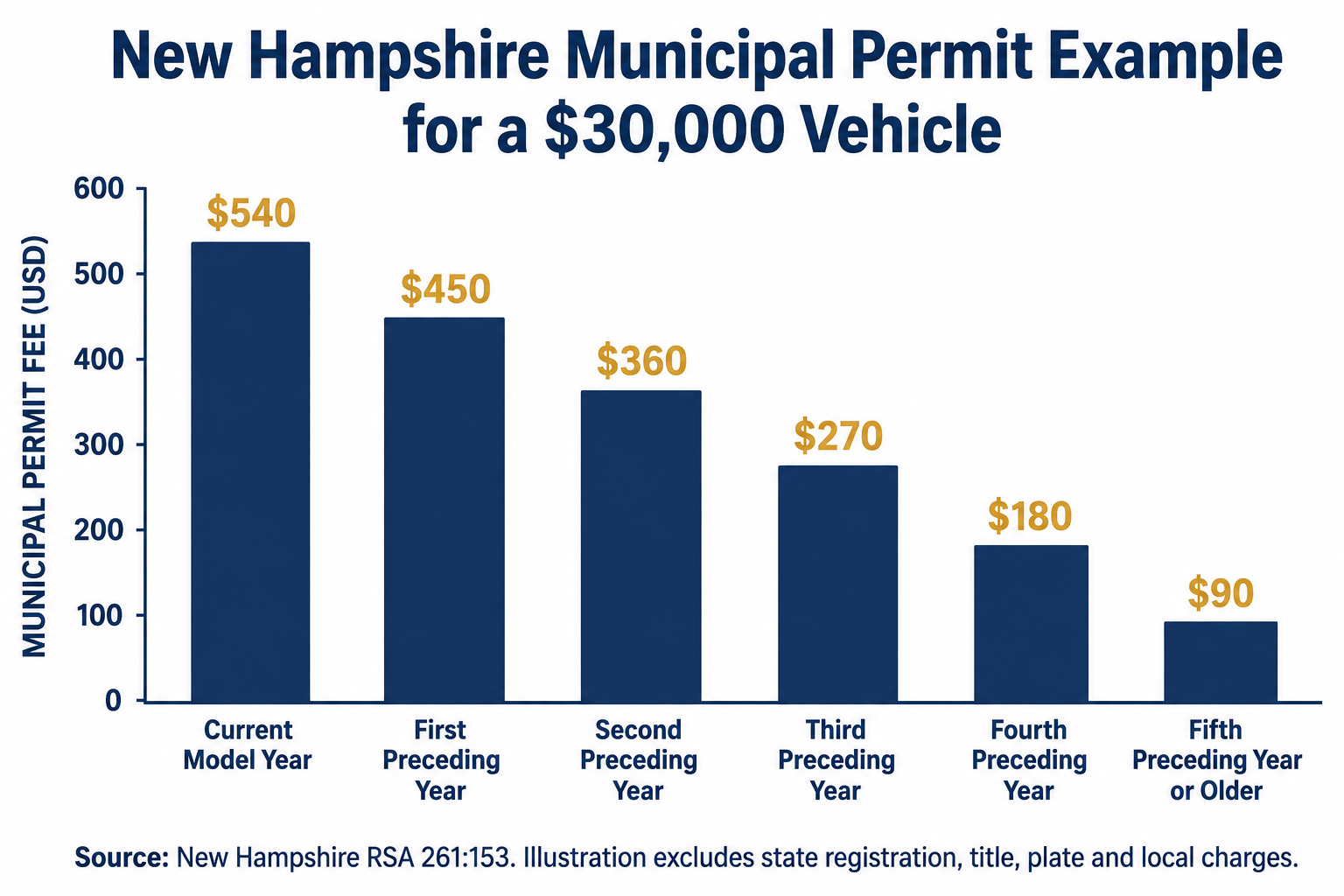
The municipal portion of registration is generally calculated from the manufacturer’s original list price and the vehicle’s model-year position.
The statutory mill rates are:
Vehicle Model-Year Position | Rate Per $1,000 of Original List Price |
Current model year | $18 |
First preceding model year | $15 |
Second preceding model year | $12 |
Third preceding model year | $9 |
Fourth preceding model year | $6 |
Fifth preceding model year and older | $3 |
The municipality may also impose permitted local charges. Registration can be prorated depending on the transaction and registration period.
Is Auto Insurance Required for the Transfer?
Proof of insurance is not listed as a universal document in New Hampshire’s ordinary private-sale registration checklist.
However, DMV can require an individual to maintain an SR-22 proof-of-insurance filing because of specified convictions, crashes, or administrative actions. A person subject to that requirement cannot retain or restore driving and registration privileges without the required filing.
Regardless of the registration paperwork, driving without adequate financial protection can expose the buyer to substantial personal liability.
What Is the 2026 Inspection Rule?
As of this guide’s September 2026 update, New Hampshire’s state vehicle inspection program is suspended until further notice.
DMV states that inspection stations are not authorized to issue state inspection stickers and vehicles are not currently required to obtain the annual state inspection. Drivers remain responsible for ensuring that their vehicles are safe to operate.
This area has been affected by legislation, litigation, and vendor changes. The state warns that the status remains subject to change, so the official New Hampshire inspection page should be checked when the article is updated.
What If the Vehicle Comes From Another State?
An out-of-state vehicle may require:
The foreign certificate of title.
Additional ownership documentation.
A VIN inspection or other identity verification.
A notarized English translation when the title is not in English.
Lienholder information when a loan remains.
The buyer should contact the local town or city clerk before the transaction when the seller cannot provide a standard English-language title.
How to Complete the Sale Correctly
Determine whether the vehicle is titled or title-exempt.
Compare the VIN on the vehicle with every ownership document.
Complete the title assignment when a title exists.
Prepare a bill of sale containing every New Hampshire-required field.
Obtain the previous registration, title copy, or VIN verification for a title-exempt vehicle.
Apply for a $20 temporary plate before driving the vehicle home.
Begin registration with the buyer’s town or city clerk.
Submit the title application and supporting documents within 20 days.
Common New Hampshire Mistakes
Using a bill of sale that lists only the price and VIN.
Entering a post-office box instead of a legal street address.
Assuming every older vehicle needs a title.
Assuming every vehicle from 1999 or earlier is exempt without checking the heavy-vehicle exceptions.
Driving home without a 20-day temporary plate.
Letting the buyer use the seller’s registration.
Confusing the temporary plate’s 20-day validity with the title-filing deadline.
Publishing outdated inspection guidance after the 2026 suspension.