
Buyer Guide Oct 16, 2026
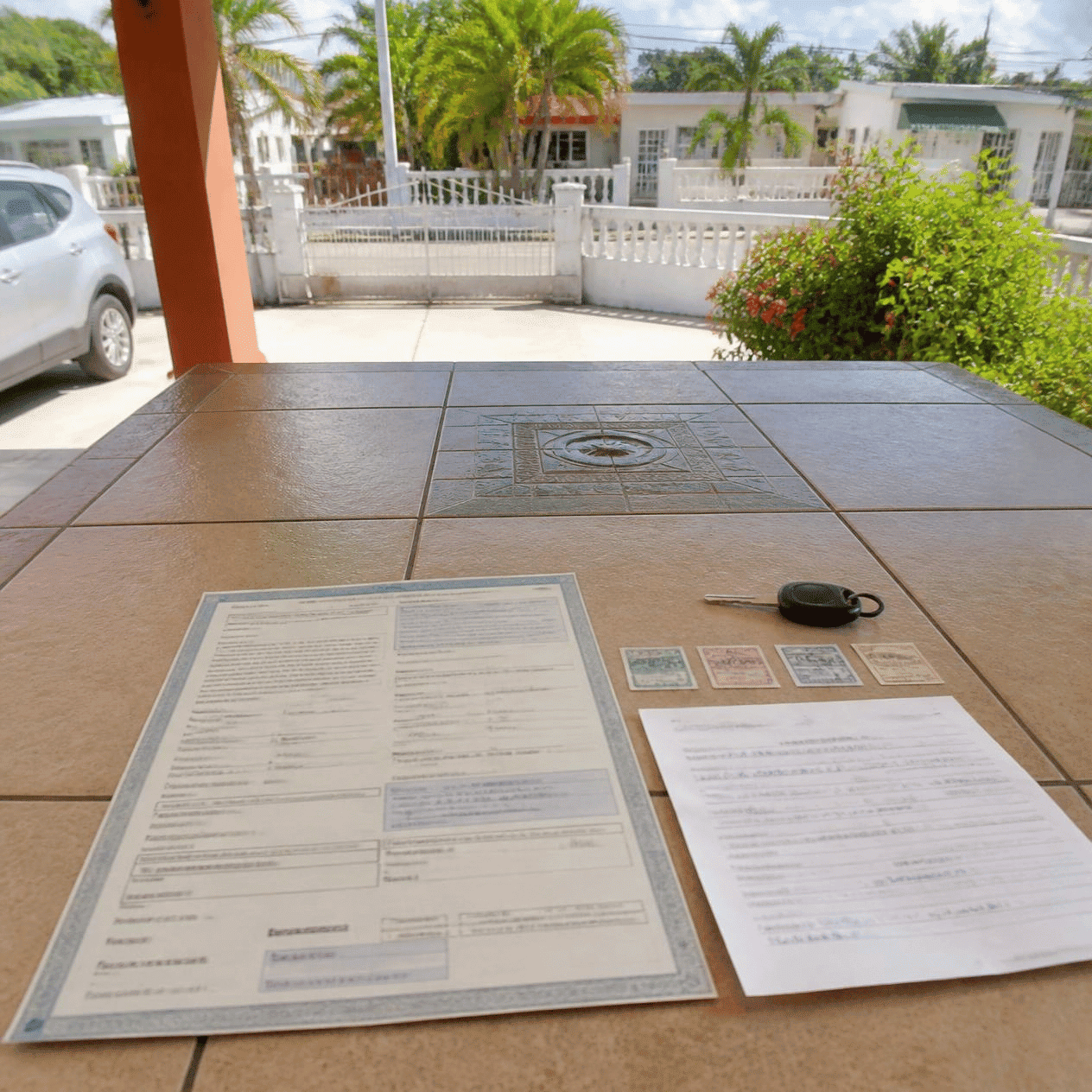
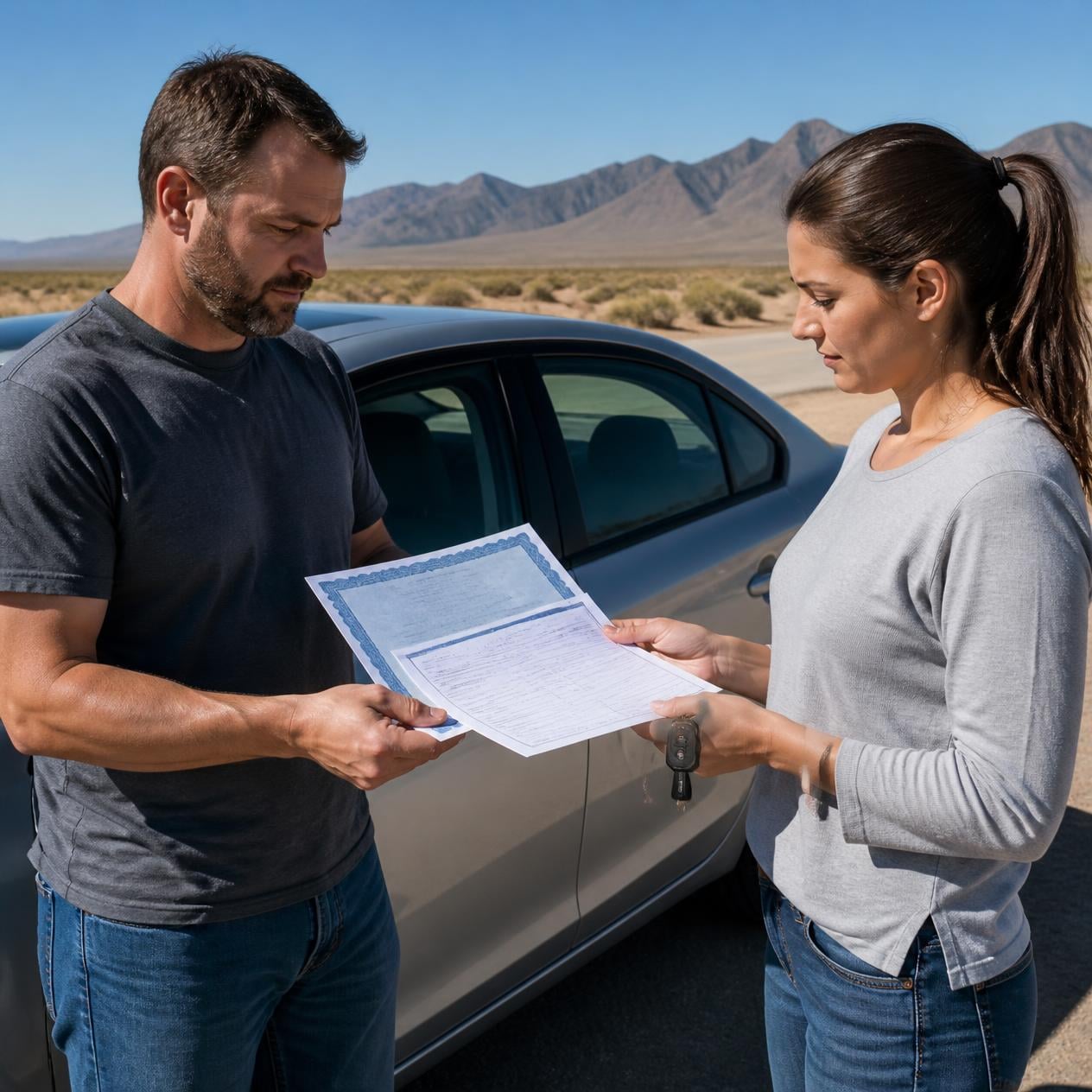
Nevada Form VP104 records a private vehicle sale, but it cannot transfer ownership by itself. The seller must also provide a properly assigned title, and the parties must follow separate rules for title submission, registration, insurance, plates, and emissions testing.
For an additional written record of the deal, buyers and sellers can use KarKiosk’s free bill of sale PDF, but it does not replace Nevada’s VP104 or the properly assigned title.
Nevada law requires the seller, buyer, or both to submit the title documents within 10 days. DMV guidance states that most vehicle sales must be registered within 30 days, although the buyer may have only three days of limited drive-away permission before a movement permit becomes necessary.
A Nevada Sale Has Two Separate Parts
Nevada treats proof of ownership and permission to drive as different matters.
The assigned title and supporting sale documents transfer ownership. Insurance, registration, emissions compliance, license plates, or a movement permit determine whether the buyer can legally operate the vehicle.
Requirement | What It Accomplishes | Enough by Itself? |
Properly assigned title | Establishes the ownership transfer | Yes, as the primary ownership document |
VP104 Bill of Sale | Records the sale and releases the seller’s interest | No |
Nevada liability insurance | Satisfies the insurance requirement | No |
Emissions report | Satisfies smog rules where applicable | No |
Vehicle Inspection Certificate VP015 | Verifies a vehicle never titled or registered in Nevada | No |
Registration or movement permit | Authorizes road use | No |
Nevada DMV specifically warns buyers not to purchase a private-sale vehicle unless the seller can provide a title in the seller’s name. A bill of sale alone is not acceptable proof of ownership for registration.
VP104 Records the Deal, Not the Ownership
Nevada DMV publishes the official VP104 Bill of Sale.
The form states:
“A Certificate of Title or other ownership documents must accompany this form.”
VP104 releases the seller’s interest and records the terms of the transaction. It does not replace the original title.
What Information Goes on VP104?
The form asks for more information than a basic handwritten receipt:
Full legal names of the buyer and seller.
Nevada driver’s license, identification number, date of birth, or business FEIN.
Physical and mailing addresses.
VIN, year, make, model, and body type.
Purchase price and sale date.
Existing lienholder information.
Rebuilt-vehicle status.
Original buyer and seller signatures.
The buyer’s information should be entered exactly as it will appear on the new title. Nevada DMV also states that signatures must be original, photocopies are not accepted, and the form cannot be changed after it is signed.
Does VP104 Need to Be Notarized?
The standard VP104 form does not contain a notary section, and Nevada DMV does not list notarization as a general requirement for a normal sale involving a valid Nevada title.
Special ownership situations can be different. When an out-of-state ownership document does not contain the required vehicle, buyer, seller, or lien information—or when no public authority has issued a title—Nevada law requires an additional statement signed and acknowledged by the buyer and seller.
The safest answer is therefore:
A standard Nevada title and VP104 transaction does not normally require notarization.
An affidavit, power of attorney, missing-title statement, or other special document may require acknowledgement or notarization.
The Title Must Be Completed Correctly
The seller must provide a properly signed title and satisfy any loan or lien before transferring the vehicle.
Owner designations control who must sign:
Person 1 AND Person 2: Both titled owners must sign.
Person 1 OR Person 2: Either titled owner may sign.
Active lien shown: Obtain a valid lien release or have the lender complete the transfer.
Seller not named on the title: Do not proceed until the ownership chain is resolved.
Nevada also prohibits informal “take over payments” or subleasing arrangements. Any existing vehicle loan must be addressed before the car can be legally sold.
Five Different Clocks Start on the Sale Date
Nevada does not use one simple deadline for the entire transaction. Different rules apply to the seller’s notice, title paperwork, registration, and road use.
Time From Sale | What the Rule Means |
Immediately | Seller delivers the title; buyer obtains Nevada insurance before driving |
First 3 days | Limited drive-away permission may apply |
Within 5 days | Seller may submit an electronic transfer or resale notification |
Within 10 days | Seller, buyer, or both submit the title documents required by NRS 482.426 |
Within 30 days | Most vehicle sales must be registered |
The Three-Day Drive-Away Rule
A buyer may drive the vehicle without a movement permit for up to three days after purchase only when all of these conditions are met:
The buyer carries the signed title or a formal bill of sale.
The vehicle has active Nevada liability insurance.
The vehicle is being driven directly home or to the DMV.
The trip occurs within three days of the purchase date.
This is not a general three-day period for errands, commuting, or unrestricted driving.
The Five-Day Seller Notification
Nevada law permits the seller to submit an electronic notice of transfer within five days. The seller can also complete a resale notification while canceling the registration through MyDMV.
The notice is useful because it creates a government record showing that the seller no longer owns the vehicle. It does not replace the buyer’s title and registration application.
The 10-Day Title-Document Rule
For a used vehicle sold by a person who is not a dealer or rebuilder, Nevada law requires the seller, buyer, or both to submit the properly endorsed title or other qualifying ownership statement within 10 days after the sale.
This statutory requirement is separate from the general 30-day registration deadline.
The 30-Day Registration Deadline
Nevada DMV states that, in most vehicle sales, the vehicle must be registered within 30 days of the sale date.
A buyer who needs to drive after the initial three-day period can obtain one online 30-day movement permit through MyDMV for $1. Proof of ownership and insurance are required.
“This was one of the most-requested online transactions.”
— Nevada DMV Director Julie Butler on the online movement permit
The permit authorizes temporary road use. It does not replace the title or registration process.
What the Buyer Needs to Complete the Transfer
Nevada’s private-party registration checklist may require different documents depending on the vehicle’s history and registration location.
Document or Requirement | When It Is Needed |
Properly assigned original title | Every normal private sale |
VP104 Bill of Sale | To document the transaction or support specific transfer situations |
Nevada liability insurance | Before registration and public-road use |
Current odometer reading | Covered motor vehicles |
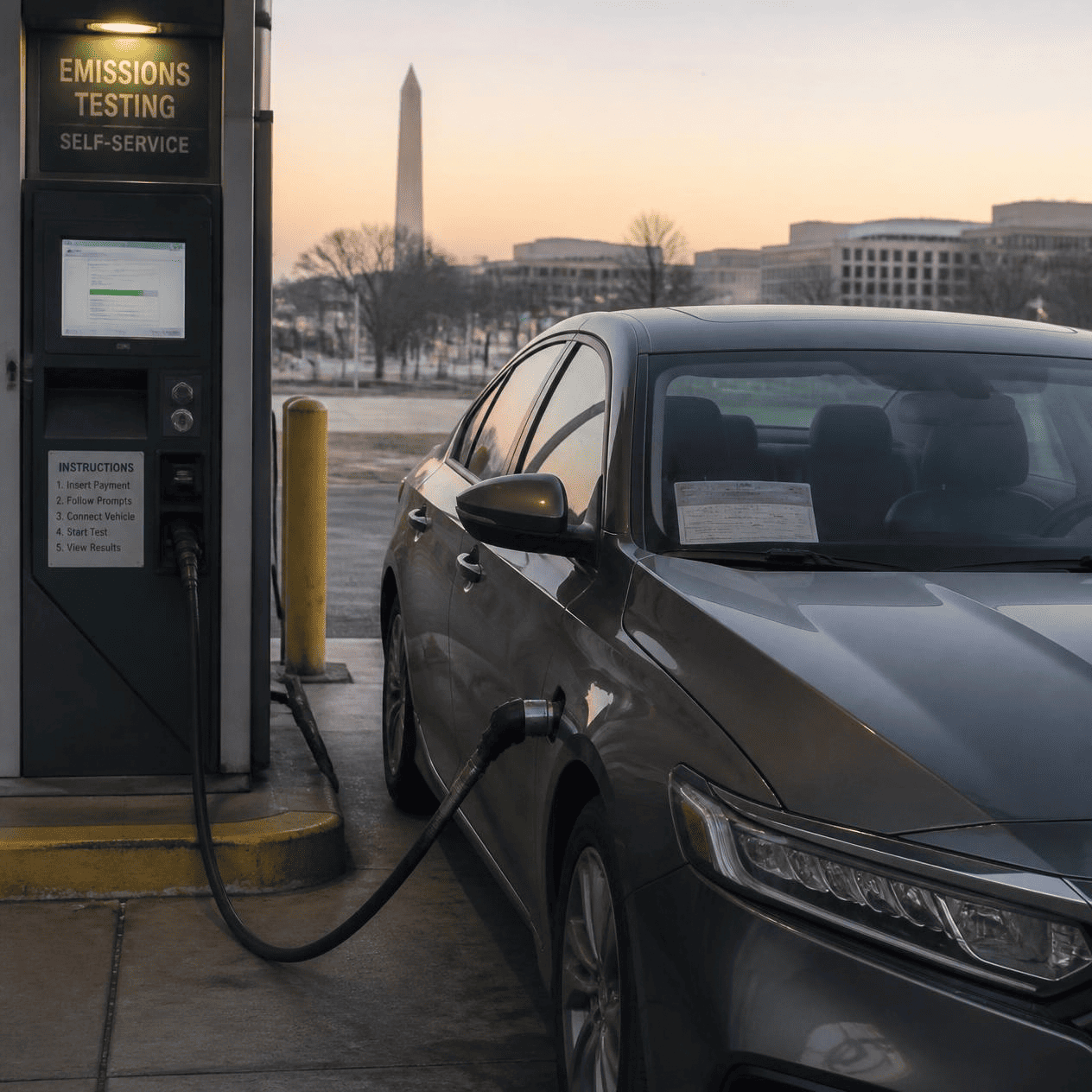
Emissions report | Qualifying vehicles in urban Clark or Washoe County |
VP015 VIN inspection | Vehicle never titled or registered in Nevada |
Lien release | When the title shows a satisfied lien |
Current registration | When the buyer transfers plates from another vehicle |
Nevada does not accept out-of-state insurance for Nevada registration. Coverage must come from a Nevada-licensed insurer, begin on or before the registration date, and use names matching the new title and registration.
Eligible private-party buyers may be able to use Nevada’s online Rapid Registration and Turbo Title services. Online registration requires a purchase or sales agreement and the documents applicable to the transaction.
Nevada Does Not Charge Ordinary Private-Sale Sales Tax
Nevada DMV does not charge sales tax on an ordinary private-party vehicle sale, family sale, or gift.
However, this does not mean every repeated sale by an individual is automatically tax-free.
The Nevada Department of Taxation explains that state law uses an occasional-sale exemption, rather than a blanket exemption called “private-party sales.” An owner making no more than two retail asset sales within a 12-month period may qualify for the occasional-sale treatment. Once a third retail sale occurs within that period, the seller can be treated as a retailer, and the earlier sales can also become taxable.
Nevada DMV separately states that a person may not sell more than three personally owned vehicles in one year without a dealer’s licence. The tax threshold and dealer-licensing threshold address different legal requirements.
No Sales Tax Does Not Mean No Registration Tax
The purchase price generally does not control Nevada’s Governmental Services Tax.
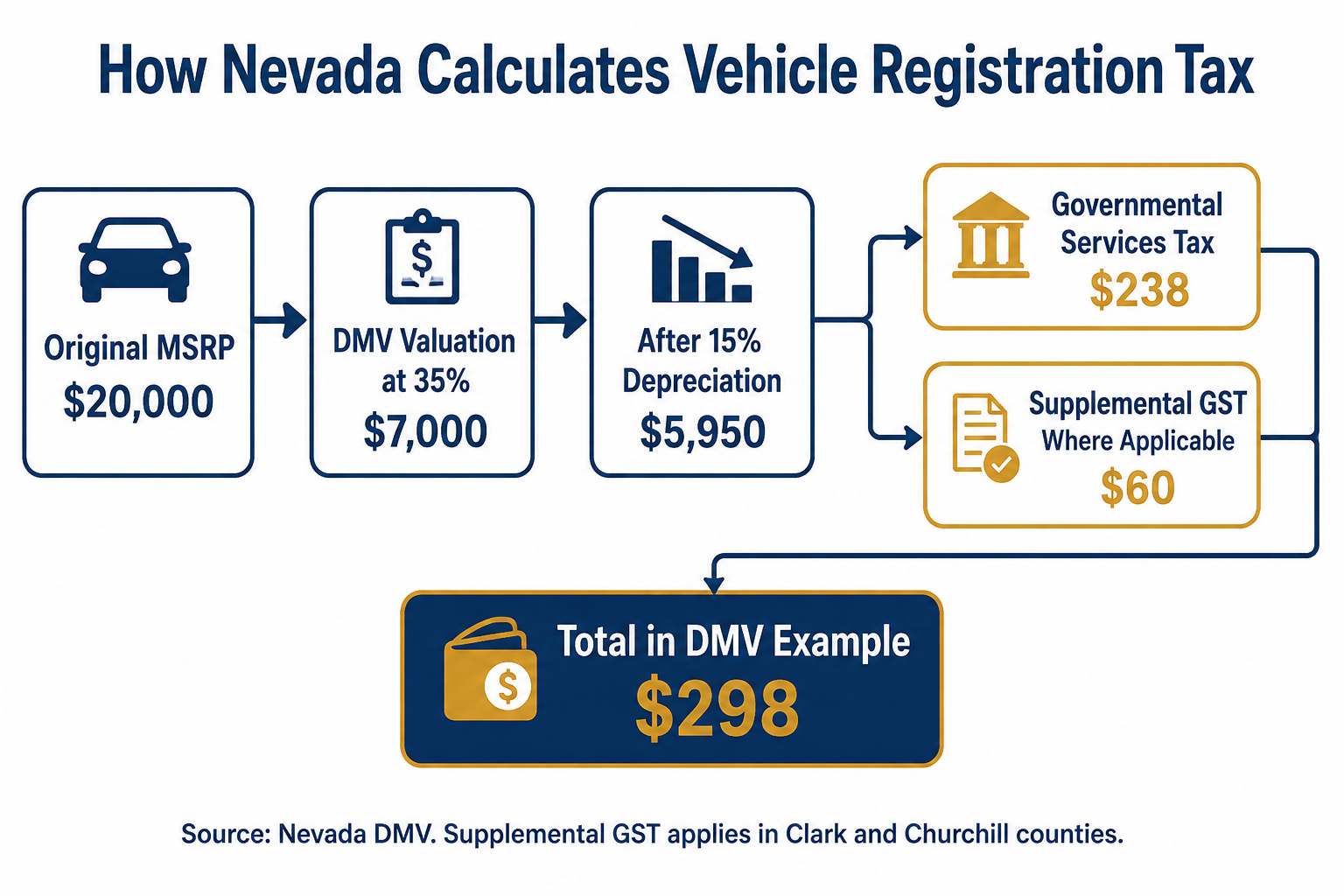
Nevada calculates that tax from the vehicle’s original manufacturer’s suggested retail price:
DMV valuation begins at 35% of the original MSRP.
The valuation is reduced by 5% after the first year.
It is reduced by 10% for each later year.
Depreciation stops at 15% of the original DMV valuation.
Governmental Services Tax equals 4% of the depreciated valuation.
The minimum Governmental Services Tax is $16.
A Supplemental Governmental Services Tax also applies in Clark and Churchill counties.
Nevada Title and Registration Costs
Charge | Current Amount or Method |
Complete change-of-ownership title transaction | $28.50 |
Passenger-car registration | $33 |
Online 30-day movement permit | $1 |
Governmental Services Tax | Based on original MSRP and depreciation |
Supplemental Governmental Services Tax | Applies in Clark and Churchill counties |
Plate or specialty-plate charges | Vary |
Nevada DMV lists $28.50 for a complete ownership change and $33 for a passenger-car registration. Governmental Services Tax, Supplemental Governmental Services Tax, emissions charges, plate fees, and other transaction-specific costs are additional.
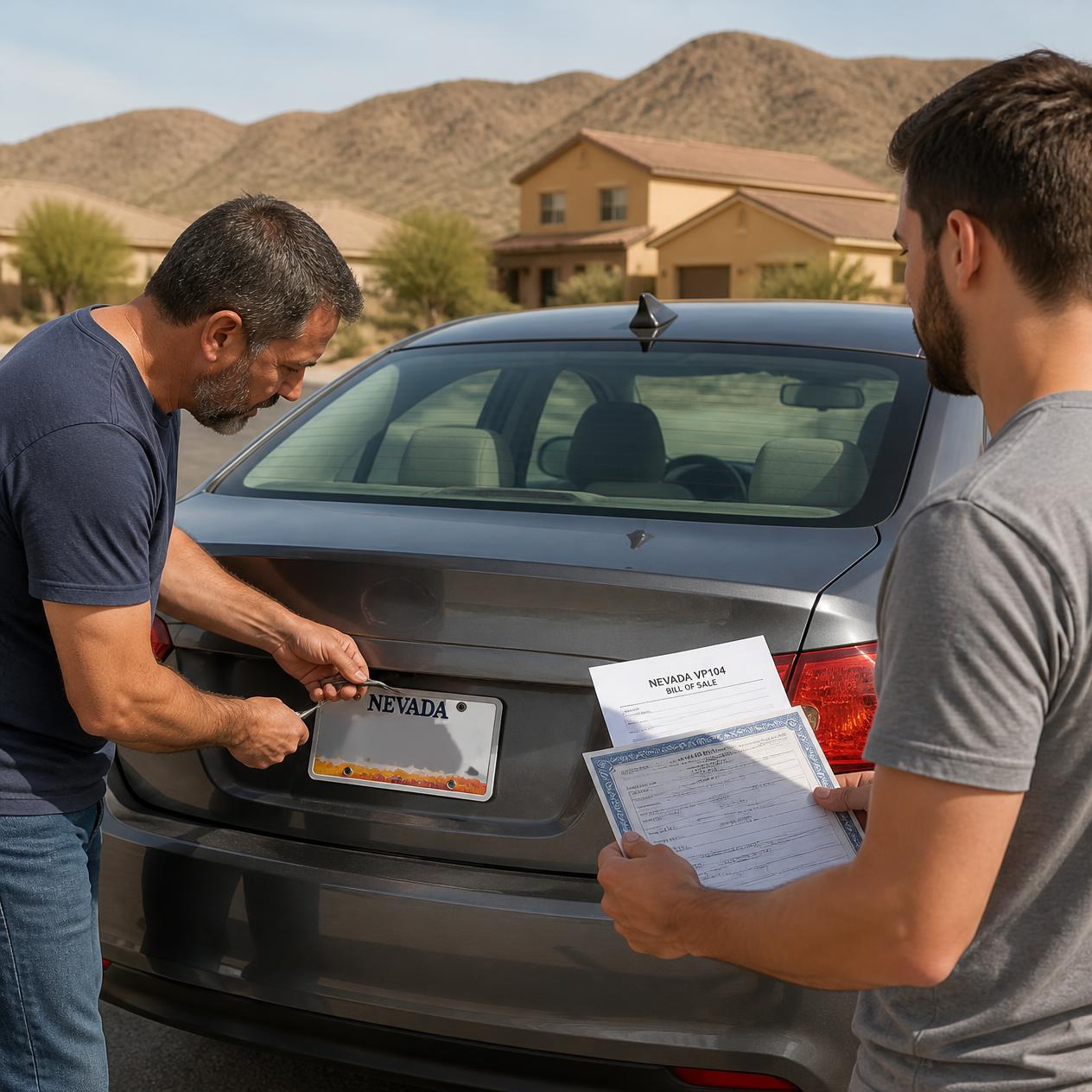
The Seller Keeps the License Plates
Nevada plates do not normally follow the vehicle to the buyer.
The seller should:
Remove and retain the license plates.
Cancel the registration through MyDMV when appropriate.
Submit the resale notification.
Transfer the plates to another eligible vehicle or surrender them.
Cancel the registration before dropping Nevada insurance.
Unused registration credit belongs to the original registrant. It can be applied to another vehicle registered in that person’s name, subject to DMV requirements and a $6 transfer charge.
Nevada allows a plate owner to release certain plates to another person using Form SP67. However, registration fee credits do not pass to the buyer with the plates.
Smog Testing Can Become the Buyer’s Responsibility
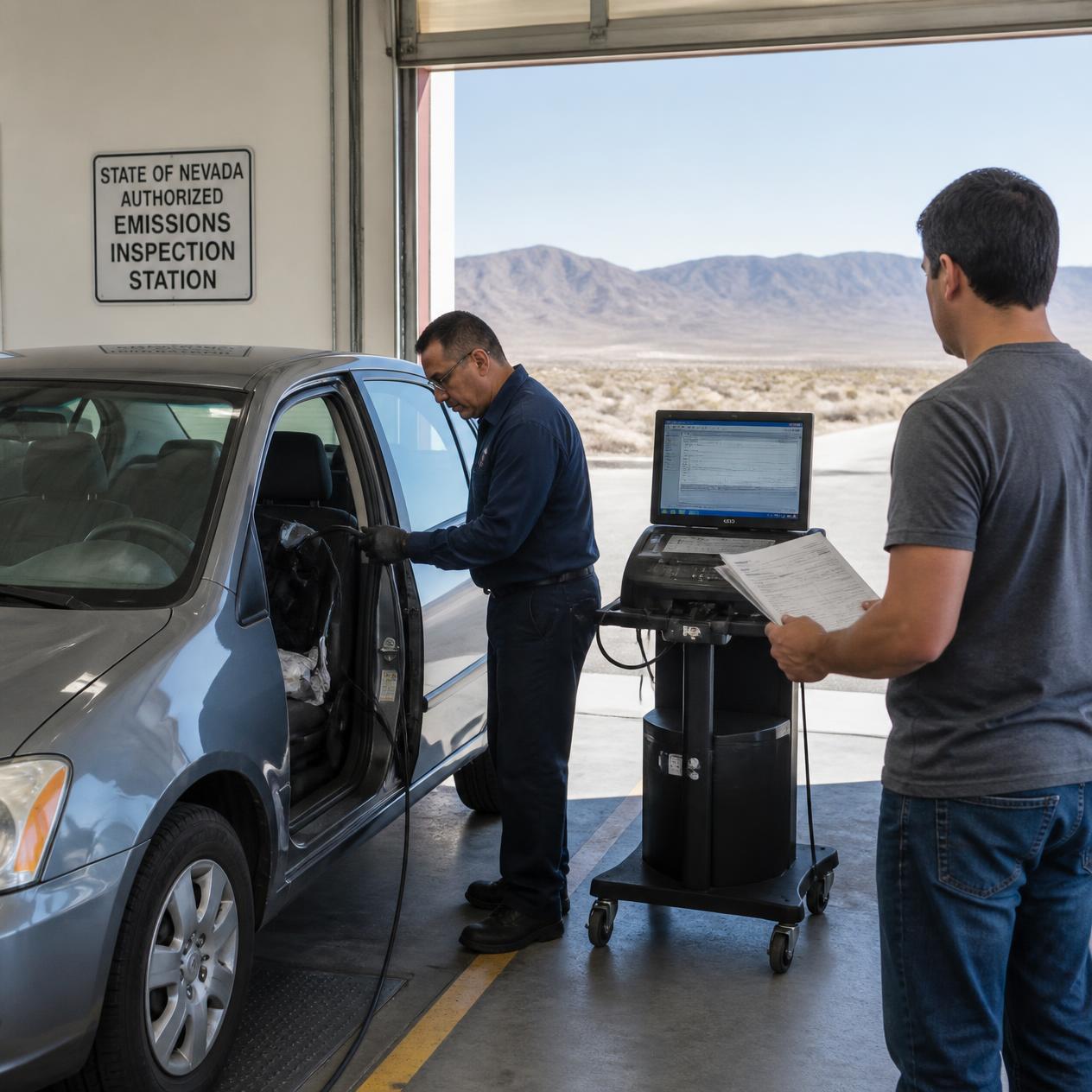
Nevada does not require a routine statewide safety inspection for a standard passenger-vehicle transfer. Its standard registration process instead requires an emissions report for qualifying vehicles and a VIN inspection for a vehicle never previously titled or registered in Nevada.
An emissions test is generally required when the vehicle is:
Based in an urban area of Clark or Washoe County.
Model year 1968 or newer.
Gasoline-powered, regardless of weight.
Diesel-powered with a gross vehicle weight rating of 14,000 pounds or less.
Not covered by an exemption.
In a private transaction, obtaining the test is the buyer’s responsibility. A standard test remains valid for 90 days.
Common Emissions Exemptions
Nevada lists exemptions for:
New vehicles during their first three registrations.
New hybrid vehicles during their first five model years.
Model-year 1967 and older vehicles.
Vehicles based outside covered urban areas.
Electric vehicles and certain permanently alternative-fuel vehicles.
Diesel vehicles rated at 14,001 pounds or more.
Transfers when a qualifying test was completed within the previous 90 days.
The exact exemption should be confirmed before registration.
Maximum Nevada Emissions Fees for 2026
Vehicle Type | Clark County Maximum | Washoe County Maximum |
Light-duty gasoline | $75.50 | $71.50 |
Heavy-duty gasoline | $75 | $73 |
Diesel | $90 | $74 |
These amounts are maximum permitted charges. An authorized station may charge less.
Vehicles From 2011 and Newer Face Stricter Title Rules
Nevada follows the federal 20-year odometer-disclosure period beginning with model-year 2011 vehicles.
For a model-year 2011 or newer vehicle:
The seller must enter the current mileage on the title.
The seller must provide a valid paper title.
A bill of sale plus a duplicate-title application is not accepted.
Multiple consecutive private-party bills of sale are not accepted.
A non-secure power of attorney cannot replace the required sale documents.
A model-year 2011 vehicle becomes exempt from the odometer-disclosure requirement in 2031.
What If the Nevada Title Is Missing?
The general rule is that the titled owner must obtain a duplicate from the state that last issued the title.
Nevada provides a limited exception when both of the following are true:
The vehicle was last titled in Nevada.
It is model year 2010 or older.
In that situation, the seller may be able to use Form VP012, Application for Duplicate Nevada Certificate of Title, together with VP104. Model-year 2011 and newer vehicles do not qualify for this bill-of-sale-and-duplicate-title shortcut.
A buyer who has already purchased a no-title vehicle may have to undergo DMV title research and could be directed to a bonded-title process. Eligibility is not guaranteed.
What If the Vehicle Is Not Operational?
Nevada allows an owner to complete a title-only transfer for a vehicle that is not registered or operational.
A title-only transaction does not require Nevada insurance, an emissions test, or registration because the vehicle is not being driven. The buyer must visit a DMV office with the ownership documents.
The vehicle cannot be driven on public roads until the buyer completes the separate insurance and registration requirements or obtains an appropriate movement permit.
How to Complete a Nevada Private Sale Without a Return Trip
Match the seller’s identification with the name on the title.
Compare the VIN on the title, vehicle, and VP104.
Verify that every lien has been released.
Complete the title assignment and VP104 without erasures.
Obtain Nevada insurance before driving the vehicle.
Complete the emissions or VIN inspection when required.
Remove the seller’s plates and submit the resale notification.
Submit the title documents within 10 days and register within the applicable 30-day period.
Match the seller’s identification with the name on the title.
Compare the VIN on the title, vehicle, and VP104.
Verify that every lien has been released.
Complete the title assignment and VP104 without erasures.
Obtain Nevada insurance before driving the vehicle.
Complete the emissions or VIN inspection when required.
Remove the seller’s plates and submit the resale notification.
Submit the title documents within 10 days and register within the applicable 30-day period.
Common Nevada Bill of Sale Mistakes
Paying for a vehicle when the seller cannot produce the title.
Treating VP104 as proof of ownership by itself.
Accepting a title signed by someone other than the titled owner.
Failing to complete the odometer section for a 2011 or newer vehicle.
Driving after the three-day period without a movement permit.
Leaving the seller’s Nevada plates on the vehicle.
Dropping insurance before canceling the registration.
Assuming that “no sales tax” means no Governmental Services Tax.