

Buyer Guide Oct 16, 2026
A Montana bill of sale records the transaction but does not replace the properly assigned certificate of title. The buyer has 40 days to apply for title and registration, and ordinary title-transfer signatures have not required notarization since October 1, 2025.
Buyers and sellers can also use KarKiosk’s free bill of sale PDF to keep a separate record of the transaction, although it does not replace the properly assigned title.
Montana Bill of Sale Quick Facts
Question | Montana Rule |
Official bill-of-sale form | MV24 |
Does a bill of sale replace the title? | No |
Buyer’s title and registration deadline | 40 days |
Late penalty | $10 |
Ordinary title-transfer notarization | No, effective October 1, 2025 |
Light-vehicle title fee | $12 through June 30, 2028 |
General sales tax | None |
County vehicle tax or flat fee | May apply |
License plates | Removed immediately by seller |
Standard temporary permit | 40 days; $19.50 |
Odometer disclosure | Generally 20 years for model-year 2011 and newer |
The main requirements come from the Montana Code Annotated, the Montana Secretary of State, and the Montana Department of Revenue. (Montana Secretary of State)
What Is Montana Form MV24?
Montana Form MV24 is a vehicle bill of sale used to document:
Buyer’s and seller’s names and addresses.
Vehicle year, make, model, body style, and VIN.
Purchase price.
Sale date.
Odometer reading and mileage status.
Buyer’s and seller’s signatures.
Electronic-title transfer information when applicable.
A government-hosted copy of Form MV24 is available through Granite County. The buyer should confirm with the county treasurer that the latest version is being used.
The bill of sale supports the transaction. The seller must still assign and deliver the title or complete the approved electronic-title transfer. (Granite County)
Does a Montana Title Need to Be Notarized?
No—not for an ordinary title transfer completed on or after October 1, 2025.
The 2025 Legislature removed the subsection that required an individual seller’s title-transfer signature to be acknowledged before a county official or notary.
The change eliminated “the need to notarize a title transfer.”
— Montana Secretary of State
The law change became effective on October 1, 2025. (Montana Secretary of State)
Some publicly available copies of MV24 may still contain an older notary section. The presence of that section does not restore the former statewide title-transfer requirement. A power of attorney, affidavit, replacement-title application, or other special document may still require notarization.
What Documents Does the Montana Buyer Need?
Document | Purpose |
Properly assigned certificate of title | Transfers ownership |
Title and registration application | Requests Montana title and registration |
Form MV24 | Records the purchase and sale |
Odometer disclosure | Records covered-vehicle mileage |
Lien release | Removes a satisfied lien |
Proof of temporary permit | Authorizes operation before registration |
Identification and payment | Completes the county transaction |
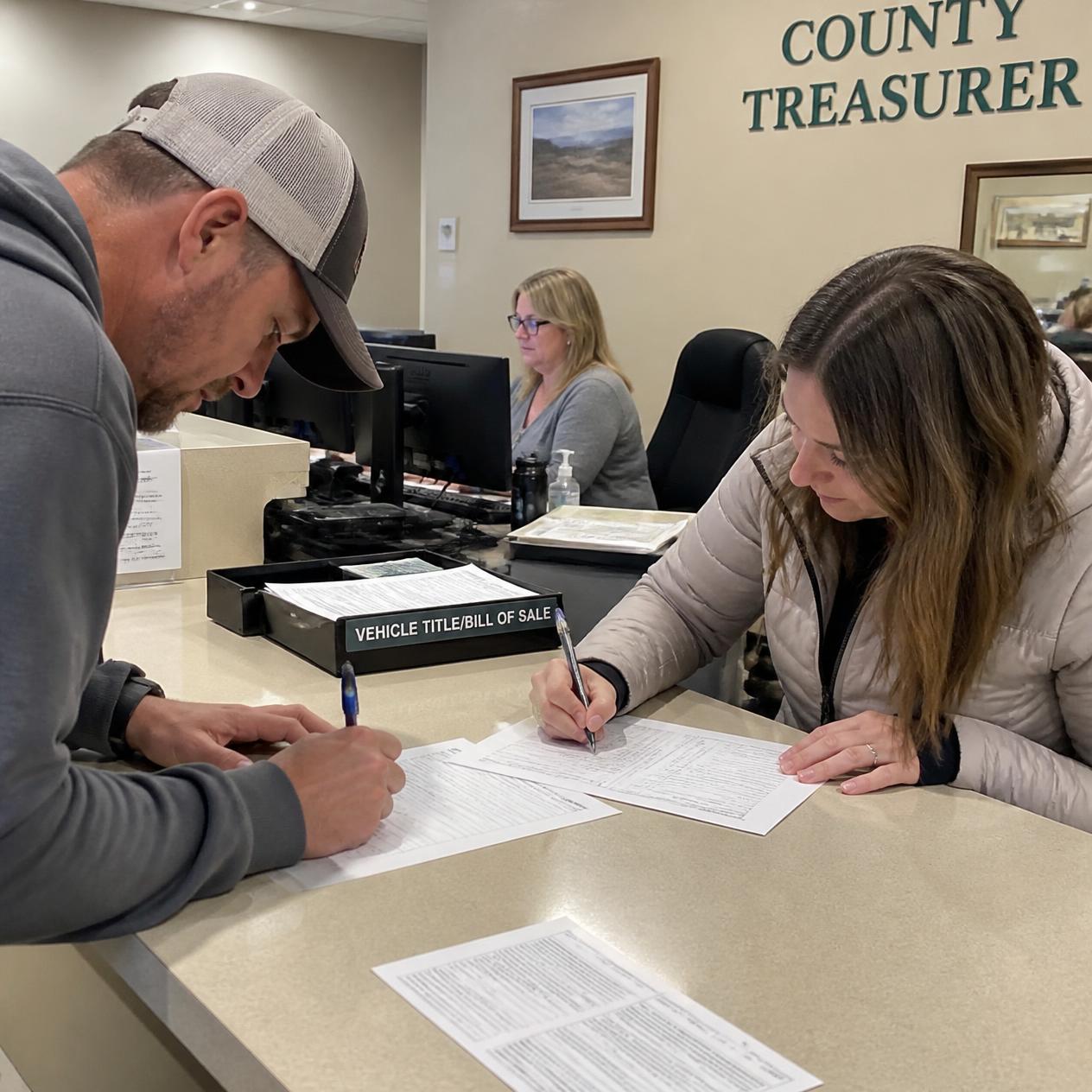
The buyer applies through the county treasurer’s office or another authorized title and registration location.
What Odometer Disclosure Is Required?
The seller must record the odometer reading on the title or provide a separate signed disclosure when the title does not contain an acceptable mileage section.
Montana does not require disclosure for:
Model-year 2010 or older vehicles.
Model-year 2011 or newer vehicles once they are 20 years old.
Non-self-propelled vehicles.
Vehicles with a gross vehicle weight rating over 16,000 pounds.
Other limited statutory categories.
The buyer must acknowledge receipt of the disclosure by signing it. Montana permits qualifying electronic odometer disclosures and signatures. (MCA Leg MT)
Does Montana Charge Sales Tax?
Montana does not have a general-use sales tax, so an ordinary private vehicle purchase is not subject to a statewide general sales tax. (Montana Department of Revenue)
Registration costs still apply. A county may impose either:
A local-option motor vehicle tax of up to 0.7% of the statutory vehicle value; or
An approved local flat fee.
The local charge is paid with the vehicle’s registration fees. (MCA Leg MT)
What Montana Title and Registration Fees Apply?
Charge | Current Amount |
Light-vehicle title fee | $12 |
Other vehicle title fee | $10 |
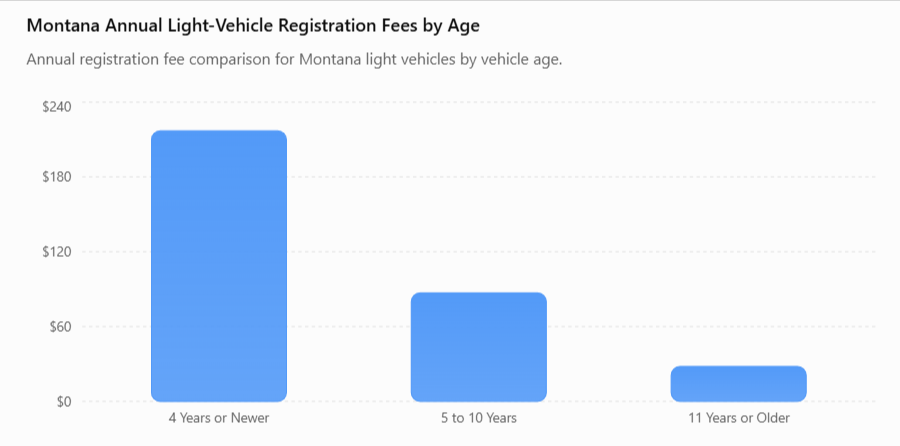
Light vehicle 4 years old or newer | $217 annually |
Light vehicle 5–10 years old | $87 annually |
Light vehicle 11 years old or older | $28 annually |
Standard temporary permit | $19.50 |
Electronic-interface or qualifying nonresident permit | $24.50 |
Mandatory motor vehicle account fee | $10 |
State parks and fishing-access fee | $9 unless declined |
The $12 light-vehicle title fee remains in effect through June 30, 2028. (MCA Leg MT)
A light vehicle with an MSRP over $150,000 that is 10 years old or newer pays an additional $825 annual registration fee. (MCA Leg MT)
What Is Montana’s 40-Day Deadline?
The buyer must apply for title and registration within 40 days after ownership is transferred.
A $10 late penalty applies when the buyer misses the deadline. The penalty must be paid before the vehicle can be registered. (MCA Leg MT)
The 40-day period does not automatically authorize the buyer to drive an unregistered vehicle. The buyer needs a properly displayed temporary registration permit or valid registration.
How Does a Montana Temporary Permit Work?
A standard temporary registration permit authorizes operation for:
40 days from issuance; or
Until the vehicle is registered, whichever happens first.
The ordinary permit fee is $19.50. A $24.50 fee applies to certain nonresident permits and permits issued through an approved electronic interface. (MCA Leg MT)
The temporary permit must be firmly attached and plainly visible at the rear of the vehicle.
What Happens to Montana License Plates?
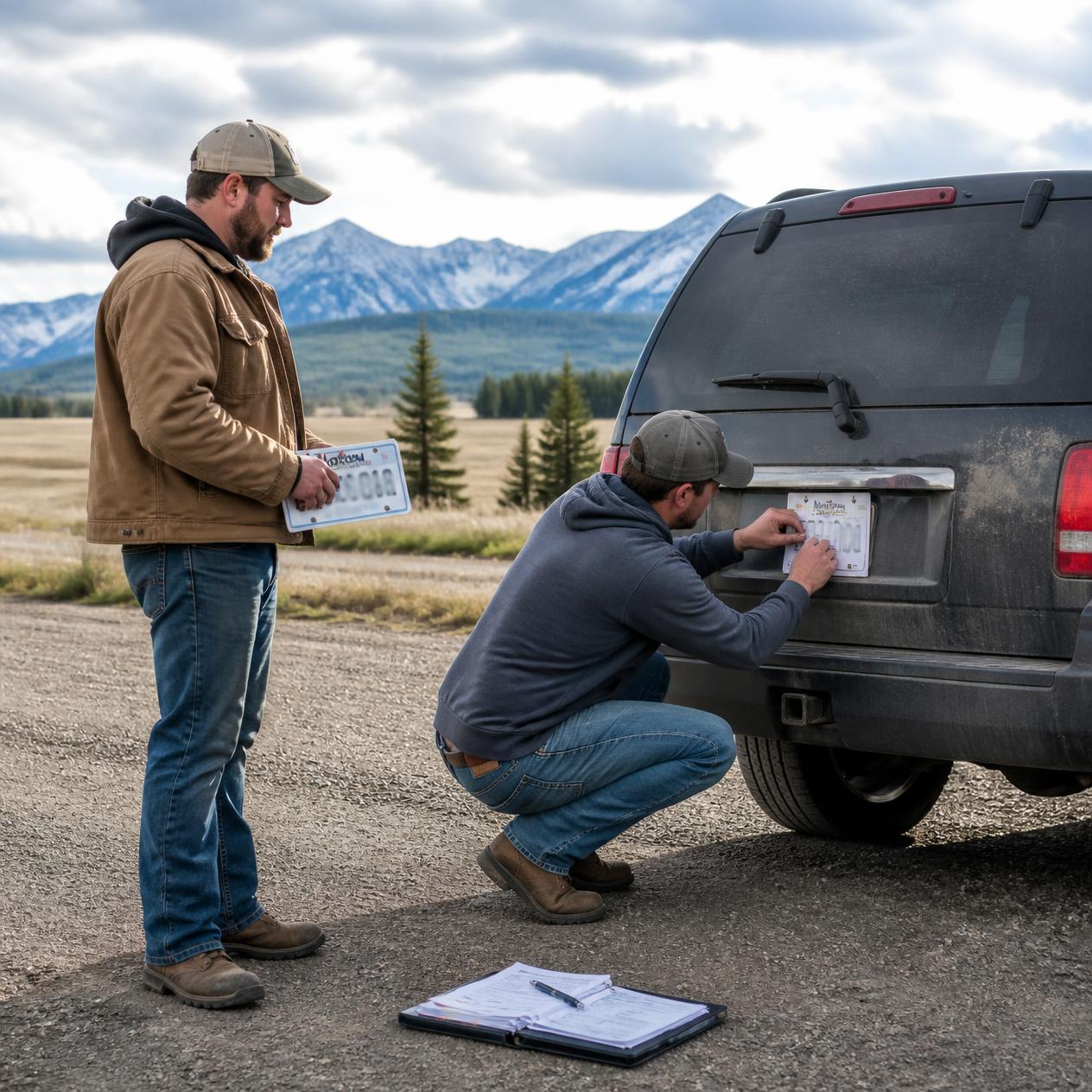
Montana law requires the seller to remove the plates immediately after transferring ownership.
“The transferor shall immediately remove the license plates.”
— Montana Code Annotated § 61-3-334
The seller may be able to transfer eligible plates to another vehicle under a separate plate-transfer procedure. The buyer should obtain a temporary permit rather than using the seller’s plates. (MCA Leg MT)
Are Safety or Emissions Inspections Required?
Montana’s ordinary private-transfer statute requires the title assignment, title application, registration, and applicable disclosures. It does not list a routine passenger-vehicle safety or emissions certificate for a standard transfer.
Assigned-VIN, rebuilt, salvage, imported, or specially constructed vehicles can require additional documentation or review. The buyer should confirm special-case requirements with the county treasurer before payment.
How to Complete a Montana Private Vehicle Sale
Confirm that the seller is the owner named on the title.
Compare the VIN on the title with the vehicle.
Confirm that all liens have been released.
Complete the title assignment and Form MV24.
Record and acknowledge the odometer disclosure.
Remove the seller’s license plates.
Obtain a temporary registration permit before driving.
Apply for title and registration within 40 days.
Confirm that the seller is the owner named on the title.
Compare the VIN on the title with the vehicle.
Confirm that all liens have been released.
Complete the title assignment and Form MV24.
Record and acknowledge the odometer disclosure.
Remove the seller’s license plates.
Obtain a temporary registration permit before driving.
Apply for title and registration within 40 days.
Important Warning About Older Montana Forms
A bill-of-sale or title form printed before October 1, 2025, may still state that the transfer must be notarized.
The current law no longer requires notarization of the ordinary title transfer. However, the parties should not delete or ignore fields on an official form without confirming the latest county instructions. When a current county form still includes an acknowledgement section, ask the county treasurer whether it remains operational or optional. (Montana Secretary of State)
Common Montana Bill of Sale Mistakes
Using an outdated article that says every title transfer must be notarized.
Treating Form MV24 as a replacement for the title.
Missing the 40-day title deadline.
Driving without a displayed temporary permit.
Leaving the seller’s plates on the vehicle.
Ignoring county vehicle taxes or flat fees.
Leaving the odometer disclosure incomplete.