
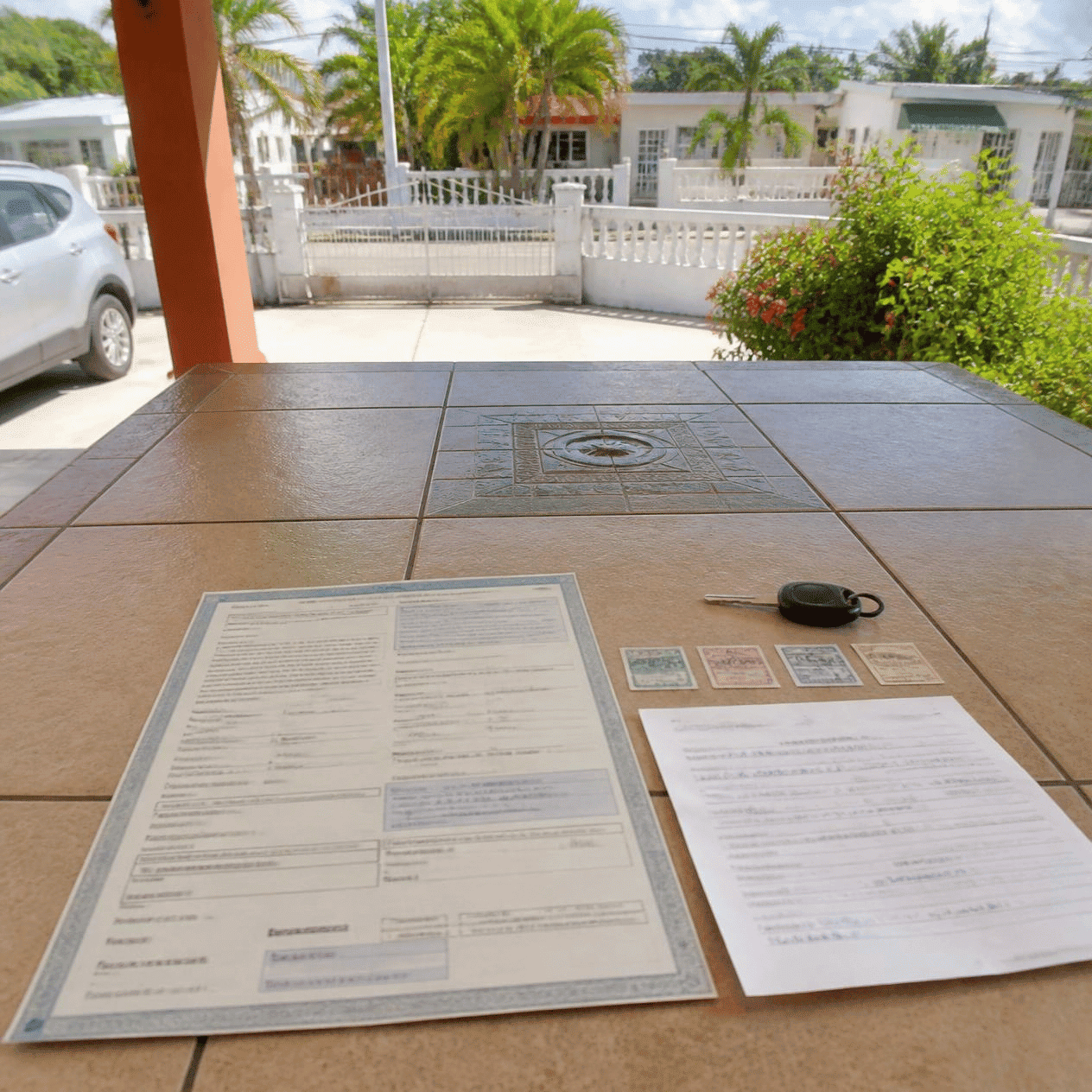
Bill of Sale Sep 22, 2026
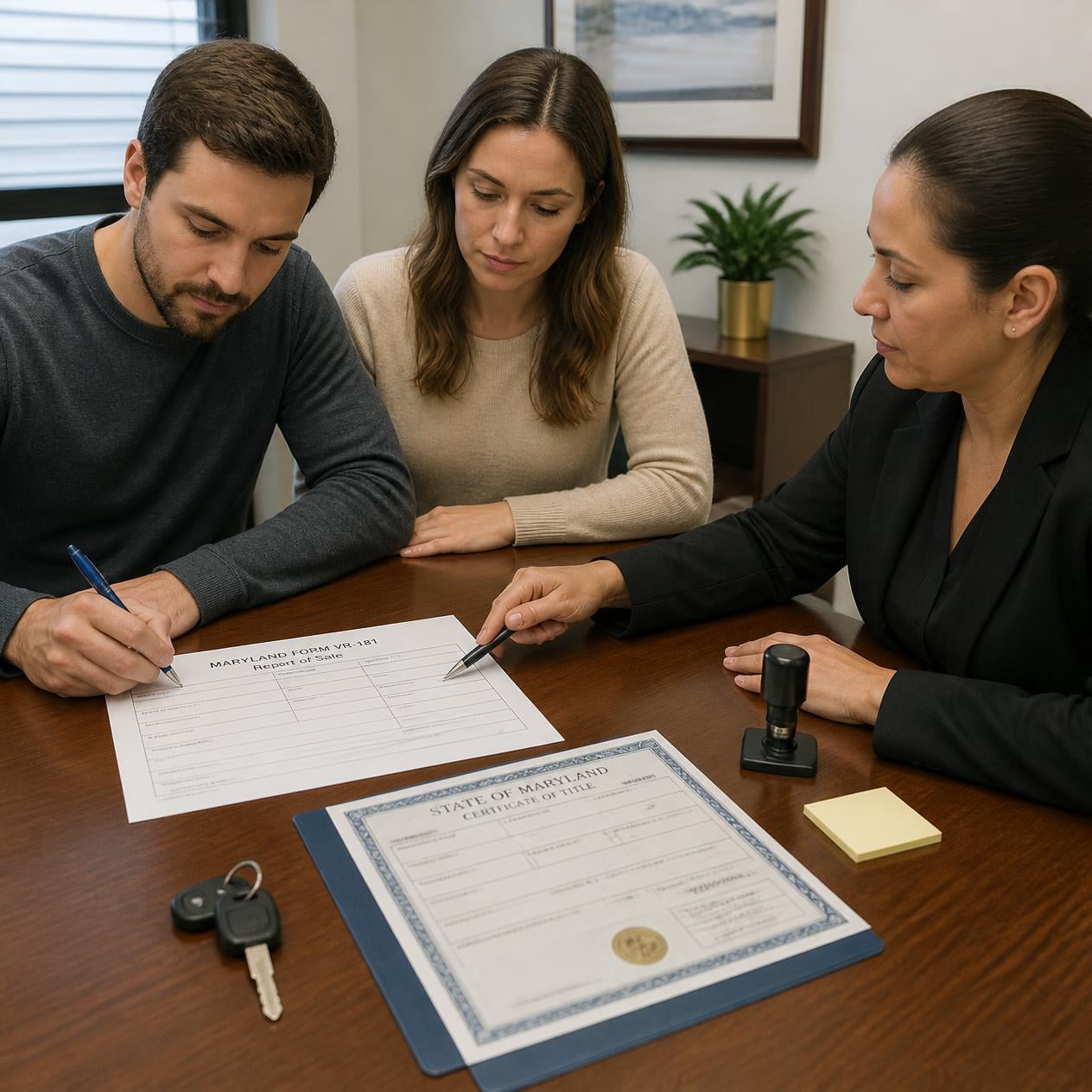
A Maryland bill of sale is not required in every straightforward private sale, but it is strongly recommended and may be necessary to prove the purchase price. When Form VR-181 is used to establish the price for excise-tax purposes, both parties must sign it and the form must be notarized.
For an additional written record of the sale, you can use KarKiosk’s free bill of sale PDF, while using notarized VR-181 when Maryland requires it to establish the purchase price.
The buyer submits the assigned title, Form VR-005, purchase-price evidence, applicable inspection documents, identification, lien release, taxes and fees to the Maryland Motor Vehicle Administration.
Maryland Bill of Sale Quick Facts
Question | Maryland Rule |
Is a bill of sale always required? | No, but it may be needed to prove purchase price |
Official form | VR-181 Bill of Sale |
Notarization | Required when VR-181 establishes the purchase price |
Title application | VR-005 |
Excise tax | 6.5% |
Minimum taxable value | $640 |
New or used title fee | $200 |
Application timing | Submit promptly; extra service fee may apply after 30 days |
Safety inspection | Generally required before final registration |
Safety certificate validity | 90 days |
License plates | Removed and retained by seller |
Emissions inspection | Generally every two years when notified |
These requirements come from the Maryland Motor Vehicle Administration and the Maryland Code. (Maryland Motor Vehicle Administration)
Is a Maryland Bill of Sale Required?
The assigned title is the main ownership document. A separate bill of sale may be needed when the buyer must prove the actual amount paid or when the title does not contain complete transaction information.
Maryland publishes Form VR-181, Bill of Sale. The form records:
Buyer’s and seller’s information.
Vehicle year, make, model and VIN.
Odometer reading.
Actual purchase price.
Reason for a below-market price.
Buyer’s and seller’s signatures.
Notary acknowledgement.
A generic receipt may not satisfy Maryland’s purchase-price verification rules.
When Does VR-181 Need to Be Notarized?
When the buyer uses VR-181 to establish the purchase price for Maryland excise-tax purposes, the form must be signed by both buyer and seller and notarized.
Maryland calculates the tax using the greater of:
The actual purchase price verified by notarized VR-181.
A minimum taxable value of $640.
Another MVA-approved valuation when the transaction requires it.
For a vehicle seven model years old or older, the tax is based on the greater of the purchase price or the $640 minimum value. (Maryland Motor Vehicle Administration)
The ordinary assignment on a valid Maryland title does not carry a universal separate notary rule. The notarization requirement discussed here applies specifically to VR-181 when it is used to prove the price.
What Documents Does the Buyer Need?
Document | Purpose |
VR-005 Certificate of Title Application | Applies for the Maryland title |
Properly assigned original title | Transfers ownership |
VR-181 or other purchase-price proof | Establishes sale price when applicable |
Odometer disclosure | Records covered-vehicle mileage |
Maryland Safety Inspection Certificate | Supports registration |
Valid identification | Confirms buyer identity |
Lien release | Removes a satisfied lien |
Maryland warns against altering official documents. A missing, changed or incomplete title may prevent MVA from processing the application. (Maryland Motor Vehicle Administration)
What Information Goes on the Title?
The seller should enter:
Buyer’s name and address.
Sale price.
Odometer reading.
Sale date.
Required owner signatures.
When multiple owners appear on the title, all generally sign unless the title shows “OR.” (Maryland Motor Vehicle Administration)
What Taxes and Fees Apply?
Maryland’s vehicle excise tax rate is 6.5%. The minimum tax is $41.60, which equals 6.5% of the $640 minimum taxable value. (Maryland Motor Vehicle Administration)
Charge | Current Amount |
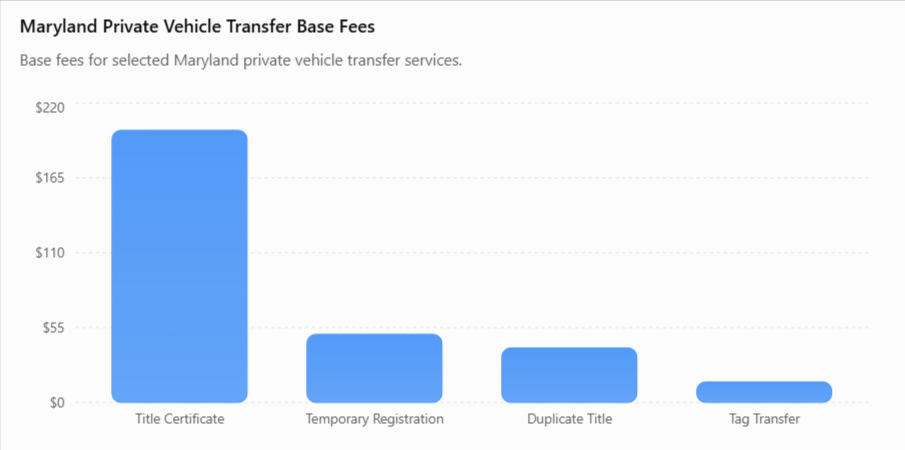
New or used title certificate | $200 |
Excise tax | 6.5% |
Minimum excise tax | $41.60 |
Passenger registration, 3,500 lbs or less | $120.50 |
Passenger registration, 3,500–3,700 lbs | $125.50 |
Passenger registration, over 3,700 lbs | $191.50 |
Temporary registration | $50 |
Registration or tag transfer | $15 |
Duplicate title | $40 |
The MVA’s official fee schedule provides the current title, registration, temporary-registration and tag-transfer charges. (Maryland Motor Vehicle Administration)
What Is Maryland’s Title Deadline?
Maryland law requires the buyer to complete the title application and promptly deliver or mail the assigned certificate and application to MVA.
If MVA does not receive the certificate and application within 30 days after the vehicle is delivered to the buyer, MVA may assess an additional service fee. (Maryland General Assembly)
The buyer should not wait until day 30. The vehicle must also meet registration, insurance and inspection requirements before normal road use.
What Happens to Maryland License Plates?
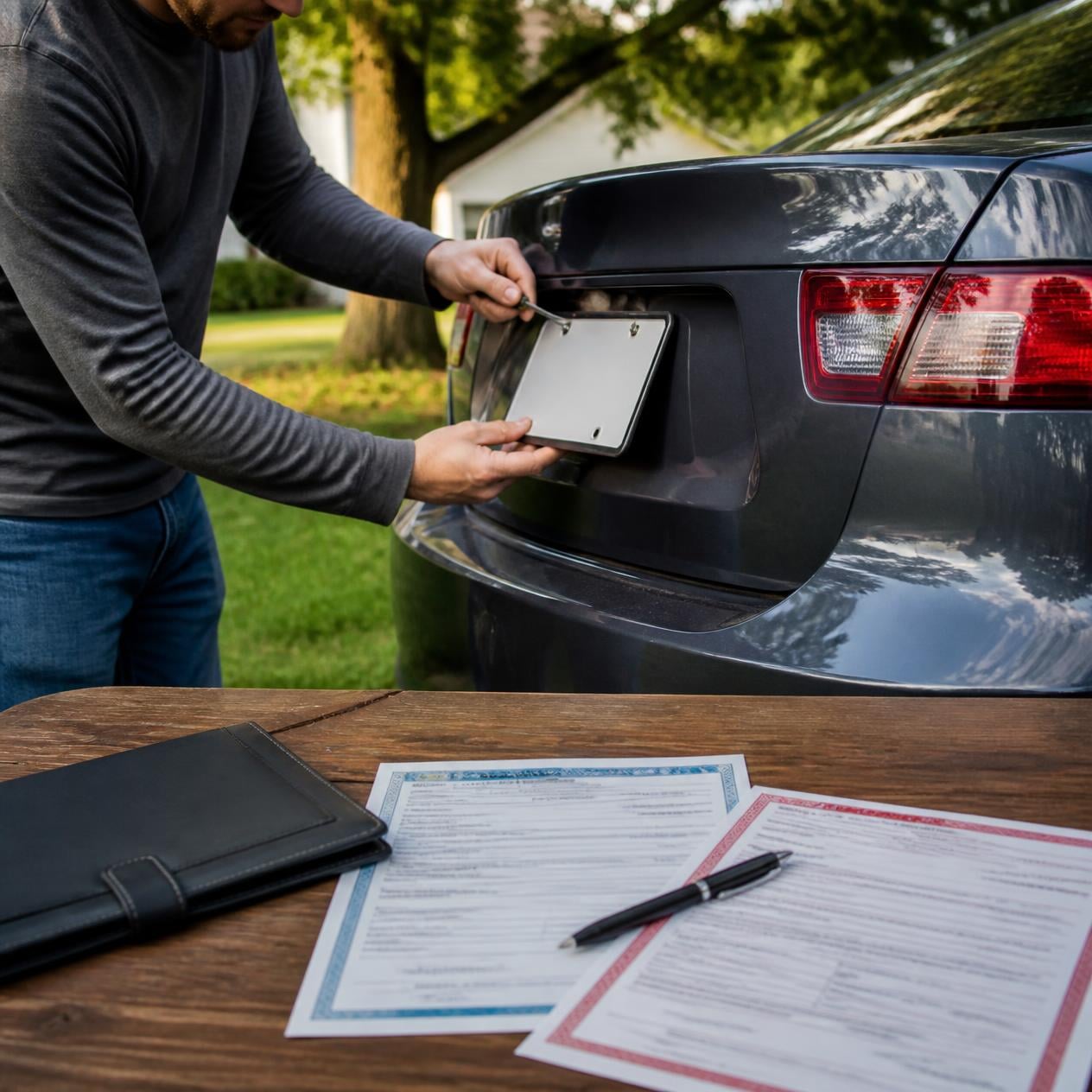
“License plates stay with the seller, not the vehicle.”
— Maryland Motor Vehicle Administration
The seller must remove the plates before the buyer takes possession. The seller should return the plates to MVA and keep the plate-return receipt, especially before ending the associated insurance coverage. (Maryland Motor Vehicle Administration)
The buyer may not legally drive using the seller’s Maryland plates.
Is a Maryland Safety Inspection Required?
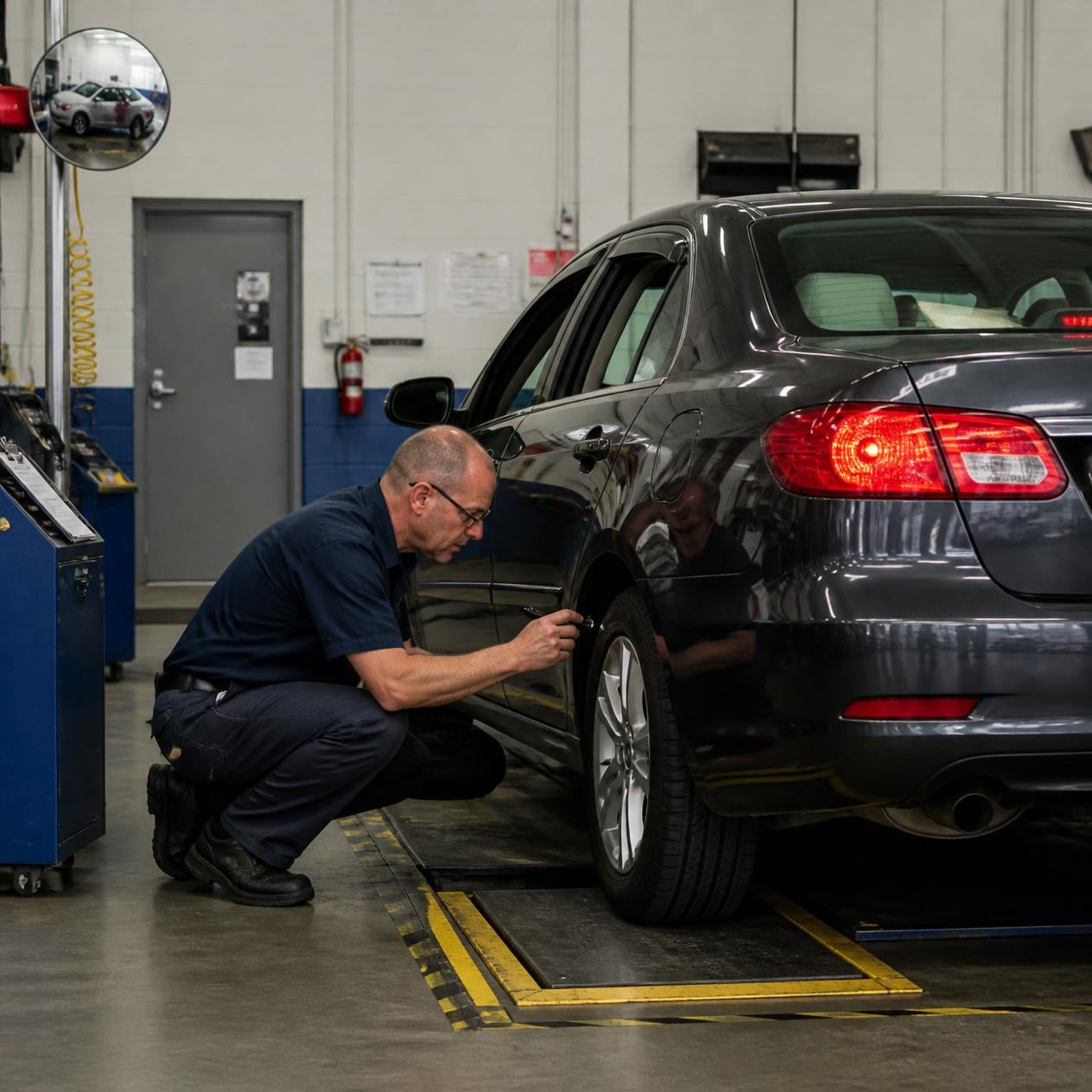
A Maryland Safety Inspection Certificate is generally required to title and fully register a used vehicle acquired in a private sale.
The certificate:
Is submitted electronically to MVA.
Remains valid for 90 days from issuance.
Must remain valid when the vehicle is titled and registered.
Requires reinspection within 30 days after a failure.
Requires a full new inspection when the vehicle travels more than 1,000 miles before reinspection or misses the 30-day window.
Inspection prices are set by individual licensed inspection stations rather than by a single statewide fee. (Maryland Motor Vehicle Administration)
A buyer who has not completed the inspection may qualify for a 30-day temporary registration in an eligible transaction.
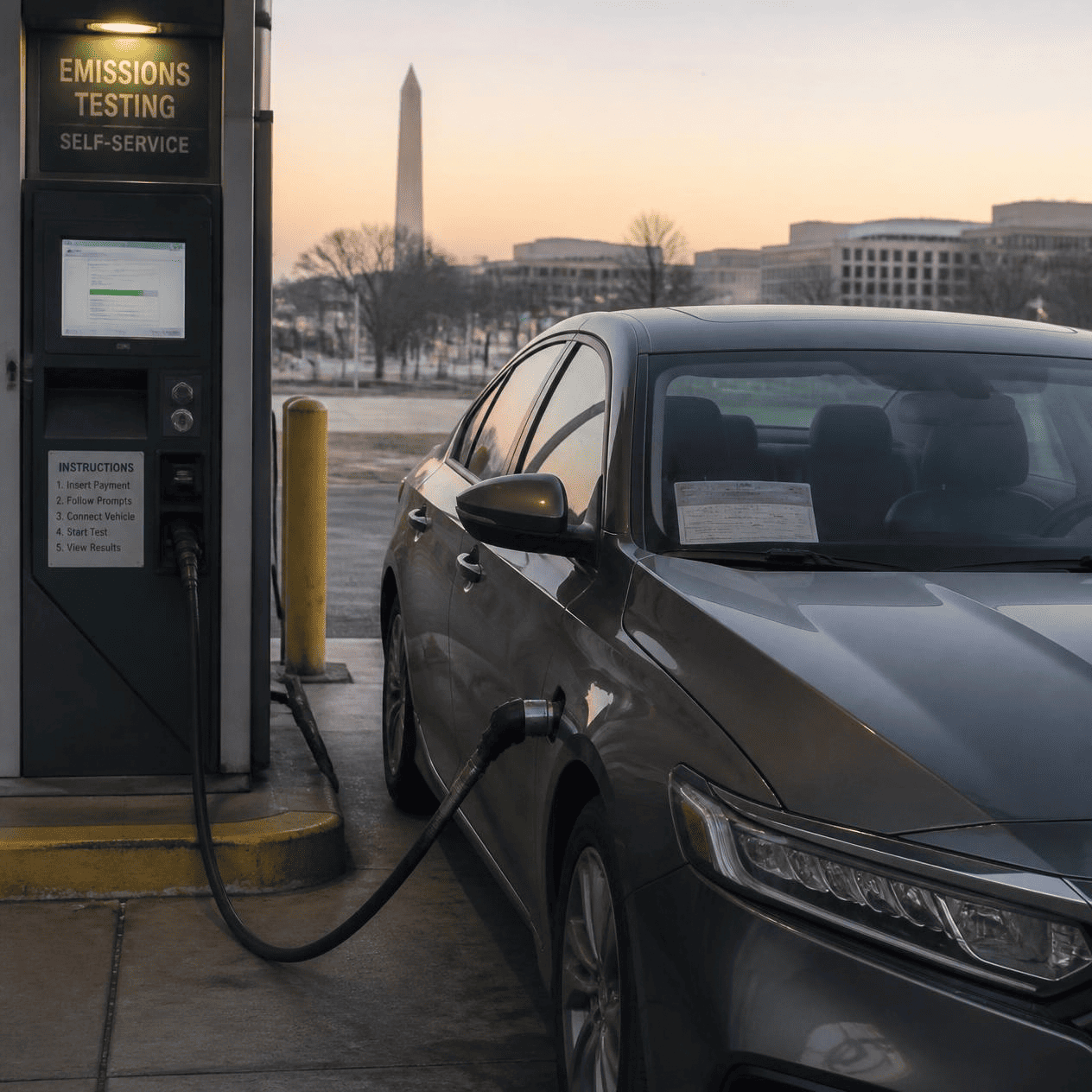
How Does Maryland Emissions Testing Work?
The Vehicle Emissions Inspection Program is separate from the one-time safety inspection.
Eligible used vehicles are generally tested every two years after MVA sends a notice. The program applies in Baltimore City and designated counties, including Anne Arundel, Baltimore, Calvert, Carroll, Cecil, Charles, Frederick, Harford, Howard, Montgomery, Prince George’s, Queen Anne’s and Washington. (Maryland Motor Vehicle Administration)
The current standard VEIP fee is $30, while qualifying self-service kiosk tests cost $26. (Maryland Motor Vehicle Administration)
How to Complete a Maryland Private Vehicle Sale
- Confirm that the seller has a valid title and released lien.
- Complete the title assignment with the buyer, price, date and mileage.
- Complete notarized VR-181 when required to prove the purchase price.
- Obtain the Maryland Safety Inspection Certificate.
- Arrange Maryland insurance and complete VR-005.
- Remove and return the seller’s plates.
- Submit the title documents promptly and within 30 days.
Gifted Vehicles and Lost Titles
A qualifying gift may use Form VR-103. The word “Gift” should be entered in the price area rather than leaving it blank, and no money or other consideration can change hands for a bona fide gift. (Maryland Motor Vehicle Administration)
When the title is lost or damaged, the titled owner should obtain a duplicate before completing the sale. Maryland’s duplicate title fee is $40. (Maryland Motor Vehicle Administration)
Common Maryland Mistakes
Using an unsigned or non-notarized VR-181 to prove the price.
Leaving the purchase price blank on the title.
Missing the 30-day title-submission period.
Allowing the buyer to use the seller’s plates.
Letting the 90-day safety certificate expire.
Confusing the safety inspection with VEIP emissions testing.
Selling a vehicle before releasing an active lien.